Share

“Copper Scrap: From Waste to Treasure of the Circular Economy” “Copper Scrap: The Clean Energy Era’s Most Coveted Resource”
Last updated: 9 Feb 2026
296 Views

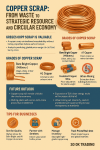
Copper Scrap: From Waste Metal to Strategic Resource and the Circular Economy

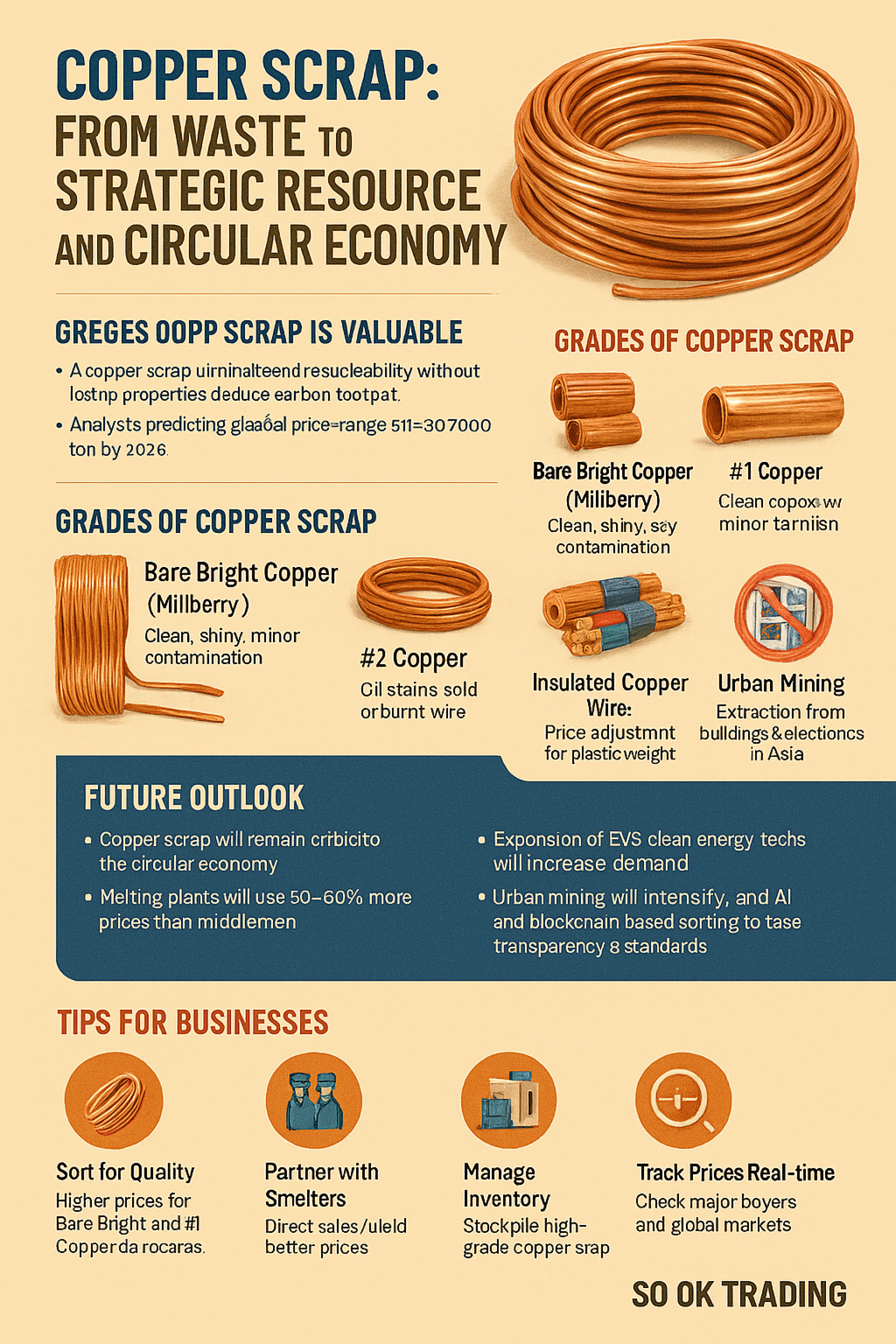
Copper scrap is rapidly transforming from “recyclable waste” into a “strategic resource” urgently sought by the world. It can be reused 100% without losing quality, and is becoming a cornerstone of clean energy and the circular economy.


Why Copper Scrap is Valuable

Copper is a metal that can be recycled endlessly without losing its properties. Demand continues to rise from expanding industries such as electric vehicles (EVs), data centers, artificial intelligence, and clean energy infrastructure. Global market prices are on a strong upward trend, with analysts predicting that by 2026 copper could reach $11,000–12,000 per ton.


Grades of Copper Scrap

Bare Bright Copper (Millberry): The highest grade, clean, shiny, and free of contamination.
#1 Copper: Clean copper with minor tarnish, such as tubing with fittings removed.
#2 Copper: Contains impurities like oil stains, solder, or burnt wire.
Insulated Copper Wire (ICW): Copper wire with insulation; prices are adjusted for plastic weight.
 

Macro Factors Changing the Game

Green Copper Premium: Global markets are setting premium prices for 100% recycled copper to meet carbon‑reduction goals.
Advanced Sorting Technology: AI, X‑ray sensors, and automated wire strippers improve accuracy and reduce costs.
Strict Regulations: The EU is restricting scrap metal exports, driving resource prices higher in Asia.
Urban Mining: Systematic recovery of copper from buildings and electronic waste is gaining momentum.
 

Future Outlook

Copper scrap will be at the heart of the circular economy. Smelters worldwide are expected to source 50–60% of their feedstock from scrap. The expansion of EVs and clean energy will further boost demand. Urban mining will intensify, while AI and blockchain will enhance transparency and standardization in the market.


Recommendations for Businesses

Sort for Quality: Bare Bright and #1 Copper achieve the highest prices.
Partner with Smelters: Direct sales yield better returns than going through middlemen.
Manage Inventory: Holding high‑grade copper scrap during an upmarket is like owning an appreciating asset.
Track Prices in Real Time: Monitor major buyers and global markets to sell at the optimal moment.
 

Conclusion

Copper scrap is evolving from “recyclable waste” into a “strategic resource” that powers clean energy and the circular economy. Those who understand its value and manage it effectively will be the ones who hold the future of production.

 
SO OK TRADING: Your Trusted Partner

In a rapidly changing world, whoever holds copper scrap holds the future of production.
SO OK TRADING is the bridge that will take you there.


Related Content
Aluminum Recycling the Circle and How it work
Aluminium is the most abundant metal in the earth’s crust. Approximately 75% of aluminium ever produced is still in use today as it can be recycled endlessly without compromising any of its unique properties or quality. Aluminium’s lifecycle provides significant benefits through recycling, saving 95% of the energy it would take to make new aluminium metal. More information on recycling may be found here. Recycling aluminium has five steps: Step 1: Collecting Scrap There are two categories of aluminium scrap: New Scrap New Scrap is surplus material that arises during the manufacture and fabrication of aluminium products, up to the point where they are sold to the final consumer. For example, off cuts of aluminium sheet or extrusions are considered new scrap. Sometimes, this new scrap can be safely recycled by aluminium smelters as its composition is known. Old Scrap Old Scrap is material that has been used by the consumer and subsequently discarded. For example, used beverage cans, window frames, electrical cabling and car cylinder heads are all considered old scrap. Aluminium smelters are unable to safely accept this old scrap as its composition is usually unknown and it can be contaminated. Scrap aluminium is also collected from the community – from households, scrap merchants, local and regional authorities, etc. Step 2: Sorting Scrap The scrap is then sorted – grouping all coated (painted or lacquered) aluminium together, and grouping all uncoated aluminium together. Paper, plastic and other non-aluminium recycling needs to be removed. Step 3: Crushing The sorted aluminium is then crushed into bales – by compacting the aluminium scrap, it reduces freight, storage and handling costs Step 4: Remelting Uncoated scrap is loaded directly into a large furnace called a remelter, where it is heated at high temperatures and turned into molten form. If the scrap aluminium is coated, it is processed through a gas fired rotary furnace to remove any coating and then transferred to the remelter. Step 5: Casting The molten aluminium is cast at a temperature of just over 700°C to form ingots
13 Nov 2025
HNY 2026 with a First Analysis on Thai Baht Value
he Thai baht in Q1 2026 is expected to strengthen against the US dollar, driven primarily by a weaker dollar globally, a seasonal tourism boost, and expectations of US Federal Reserve rate cuts. This strength is occurring despite a weak domestic economic outlook and the Bank of Thailand's (BoT) likely continued easing of its policy rate. Exchange Rate Drivers and Forecast External Factors: The primary driver for the strengthening baht is external, mainly the broad weakness of the US dollar as global markets price in expected Fed rate cuts. The baht is also correlated with global gold prices, which have been climbing. Tourism High Season: The period extending into Q1 2026 is the high season for tourism, which typically brings in foreign currency and supports the baht's value. Policy Divergence: The BoT is expected to continue its easing cycle, potentially cutting the policy rate further to 1.00% by Q1 2026 to stimulate the sluggish domestic economy. This divergence from a potentially less aggressive US Fed in Q1 could support the baht in the short term, though some analysts warn the currency could weaken later in 2026. Forecasts: Projections for 2026 generally place the baht in a range of 30.80–33.00 per US dollar. Some models estimate it could trade around 31.06 by the end of Q1. A persistently strong baht below 31 per US$ is seen as a significant risk to the Thai export and tourism sectors. Key Economic Context Weak Growth: Thailand's economy is expected to slow down to a 5-year low growth rate of around 1.6-1.8% in 2026, pressured by US tariffs, global trade tensions, and high household debt. The central bank chief expects an improvement in Q1 2026 after a weak second half of 2025. Political Uncertainty: A general election expected in February 2026 could also introduce volatility, though some historical trends suggest the baht may strengthen following the formation of a new government. Low Inflation: Headline inflation is projected to remain subdued or even negative, providing the central bank with justification for further rate cuts to stimulate demand. In summary, Q1 2026 is characterized by a strong and volatile baht driven by external factors, contrasting sharply with a weak domestic economy and accommodative monetary policy.
1 Jan 2026
India’s Golden Opportunity in Copper & Aluminium (2026–2030): Recycling and Innovation Driving the Non-Ferrous Metals Revolution
India is rapidly emerging as the global hub for copper and aluminium in the clean energy and EV era! SO OK TRADING proudly presents an in-depth article: “India and the Golden Opportunity of Non-Ferrous Metals (2026–2030)” — covering market trends, major players, recycling opportunities, and strategic insights for Thai businesses aiming to expand confidently into India.
26 Feb 2026
This website uses cookies for best user experience, to find out more you can go to our Privacy Policy and Cookies Policy
Compare product
0/4
Remove all
Compare
Powered By MakeWebEasy Logo MakeWebEasy