Share

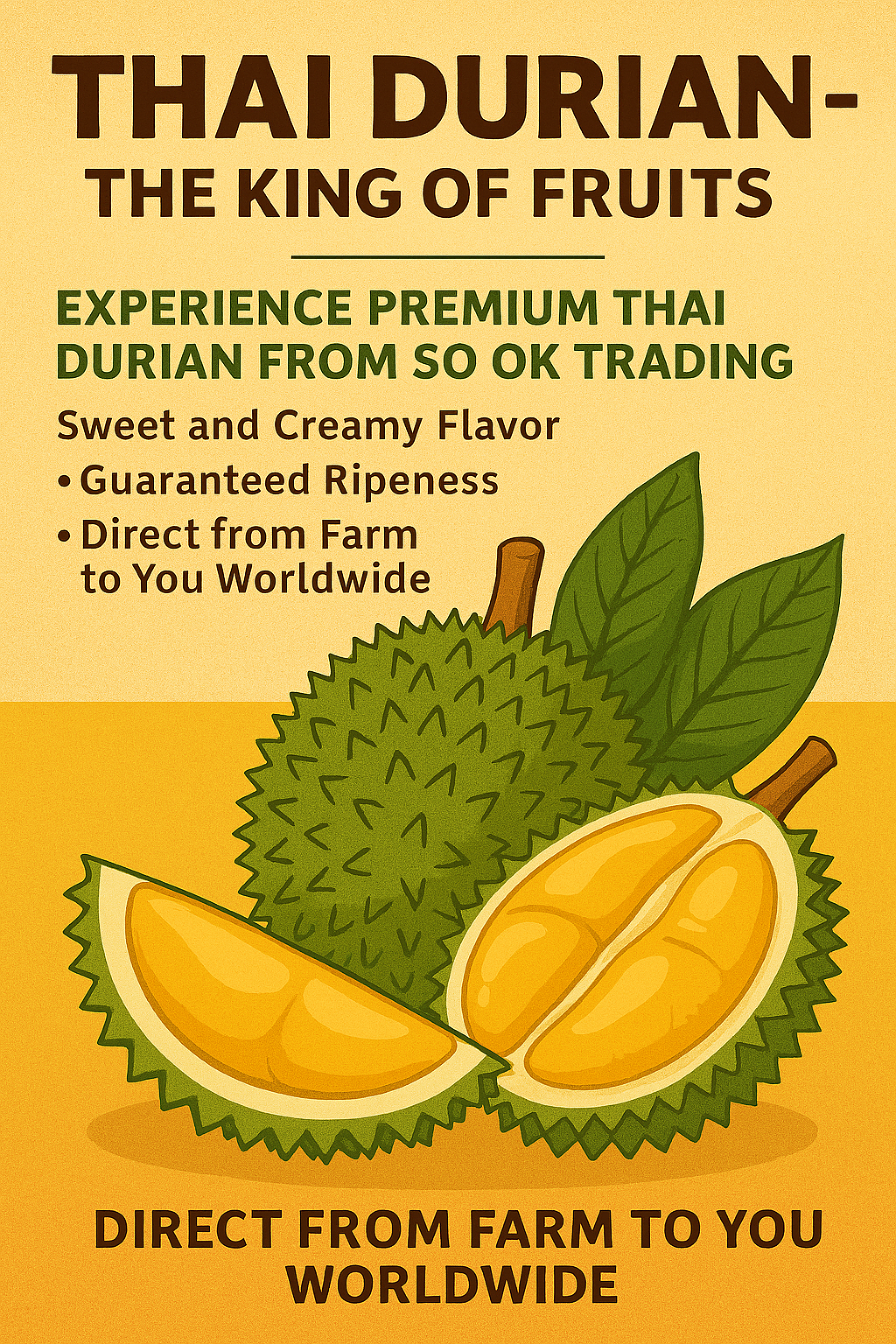
Experience the King of Fruits – Premium Thai Durian from SO OK TRADING Sweet and creamy flavor, guaranteed ripeness, direct from farm to your hands worldwide.
Last updated: 23 Jan 2026
2100 Views

Thai Durian – The King of Fruits Conquering the Global Market

Premium Durian Exports by SO OK TRADING

Global Overview of Thai Durian

Thailand is the world’s leading exporter of durian, proudly recognized as the “King of Fruits.”

Export Value (2024): USD 3.76 billion (approx. THB 130 billion)
Global Market Share: 93.3% in 2022, still dominant despite rising competition
Main Market: China (97% of Thai durian exports), where consumers view Thai durians as premium, luxurious, and symbols of prosperity
Chinese Consumer Perception:

Thai durian is seen as a fruit of luck and wealth
Monthong is approachable with mild aroma, ideal for beginners
Kanyao and Chanee are considered luxury indulgences
 

Why Thai Durian is Premium

1. Terroir – Geographic and Climatic Advantages

Sisaket volcanic soil: Crisp outside, creamy inside, deep sweetness
Nonthaburi clay soil: Smooth, mellow flavor
Tropical climate: 25–32°C, 75–85% humidity – ideal growing conditions
2. Diversity of Varieties

Monthong: Thick golden flesh, sweet and creamy, mild aroma
Kanyao: Custard-like texture, balanced richness, “Millionaire’s Durian”
Chanee: Strong aroma, complex bittersweet taste
Puangmanee: Small but intense, vibrant orange flesh
Nok Krajib: Soft texture, honey-like fragrance, sharp sweetness
Musang King (grown in Thailand): Rich mousse-like texture, bold bittersweet flavor
3. Cultivation Expertise & Quality Standards

Generational farming wisdom in grafting and ripeness assessment
Harvested at 75–85% maturity for perfect flavor during transport
GAP & GMP standards ensure safety, consistency, and premium quality
4. Unique Taste & Texture

Premium Monthong: Dry yet creamy, balanced sweetness, subtle bittersweet aftertaste
Kanyao: Ultra-creamy, luxurious mouthfeel
Chanee: Bold, complex, intense flavor for true durian lovers
 
Premium Experience Beyond Ordinary

Uniform golden flesh, flawless appearance
Small seeds, more edible flesh
Gentle aroma, not overpowering
Bittersweet finish adds depth
Cultural Value:

Premium durians are gifted during festivals and special occasions
Symbol of prosperity and luxury in Chinese society
 

“Direct-from-Farm” Trend (2026)

SO OK TRADING introduces Farm-to-Table Premium Durian.

Consumer Benefits:

Guaranteed ripeness (85–90% maturity)
Delivered within 24–48 hours after harvest
Regional terroir flavors (Nonthaburi, Sisaket, Pala-U)
GAP/GMP traceability system
Product guarantee (replacement/refund for substandard fruits)
Rare heritage varieties (Kab Chai Nam, Luang, Thong Yoi Chat)
 

Challenges & Adaptation

Competition: Vietnam (year-round supply, lower costs), Malaysia (Musang King premium branding)
Quality Control: Prevent immature harvests and chemical residue issues
Market Dependence: Diversify beyond China into Middle East, Australia, and India
Innovation: Digital traceability platforms to build consumer trust
 

Strengths of SO OK TRADING

Premium Quality: Only fully mature durians selected
Global Network: Dominant in China, expanding worldwide
Authenticity: Direct partnerships with certified orchards
Sustainability: Supporting Thai farmers and preserving heritage varieties
Customer Care: Guarantee policies and transparent service
 

Marketing Message

“Experience the King of Fruits – Premium Thai Durian from SO OK TRADING. Sweet and creamy flavor, guaranteed ripeness, delivered fresh from farm to your hands worldwide.”


Related Content
“Thailand’s Corn Power: From Fields to Global Markets – In-Depth Corn Market Outlook 2026: Thailand on the World Stage  Article by SO OK TRADING”
Thailand’s Corn Industry: Global Market By SO OK TRADING Thailand is one of the world’s key players in the corn industry, contributing both to livestock feed and human consumption exports. Sweet corn, in particular, has secured Thailand’s position as the No.1 exporter worldwide. This infographic highlights the Thai–global corn market in five essential dimensions: - Feed Corn: 7 million rai cultivated, yet domestic output still falls short of demand. - Consumption Corn: Thailand leads in sweet corn exports, with potential expansion into bioplastics and textiles. - Cost & Environmental Challenges: High production costs, PM2.5 pollution, and new “No Burning” certification standards. - Imports: 3–4 million tons annually from Laos, Myanmar, and Cambodia, subject to moisture standards and strict traceability. - Market Prices: Bullish trend both domestically and globally (CBOT), signaling strong demand and tight supply.
21 Feb 2026
“Energy Pulse 2026: Naphtha Recovery – Positive Signals from the Global Energy Crisis Toward a New Market Balance” Article by SO OK TRADING | May 18, 2026
Naphtha Crisis 2026 – Latest Situation Update Positive Outlook | SO OK TRADING Since the outbreak of the Middle East conflict in late February, the global energy market has been shaken dramatically. Crude oil prices surged past $150 per barrel, driving Asian naphtha prices to nearly double. By mid‑May, prices corrected to $897 per ton, though still 62.54% higher than last year. Even as prices begin to ease, supply chain “lag effects” remain — shipping delays of 15–20 days and congested ports due to competition for raw material shipments from the Middle East continue to pressure industries across Asia. In Thailand, SCGC declared force majeure and temporarily shut down the Rayong Olefins plant, while PTTGC and SCGC are studying the establishment of a joint venture to enhance flexibility and reduce long‑term costs. In Japan, leading snack brand Calbee announced a packaging strategy shift, reducing color printing on 14 products to black‑and‑white to cope with ink and resin shortages — reflecting the rising trend of “minimalist design” during the crisis. At the same time, recovery signals are emerging: Naphtha prices dropped from the peak of $1,020 → $897 per ton Spreads rebounded: Ethylene–Naphtha +250–280 / Propylene–Naphtha +310–330 Plastic prices remain high but show signs of stabilization If the Middle East situation does not flare up again, this crisis is expected to ease by late June – early July 2026. SO OK TRADING FAST • SHARP • RELIABLE Your Trusted Business Partner
18 May 2026
“Global Raw Material Crisis: Hormuz Eases, Energy Landscape Transforms — Oil Plunges, Naphtha Softens, Fertilizer Remains Costly”
Global Raw Material Crisis: From Middle East Conflict to the Recovery of Energy and Industrial Markets SO OK TRADING | April 18, 2026 After the tension in the Strait of Hormuz that sent oil and raw material prices soaring, the world is now witnessing clear signs of easing and recovery. Crude oil prices have dropped sharply, naphtha is gradually stabilizing though still costly, and chemical fertilizers remain expensive. Yet the overall direction is a tangible return to balance. ⛽ Oil: Prices fell immediately after Iran reopened the Strait of Hormuz ⚗️ Naphtha: Supply is returning, but full recovery will take time
18 Apr 2026
This website uses cookies for best user experience, to find out more you can go to our Privacy Policy and Cookies Policy
Powered By MakeWebEasy Logo MakeWebEasy