Share

USD Outlook 2026: Golden Opportunities for Thai Exporters and International Business BY SOOK TRADING
Last updated: 19 Jan 2026
2013 Views

USD Outlook 2026 and Business Opportunities

BY SO OK TRADING

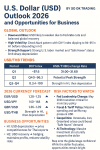
In 2026, the U.S. Dollar (USD) is expected to show notable movements. The first half of the year is projected to see a depreciation trend, while the second half may witness a gradual recovery supported by fiscal policy and investments in artificial intelligence (AI). This shift will not only impact the global economy but also create strategic opportunities for Thai enterprises, especially SO OK TRADING, which exports industrial and agricultural products to the world market.

 Global Outlook

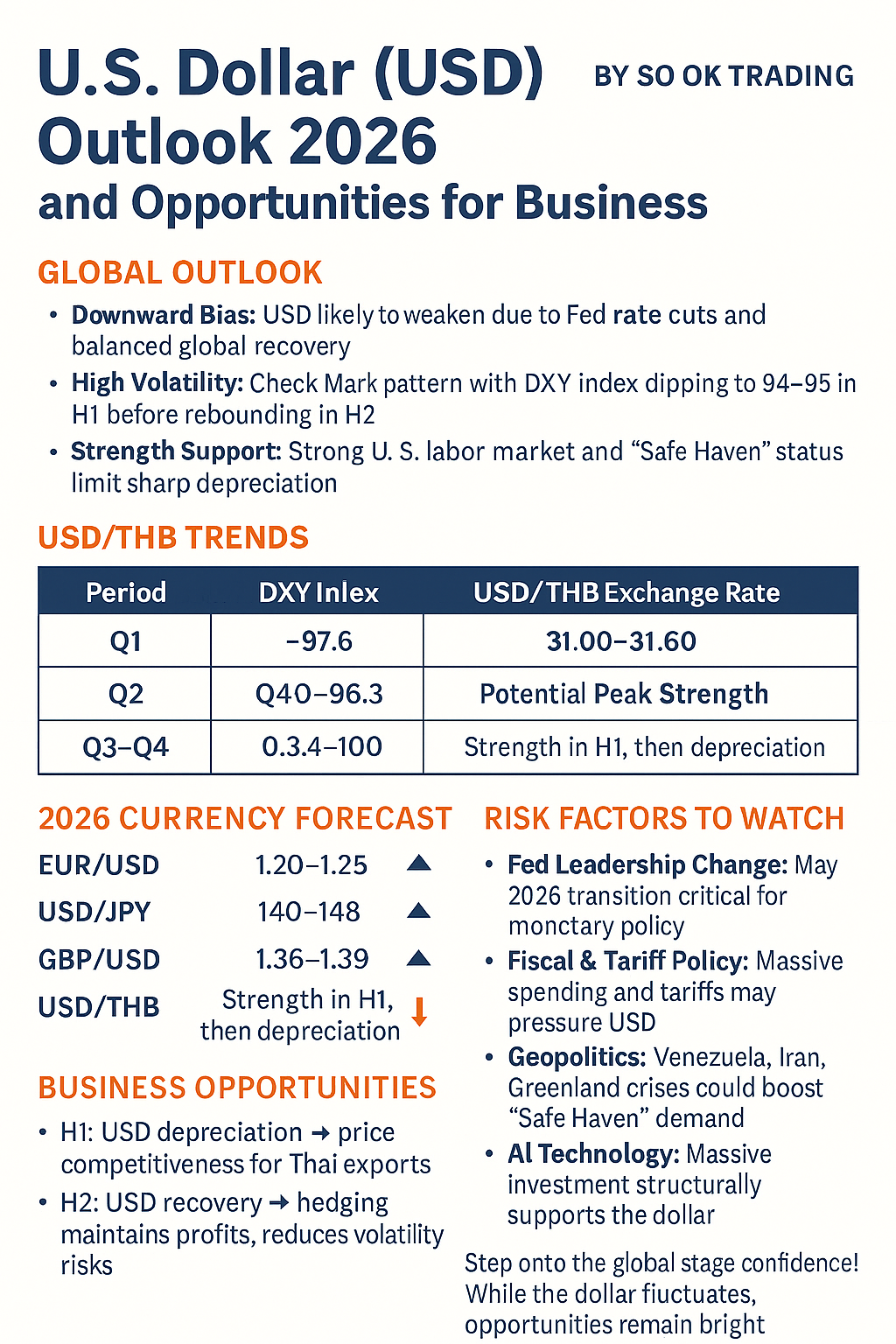
Downward Bias: Continued interest rate cuts by the Federal Reserve (FRB) and balanced global recovery are likely to weaken the dollar.
High Volatility: A “check-mark” pattern is expected—decline in the first half (DXY index possibly down to 94–95), followed by recovery in the second half.
Strength Support: The strong U.S. labor market and the dollar’s role as a “safe haven” asset will limit sharp depreciation.
 

Thai Baht Trends (USD/THB)

First Half of 2026: The baht strengthens against the dollar, trading within 31.10–31.60, and may even dip below 31.00.
Second Half: Political uncertainty and domestic economic slowdown may weaken the baht again, while the dollar recovers.
USD/THB Forecast 2026 

Major Currency Comparisons (2026 Forecast)

EUR/USD: Euro strengthens → 1.20–1.25
USD/JPY: Yen strengthens → 140–148 (with risk of rebound to 164 if U.S. economy remains strong)
GBP/USD: Pound strengthens → 1.36–1.39
USD/THB: Baht strong in H1, weaker in H2
USD/CNY: Yuan stable to slightly stronger → 6.80–7.10
 
Yuan (CNY) Outlook

First Half: Average 6.9855, high 6.9973, low 6.9732 → Slight strengthening.
Second Half: If global slowdown or geopolitical risks intensify, safe-haven demand for USD may weaken the yuan.
Supporting Factors:

Cautious monetary easing by the People’s Bank of China (PBoC)
Recovery in exports and infrastructure investment
Reduced reliance on the dollar in BRICS and Asian trade partnerships
Risk Factors:

U.S.–China tensions → Risk of sharp yuan depreciation
Stricter capital outflow controls → Liquidity concerns
Weak domestic consumption → Confidence decline
 

⚠️ Key Risk Factors to Watch

Fed Leadership Change: May 2026 transition could significantly impact monetary policy direction.
Fiscal Policy & Tariffs: Massive spending and tariffs may pressure the dollar.
Geopolitics: Tensions in Venezuela, Iran, and Greenland may boost demand for the dollar as a “safe haven.”
AI Technology: Large-scale investment provides structural support for the dollar.
 

Business Opportunity Analysis

First Half: Dollar depreciation → Thai exports gain stronger price competitiveness.
Second Half: Dollar recovery → Hedging strategies help maintain profits and reduce volatility risks.
 

Conclusion

2026 is expected to be a year of significant dollar volatility, but it also represents a stage of opportunity. By continuously monitoring economic news, applying effective hedging tools, and delivering high-quality Thai products that meet international standards, SO OK TRADING can secure a competitive edge in the global market.

Step onto the global stage with confidence with SO OK TRADING. Even as the dollar fluctuates, opportunities continue to shine.


Related Content
HNY 2026 with a First Analysis on Thai Baht Value
he Thai baht in Q1 2026 is expected to strengthen against the US dollar, driven primarily by a weaker dollar globally, a seasonal tourism boost, and expectations of US Federal Reserve rate cuts. This strength is occurring despite a weak domestic economic outlook and the Bank of Thailand's (BoT) likely continued easing of its policy rate. Exchange Rate Drivers and Forecast External Factors: The primary driver for the strengthening baht is external, mainly the broad weakness of the US dollar as global markets price in expected Fed rate cuts. The baht is also correlated with global gold prices, which have been climbing. Tourism High Season: The period extending into Q1 2026 is the high season for tourism, which typically brings in foreign currency and supports the baht's value. Policy Divergence: The BoT is expected to continue its easing cycle, potentially cutting the policy rate further to 1.00% by Q1 2026 to stimulate the sluggish domestic economy. This divergence from a potentially less aggressive US Fed in Q1 could support the baht in the short term, though some analysts warn the currency could weaken later in 2026. Forecasts: Projections for 2026 generally place the baht in a range of 30.80–33.00 per US dollar. Some models estimate it could trade around 31.06 by the end of Q1. A persistently strong baht below 31 per US$ is seen as a significant risk to the Thai export and tourism sectors. Key Economic Context Weak Growth: Thailand's economy is expected to slow down to a 5-year low growth rate of around 1.6-1.8% in 2026, pressured by US tariffs, global trade tensions, and high household debt. The central bank chief expects an improvement in Q1 2026 after a weak second half of 2025. Political Uncertainty: A general election expected in February 2026 could also introduce volatility, though some historical trends suggest the baht may strengthen following the formation of a new government. Low Inflation: Headline inflation is projected to remain subdued or even negative, providing the central bank with justification for further rate cuts to stimulate demand. In summary, Q1 2026 is characterized by a strong and volatile baht driven by external factors, contrasting sharply with a weak domestic economy and accommodative monetary policy.
1 Jan 2026
Copper Cathode: The Lifeblood of the Global Economy The Heart of the Energy Transition The Strategic Metal the World Demands Insights by SO OK TRADING
Copper Cathode: The Strategic Metal of the Future With a purity of 99.95–99.99%, copper cathode is hailed as the “lifeblood of the global economy” — the core material powering clean energy, AI, EVs, and Data Centers.
10 May 2026
Aluminum For Packaging How it used and it application
Aluminum is ideal for beverages due to its light weight, strength for carbonation, and excellent barrier properties (blocking light/air) to keep drinks fresh, plus it's infinitely recyclable, requiring much less energy to recycle than to produce new, making it highly sustainable for packaging sodas, beers, juices, and more. Its high recycling rate and ability to form a perfect, airtight seal make it a superior choice for preserving flavor, extending shelf life, and reducing environmental impact. Key Benefits of Aluminum for Beverages: Preserves Freshness: Blocks 100% of light and oxygen, preventing contamination and spoilage, protecting flavor. Sustainable & Recyclable: Infinitely recyclable in a true closed-loop system, using 95% less energy to recycle than to make new aluminum, with high recycled content. Lightweight & Efficient: Easier and cheaper to transport, store, and display, reducing carbon footprints. Durable & Strong: Withstands the pressure of carbonated drinks and resists breakage during transport, unlike glass. Versatile: Used for soda, beer, hard seltzers, energy drinks, juices, and more. Cooling: Has a natural cooling effect, keeping drinks cool with minimal energy. How it Works: Manufacturing: Bauxite ore is refined into pure aluminum, then rolled into thin sheets, stamped into discs, and drawn into the can shape. Lining: An epoxy lacquer or polymer lining is sprayed inside to prevent the aluminum from corroding and imparting a metallic taste. Sealing: A double-seam process creates an airtight, hygienic seal for the lid, locking in freshness. Recycling: Cans can be melted and reformed into new cans in as little as 60 days, making aluminum a circular packaging material.
20 Dec 2025
This website uses cookies for best user experience, to find out more you can go to our Privacy Policy and Cookies Policy
Powered By MakeWebEasy Logo MakeWebEasy