USD Outlook 2026: Golden Opportunities for Thai Exporters and International Business BY SOOK TRADING
USD Outlook 2026 and Business Opportunities
BY SO OK TRADING
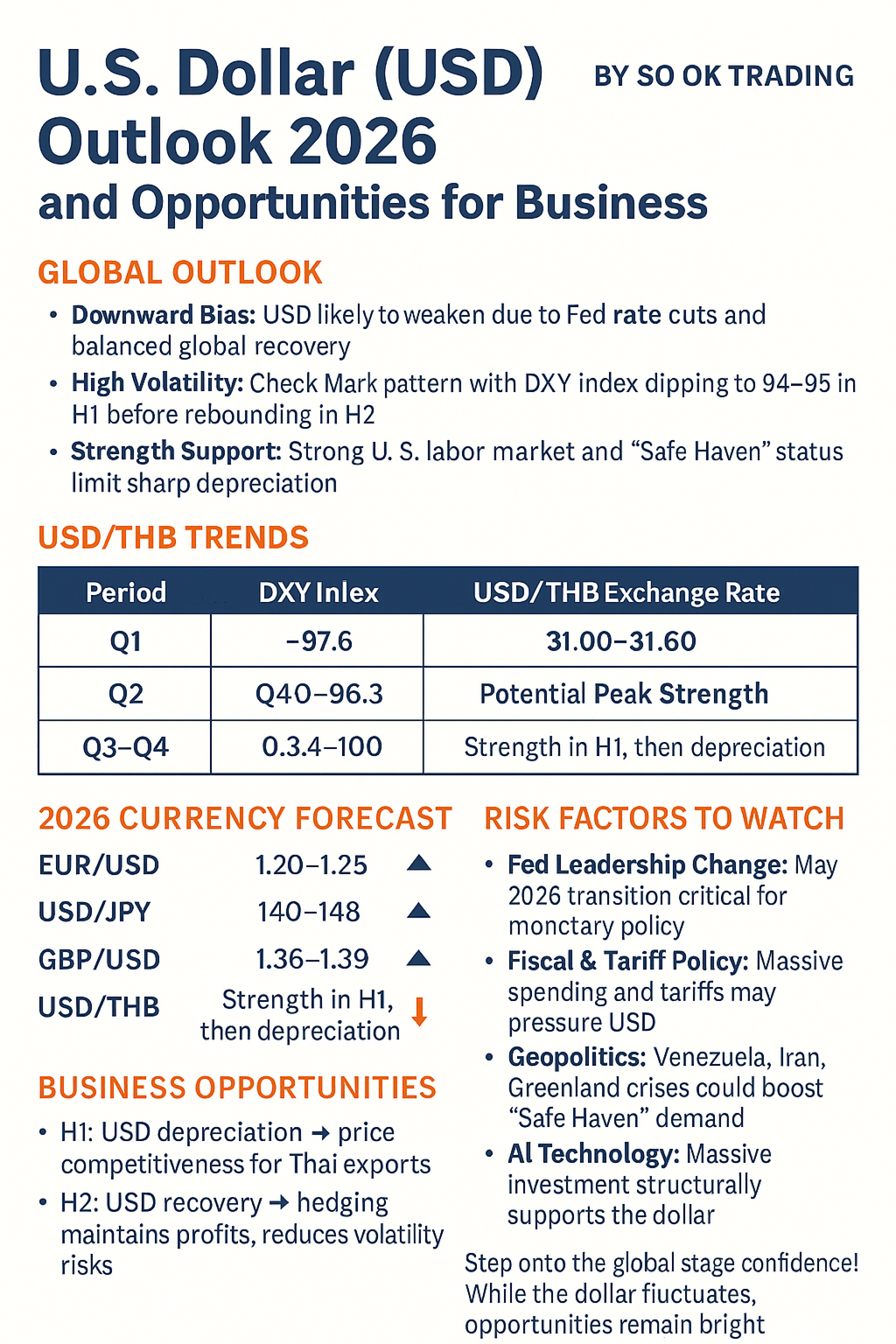
In 2026, the U.S. Dollar (USD) is expected to show notable movements. The first half of the year is projected to see a depreciation trend, while the second half may witness a gradual recovery supported by fiscal policy and investments in artificial intelligence (AI). This shift will not only impact the global economy but also create strategic opportunities for Thai enterprises, especially SO OK TRADING, which exports industrial and agricultural products to the world market.
Global Outlook
Downward Bias: Continued interest rate cuts by the Federal Reserve (FRB) and balanced global recovery are likely to weaken the dollar.
High Volatility: A “check-mark” pattern is expected—decline in the first half (DXY index possibly down to 94–95), followed by recovery in the second half.
Strength Support: The strong U.S. labor market and the dollar’s role as a “safe haven” asset will limit sharp depreciation.
Thai Baht Trends (USD/THB)
First Half of 2026: The baht strengthens against the dollar, trading within 31.10–31.60, and may even dip below 31.00.
Second Half: Political uncertainty and domestic economic slowdown may weaken the baht again, while the dollar recovers.
USD/THB Forecast 2026
Major Currency Comparisons (2026 Forecast)
EUR/USD: Euro strengthens → 1.20–1.25
USD/JPY: Yen strengthens → 140–148 (with risk of rebound to 164 if U.S. economy remains strong)
GBP/USD: Pound strengthens → 1.36–1.39
USD/THB: Baht strong in H1, weaker in H2
USD/CNY: Yuan stable to slightly stronger → 6.80–7.10
Yuan (CNY) Outlook
First Half: Average 6.9855, high 6.9973, low 6.9732 → Slight strengthening.
Second Half: If global slowdown or geopolitical risks intensify, safe-haven demand for USD may weaken the yuan.
Supporting Factors:
Cautious monetary easing by the People’s Bank of China (PBoC)
Recovery in exports and infrastructure investment
Reduced reliance on the dollar in BRICS and Asian trade partnerships
Risk Factors:
U.S.–China tensions → Risk of sharp yuan depreciation
Stricter capital outflow controls → Liquidity concerns
Weak domestic consumption → Confidence decline
⚠️ Key Risk Factors to Watch
Fed Leadership Change: May 2026 transition could significantly impact monetary policy direction.
Fiscal Policy & Tariffs: Massive spending and tariffs may pressure the dollar.
Geopolitics: Tensions in Venezuela, Iran, and Greenland may boost demand for the dollar as a “safe haven.”
AI Technology: Large-scale investment provides structural support for the dollar.
Business Opportunity Analysis
First Half: Dollar depreciation → Thai exports gain stronger price competitiveness.
Second Half: Dollar recovery → Hedging strategies help maintain profits and reduce volatility risks.
Conclusion
2026 is expected to be a year of significant dollar volatility, but it also represents a stage of opportunity. By continuously monitoring economic news, applying effective hedging tools, and delivering high-quality Thai products that meet international standards, SO OK TRADING can secure a competitive edge in the global market.
Step onto the global stage with confidence with SO OK TRADING. Even as the dollar fluctuates, opportunities continue to shine.