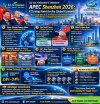
SO OK TRADING'S INSIGHT | APEC Shenzhen 2026: A Turning Point for the Global Economy - From Tariff Wars to the Era of AI, Clean Energy, and the New Global Supply Chain 19 November 2026
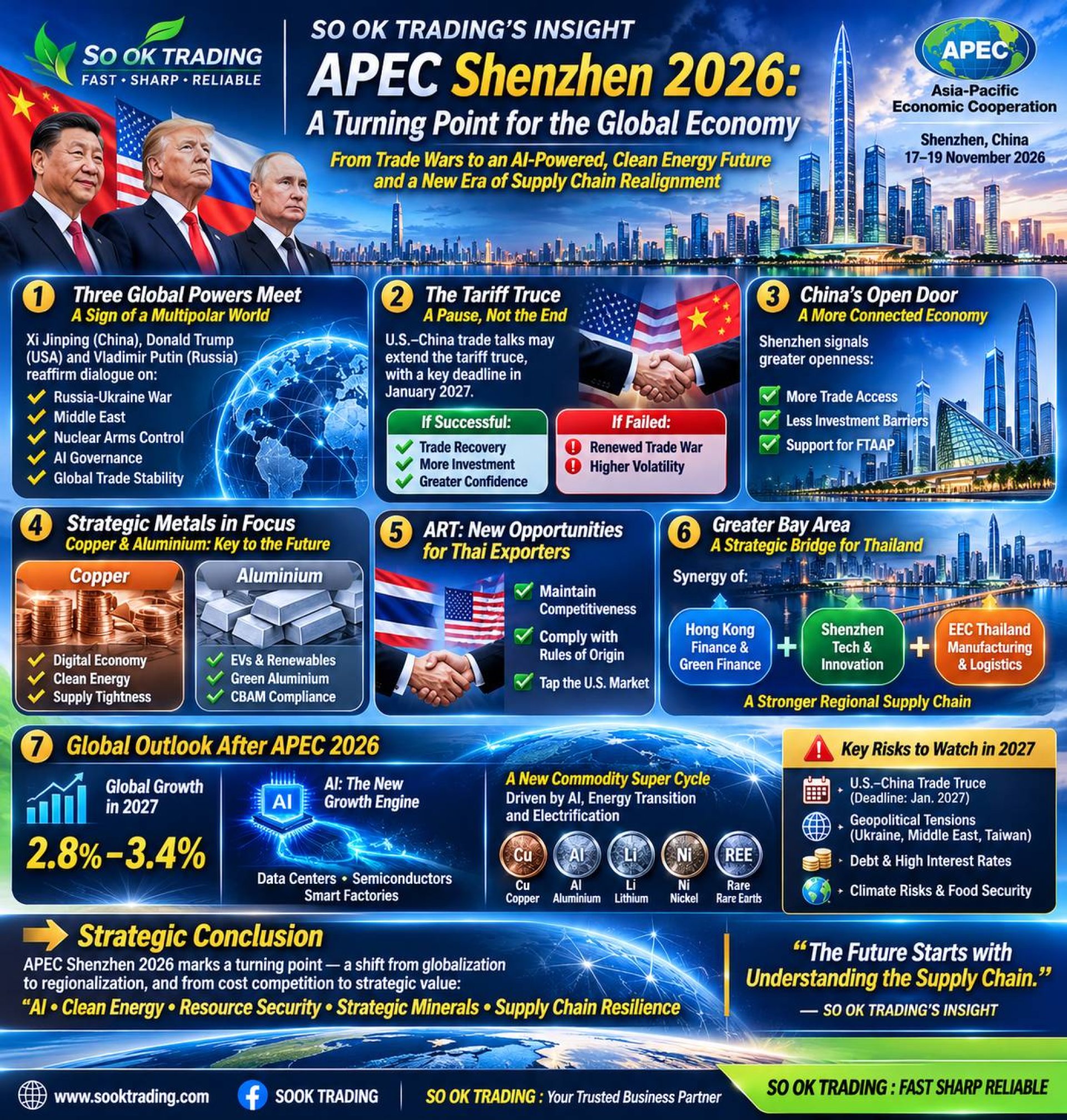
SO OK TRADING'S INSIGHT
APEC Shenzhen 2026: A Turning Point for the Global Economy
From Tariff Wars to the Era of AI, Clean Energy, and the New Global Supply Chain Order
Between 17-19 November 2026, Shenzhen, Guangdong Province, China, became the focal point of global attention as it hosted the 33rd APEC Economic Leaders' Meeting and the APEC CEO Summit under the theme:
"Building an Asia-Pacific Community for Shared Prosperity."
While APEC has traditionally served as a platform for economic cooperation, the 2026 summit carried a significance far beyond trade policy discussions. It took place at a time when the world is undergoing profound transformation across geopolitics, international trade, technological competition, energy transition, and global supply chain restructuring.
As a result, Shenzhen is no longer merely a host city. It is rapidly becoming a symbol of a new global economy powered by artificial intelligence, clean energy, and the strategic industries of the future.
1. Three Superpowers, One Stage:
A Signal of a Multipolar World
One of the most closely watched highlights of APEC Shenzhen 2026 was the appearance of three major world leaders:
Xi Jinping (China)
Donald Trump (United States)
Vladimir Putin (Russia)
Their bilateral and trilateral discussions attracted enormous international attention due to their relevance to:
The Russia-Ukraine conflict
Middle East stability
Nuclear arms control
AI governance
Global trade stability
Although markets were not expecting immediate breakthroughs or formal agreements, the reopening of high-level communication channels among major powers was widely viewed as a positive signal for future economic and geopolitical stability.
2. The Tariff War Isn't Over:
But the World May Be Entering a Truce
Perhaps the most important issue for global investors was the ongoing negotiation between the United States and China over extending their tariff truce.
Both countries currently maintain various tariff relief measures designed to minimize disruptions to global trade and supply chains.
However, the current framework faces a critical turning point in January 2027.
The outcome of discussions in Shenzhen could therefore become a key indicator of the global economic trajectory for the coming year.
If negotiations succeed:
✅ Recovery in global trade
✅ Increased industrial investment
✅ Stronger capital flows
✅ Improved business confidence
If negotiations fail:
⚠ Renewed tariff escalation
⚠ Supply chain disruptions
⚠ Heightened market volatility
⚠ Slower global economic growth
3. China's Message:
Economic Openness Over Isolation
The choice of Shenzhen as the host city was far from accidental.
Shenzhen represents China's leadership in:
Artificial Intelligence (AI)
Semiconductors
Smart Manufacturing
Robotics
Digital Economy
Through APEC, China used the global stage to communicate its commitment to:
Further trade liberalization
Reduced investment barriers
Greater foreign access to manufacturing
Promotion of the Free Trade Area of the Asia-Pacific (FTAAP)
At a time when protectionist policies remain prevalent across many regions, China is positioning itself as a key hub for economic connectivity throughout the Asia-Pacific.
4. Metals Are Becoming Strategic Resources
One of the most important themes emerging from the APEC CEO Summit was the growing importance of critical minerals and industrial metals.
Executives from mining, energy, and technology sectors broadly agreed that rising demand from:
AI Data Centers
Electric Vehicles (EVs)
Clean Energy Systems
Smart Power Grids
will significantly increase the need for strategic minerals over the coming decades.
Copper:
The Metal of the Digital Age
Copper is rapidly becoming one of the most important materials of the digital economy.
At the same time, China has signaled that its copper smelting capacity is approaching practical limits, raising concerns about future supply constraints.
Demand continues to grow from:
Data Centers
Power Infrastructure
AI Infrastructure
Renewable Energy Systems
As a result, copper is increasingly viewed as one of the world's most strategic commodities.
Aluminum:
The Metal of Decarbonization
Aluminum is a major beneficiary of the global decarbonization trend.
Its growth is being driven by:
Electric Vehicles
Renewable Energy
Green Buildings
Sustainable Packaging
Furthermore, the rise of Green Aluminum and carbon-related regulations such as CBAM (Carbon Border Adjustment Mechanism) means competition is no longer based solely on product pricing.
Future competitiveness will increasingly depend on:
Carbon footprint performance
Sustainable production
Raw material traceability
5. Thailand-U.S. ART Agreement:
New Opportunities for Thai Exporters
Prior to APEC, Thailand and the United States reached the Agreement on Reciprocal Trade (ART).
The agreement helps strengthen Thai exporters' competitiveness in the U.S. market while reducing uncertainty for exporters and investors.
However, businesses must closely monitor:
Rules of Origin
Industries most affected include:
Automotive Components
Electronics
Metal Packaging
Home Appliances
Manufacturers must demonstrate sufficient value-added production within Thailand.
Failure to do so could result in products being classified as originating from third countries and facing higher tariff rates.
6. Greater Bay Area:
A Major Opportunity for Thai Businesses
Another strategically important theme is the connection between:
Thailand's Eastern Economic Corridor (EEC)
Hong Kong
Shenzhen
The Greater Bay Area (GBA)
The GBA has become one of the world's most dynamic economic regions.
For Thai businesses, a new development model is emerging:
Hong Kong
A global hub for finance, fundraising, and green finance.
Shenzhen
A center for technology, innovation, and advanced manufacturing.
Thailand's EEC
A manufacturing hub and gateway to ASEAN markets.
By linking these three pillars together, Thailand has the potential to evolve from a traditional manufacturing base into a regional supply chain hub.
7. Global Economic Outlook After APEC Shenzhen 2026
One of the clearest messages emerging from Shenzhen is that the world is transitioning from an era of consumption-led growth to one driven by strategic investment.
Leading financial institutions project that:
Global GDP growth in 2027 could range between 2.8% and 3.4%.
While not as rapid as previous economic booms, this pace is still strong enough to support long-term industrial and infrastructure investment.
AI Will Become the Next Global Growth Engine
If the period from 2000-2020 belonged to the Internet Era,
then the years between 2027-2035 may belong to the AI Era.
Competition among the United States, China, Japan, South Korea, and ASEAN economies is accelerating across:
Data Centers
Semiconductors
Cloud Computing
Smart Factories
AI Computing Infrastructure
AI investment is expected to become one of the most powerful drivers of global growth during the next decade.
A New Commodity Super Cycle May Be Emerging
Unlike previous commodity booms driven primarily by China's industrialization,
the next cycle could be powered by:
AI Infrastructure
Energy Transition
Digital Economy
Electrification
All of which require substantial quantities of:
Copper
Aluminum
Lithium
Nickel
Rare Earth Elements
This trend could provide long-term support to global mining and metals industries.
From Globalization to Regionalization
APEC Shenzhen 2026 reinforced a critical trend:
The world is not necessarily deglobalizing.
Instead, it is evolving.
The traditional:
Global Supply Chain
is gradually transforming into:
Regional Supply Chain Networks
Key strategies increasingly adopted by multinational corporations include:
China + 1
Friend-Shoring
Near-Shoring
Multi-Sourcing
Countries capable of connecting multiple regions efficiently are likely to be the biggest beneficiaries.
Asia-Pacific Remains the World's Growth Engine
Although China's growth has moderated compared with previous decades, the Asia-Pacific region remains the most dynamic economic area in the world.
The region continues to be supported by:
RCEP
DEFA
Greater Bay Area Development
Digital Trade
Green Economy Initiatives
These factors are expected to shape global investment flows throughout the coming decade.
Key Risks to Watch in 2027
Despite an improving outlook, significant risks remain:
⚠ U.S.-China Tariff Truce Expiration in January 2027
⚠ Geopolitical Tensions in Ukraine, the Middle East, and the Taiwan Strait
⚠ Rising Public Debt and Higher Interest Rates
⚠ Climate Change and Food Security Risks
⚠ Potential Financial Market Volatility
Conclusion
APEC Shenzhen 2026 may ultimately be remembered as a major turning point in the evolution of the global economy.
This was not merely a conference about trade policy.
It was a reflection of how a new economic order is taking shape.
The world is moving away from competition based primarily on labor costs and tariff policies,
toward competition centered on:
✅ Artificial Intelligence (AI)
✅ Clean Energy
✅ Strategic Resources
✅ Critical Minerals
✅ Supply Chain Resilience
For Thailand, this represents a pivotal moment to redefine national strategies for trade, investment, and industrial development.
Because in the post-APEC 2026 world, the most important question may no longer be:
"Who will become the next global superpower?"
Instead, it may be:
"Who will connect fastest to the emerging global economic network and capture the opportunities created by this historic transformation?"
SO OK TRADING'S INSIGHT
Trade. Technology. Transformation.
The Future Starts with Understanding the Supply Chain.
SO OK TRADING
Your Trusted Business Partner
FAST • SHARP • RELIABLE
www.sooktrading.com
Facebook: SO OK TRADING