SO OK TRADING'S INSIGHT Zinc's Next Cycle How the Clean Energy Transition Is Creating a New Wave of Demand for Zinc 15 NOV 2026
SO OK TRADING'S INSIGHT | 15 NOV 2026
Global Zinc Market Outlook 2026-2027
The Metal Powering Corrosion Protection, Infrastructure, and the Future of Energy
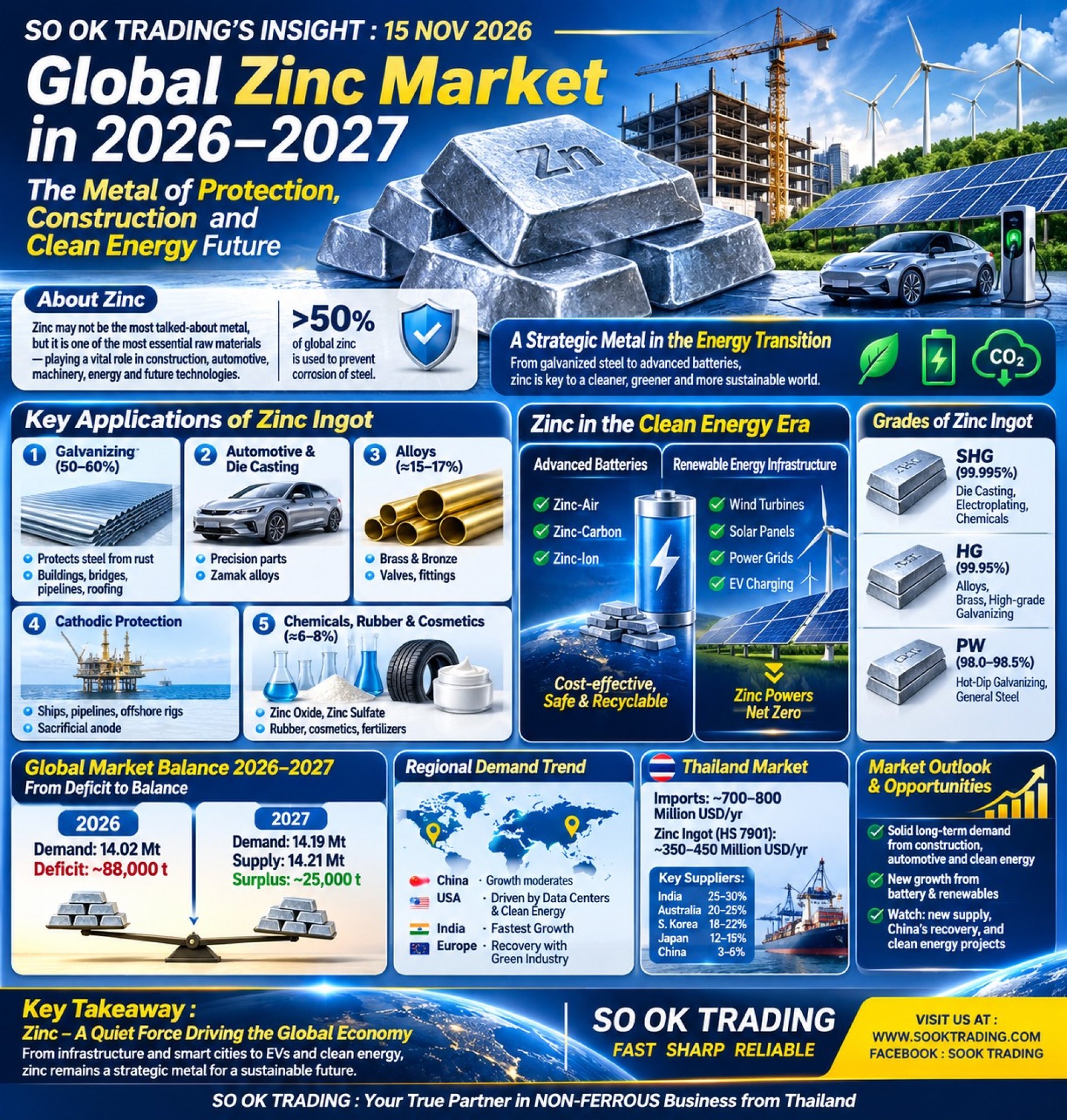
Although Zinc may not receive as much attention as Copper, Aluminum, or critical minerals associated with the clean energy transition, it remains one of the most essential industrial metals in the global economy. Zinc plays a vital role across construction, automotive manufacturing, machinery, energy infrastructure, and emerging energy storage technologies.
Today, more than half of the world's zinc consumption is dedicated to protecting steel and infrastructure from corrosion. At the same time, the global Energy Transition is creating new growth opportunities for the zinc industry, particularly in batteries, renewable energy infrastructure, and large-scale energy storage systems.
The Critical Role of Zinc Ingots in Global Industries
1. Galvanizing
Galvanizing is the largest end-use market for zinc worldwide, accounting for approximately 50-60% of total zinc consumption.
Zinc ingots are melted and applied as a protective coating on steel surfaces, creating a corrosion-resistant barrier against moisture, weather, and chemicals. This process significantly extends the lifespan of steel products and infrastructure.
Key applications include:
• Structural steel buildings
• High-voltage transmission towers
• Bridges and public infrastructure
• Water and industrial pipelines
• Roofing sheets
• Automotive bodies and components
With continued global investment in infrastructure, galvanizing remains the primary demand driver for zinc consumption.
2. Automotive and Die Casting Industries
Zinc is a key raw material for producing precision die-cast components.
Zamak alloys, composed primarily of zinc, aluminum, magnesium, and copper, are widely used in the automotive and electronics industries.
Typical applications include:
• Automotive door handles
• Transmission systems
• Engine components
• Electronic housings
• Household appliance parts
• Industrial hardware products
Zinc's low melting point, excellent castability, and dimensional stability help manufacturers improve production efficiency and reduce manufacturing costs.
3. Alloy Production
Zinc is also an essential ingredient in the production of numerous alloys, particularly Brass.
Brass, an alloy of copper and zinc, offers excellent strength, appearance, and corrosion resistance.
Major applications include:
• Valves
• Plumbing fittings
• Sanitary ware
• Industrial machinery
• Electrical components
• Industrial parts
Brass and bronze production accounts for approximately 15-17% of total global zinc consumption.
4. Cathodic Protection Systems
Zinc possesses unique electrochemical properties that enable it to function as a sacrificial anode.
As a result, it is widely used in:
• Marine applications
• Commercial vessels
• Offshore oil and gas platforms
• Natural gas pipelines
• Subsea steel structures
This technology significantly extends asset life while reducing long-term maintenance costs.
5. Chemical, Rubber, and Cosmetics Industries
Zinc ingots can be further processed into various chemical compounds.
Zinc Oxide (ZnO)
Applications include:
• Tire manufacturing
• Synthetic rubber
• Industrial paints and coatings
• Ceramics
• Cosmetics
• Sunscreen products
Zinc Sulfate
Applications include:
• Micronutrient fertilizers
• Animal feed additives
• Pharmaceuticals
• Agricultural soil enhancement
The chemical industry represents approximately 6-8% of global zinc consumption.
Zinc in the Clean Energy Era
One of the most promising trends is zinc's expanding role within future energy systems.
Several advanced battery technologies currently under development utilize zinc as a key component, including:
• Zinc-Air Batteries
• Zinc-Carbon Batteries
• Zinc-Ion Batteries
These technologies are attracting growing attention due to their cost-effectiveness, safety, and recyclability.
In addition, renewable energy infrastructure relies heavily on galvanized steel applications, including:
• Wind turbine towers
• Solar mounting structures
• Power transmission networks
• EV charging stations
These developments position zinc as one of the major beneficiaries of the global Net Zero and Energy Transition megatrends.
Zinc Ingot Grades and Specifications
SHG (Special High Grade)
Purity: 99.995%
Suitable for:
• Die Casting
• Electroplating
• Chemical Applications
• Electronics Industry
HG (High Grade)
Purity: 99.95%
Suitable for:
• Alloy Production
• Brass Manufacturing
• Premium Galvanizing Applications
PW (Prime Western)
Purity: 98.0% - 98.5%
Suitable for:
• Hot-Dip Galvanizing
• General Structural Steel Applications
Global Zinc Market Balance (2026-2027)
After several years of supply tightness, the global zinc market is entering a significant transition phase.
In 2026, the market remains in deficit due to shortages of zinc concentrates, mine closures, and elevated smelting costs.
However, the outlook begins to change in 2027 as new mining capacity enters production across several regions, potentially shifting the market into a modest surplus.
Global Zinc Market Forecast
2026
Refined Zinc Demand:
14.02 Million Tons
Market Balance:
Deficit of approximately 88,000 Tons
2027
Refined Zinc Demand:
14.19 Million Tons
Refined Zinc Production:
14.21 Million Tons
Market Balance:
Surplus of approximately 25,000 Tons
The overall picture suggests supply growth could begin to outpace demand growth, creating potential downward pressure on zinc prices in the medium term.
Regional Demand Outlook
China
China remains the world's largest zinc consumer, although growth is slowing due to weakness in the property and construction sectors.
United States
Demand is supported by:
• Data Center Development
• Infrastructure Investment
• Domestic Manufacturing Expansion
• Clean Energy Projects
India
India is emerging as one of the fastest-growing zinc markets, fueled by urbanization and industrial development.
Europe
Demand recovery is supported by the automotive sector and renewable energy investments.
Thailand's Zinc Market
Thailand no longer produces refined zinc commercially and therefore relies heavily on imported zinc ingots.
The country's annual import value for zinc and zinc-related products is estimated at approximately US$700-800 million.
For zinc ingots (HS 7901), annual imports are valued at approximately US$350-450 million.
Major Zinc Suppliers to Thailand
• India (25-30%)
• Australia (20-25%)
• South Korea (18-22%)
• Japan (12-15%)
• China (3-6%)
India, in particular, is strengthening its position in the Thai market as major global producers continue expanding production capacity.
Non-Ferrous Zinc Outlook Toward 2027
While the global zinc market is gradually transitioning from deficit to balance, long-term fundamentals remain supported by demand from corrosion protection, infrastructure development, automotive manufacturing, and clean energy industries.
Galvanized steel will continue to represent the core of global zinc consumption, while battery technologies and renewable energy investments are creating new and promising growth opportunities.
For industry participants, manufacturers, and investors, three critical factors will shape future zinc prices and market opportunities:
• New Mining Supply Growth
• China's Economic Recovery
• Expansion of Clean Energy Projects
Conclusion
Zinc may not be the most talked-about metal in the world, but it remains one of the most indispensable.
From infrastructure and smart cities to modern transportation and future energy systems, zinc continues to serve as a foundational material that supports global industrial development.
As the world moves toward a cleaner and more connected future, zinc is expected to remain a strategic metal with an increasingly important role throughout the coming decade.
SO OK TRADING
Your Trusted Business Partner
SO OK TRADING
FAST • SHARP • RELIABLE
VISIT US AT: WWW.SOOKTRADING.COM
FACEBOOK: SOOK TRADING
SO OK TRADING
Thailand's Non-Ferrous Metal Specialist
Your Trusted Partner in Global Metal Trade