“SO OK TRADING INSIGHT: ASEAN Driving Economic Growth, Agricultural Export Powering the Future — ASEAN AGRI POWER”
SO OK TRADING “S INSIGHT” ASEAN Agricultural Products: November 3, 2026
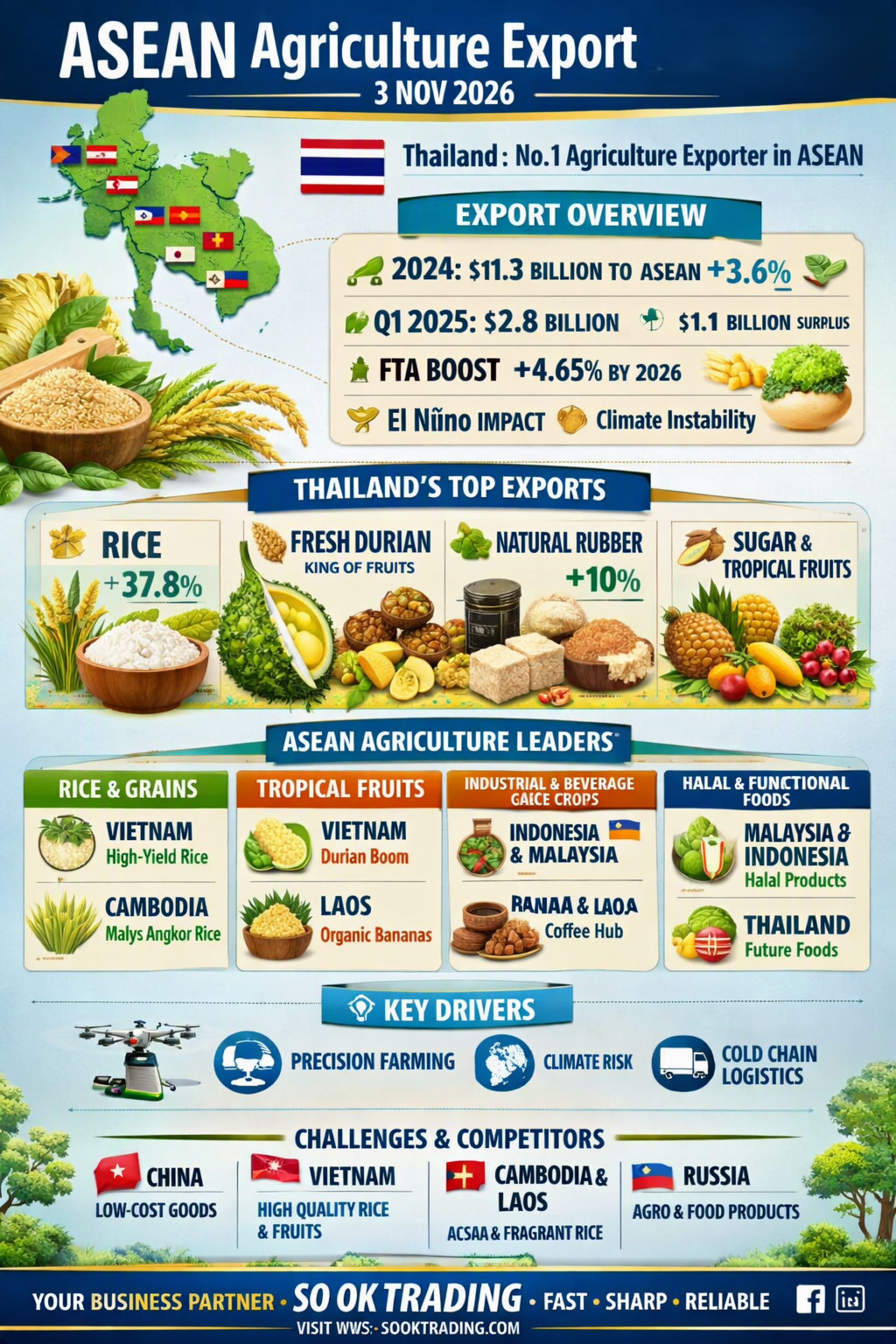
Thailand Remains ASEAN’s No.1 Agricultural Export Leader
Thailand continues to dominate ASEAN’s agricultural exports, with the ASEAN market serving as a vital driver of revenue and a pillar of economic strength.
Trade Overview and Export Value
In 2024 (BE 2567), Thailand exported agricultural products to ASEAN worth 410.83 billion baht, a 3.6% growth.
In Q1 2025 (BE 2568), revenue surpassed 100 billion baht, with a trade surplus of 40.915 billion baht.
Benefits from FTAs supported continuous export growth of 4.65% in 2026 (BE 2569).
Key drivers included El Niño and climate variability, prompting neighboring countries to import more for food security.
Thailand’s Star Export Products
Rice: Prices of ordinary paddy rice rose 37.82%, jasmine rice 12.48%. The Philippines and Malaysia continued importing for stockpiling.
Fresh Durian: The “King of Fruits” generated the highest revenue, dominating China and ASEAN markets, though facing competition from Vietnam.
Natural Rubber: Thailand remains the world’s No.1 exporter of natural latex, with export value expected to grow 10%.
Cassava: Export volume declined due to drought and disease, but high-value cassava starch grew +30.74%.
Sugar: Constrained by quotas and environmental measures, yet still a key global commodity.
Other Fruits: Longan, mangosteen, aromatic coconut, and pomelo show strong potential in premium markets.
ASEAN Agricultural Highlights by Country
Rice & Staple Crops
Vietnam: Developing high-yield rice varieties.
Cambodia: Fragrant rice “Malys Angkor” won international awards.
Thailand: Focused on premium jasmine rice.
Tropical Fruits
Thailand: Durian, mangosteen, aromatic coconut, and longan lead in export value.
Vietnam: Expanding durian and tropical fruit orchards with cost and logistics advantages.
Laos: Strong in bananas and organic fruits, leveraging the Laos–China railway.
Industrial & Beverage Crops
Indonesia & Malaysia: Dominating palm oil and processed cocoa.
Thailand: Leading in natural latex and cassava starch exports.
Vietnam & Laos: Global coffee hubs—Vietnam for robusta, Laos for premium Bolaven Plateau coffee.
Halal & Functional Foods
Malaysia & Indonesia: Strictly advancing Halal certification.
Thailand: Developing functional and future foods to add value and avoid price wars.
Common ASEAN Agricultural Growth Drivers
Precision Farming: Drones, sensors, and smart irrigation reduce labor costs.
Climate Risk: Weather variability impacts yields, driving ASEAN’s 2026–2030 agriculture and forestry strategy.
Cold Chain Logistics: Thailand, Vietnam, and Indonesia investing in cold storage infrastructure to reduce post-harvest losses.
Key Challenges and Competitors
China: Flood of cheap products pressures markets; long-term reduction in rice and sugar imports.
Vietnam: Rapidly developing high-quality rice and durian with cost/logistics advantages.
Cambodia & Laos: Expanding cassava and fragrant rice cultivation for exports.
Russia: Entering ASEAN with agricultural and processed food products.
Outlook for 2027
ASEAN’s agricultural market is expected to maintain strong growth, especially in high-value and processed foods. Businesses must adapt to fierce competition, stricter global trade standards, and currency volatility.
Conclusion
Thailand remains the “Kitchen of ASEAN,” with strong potential to sustain its leadership in agricultural exports. Meanwhile, other ASEAN members also contribute star products, making the region a true “global pantry and kitchen.” Future success depends on raising product standards and adopting modern agricultural technologies to stay ahead in global competition.
SO OK TRADING: Your Business Partner SO OK TRADING: FAST SHARP RELIABLE VISIT US AT: WWW.SOOKTRADING.COM FACEBOOK: SOOK TRADING