SO OK TRADING Insight: Global & Thai Rebar Market 2026–2027 — High Prices, Mounting Pressures, and the Transition to the Green Steel Revolution
Steel Market Situation in Thailand and the World 2026–2027 : SO OK TRADING : 27 OCT 2026
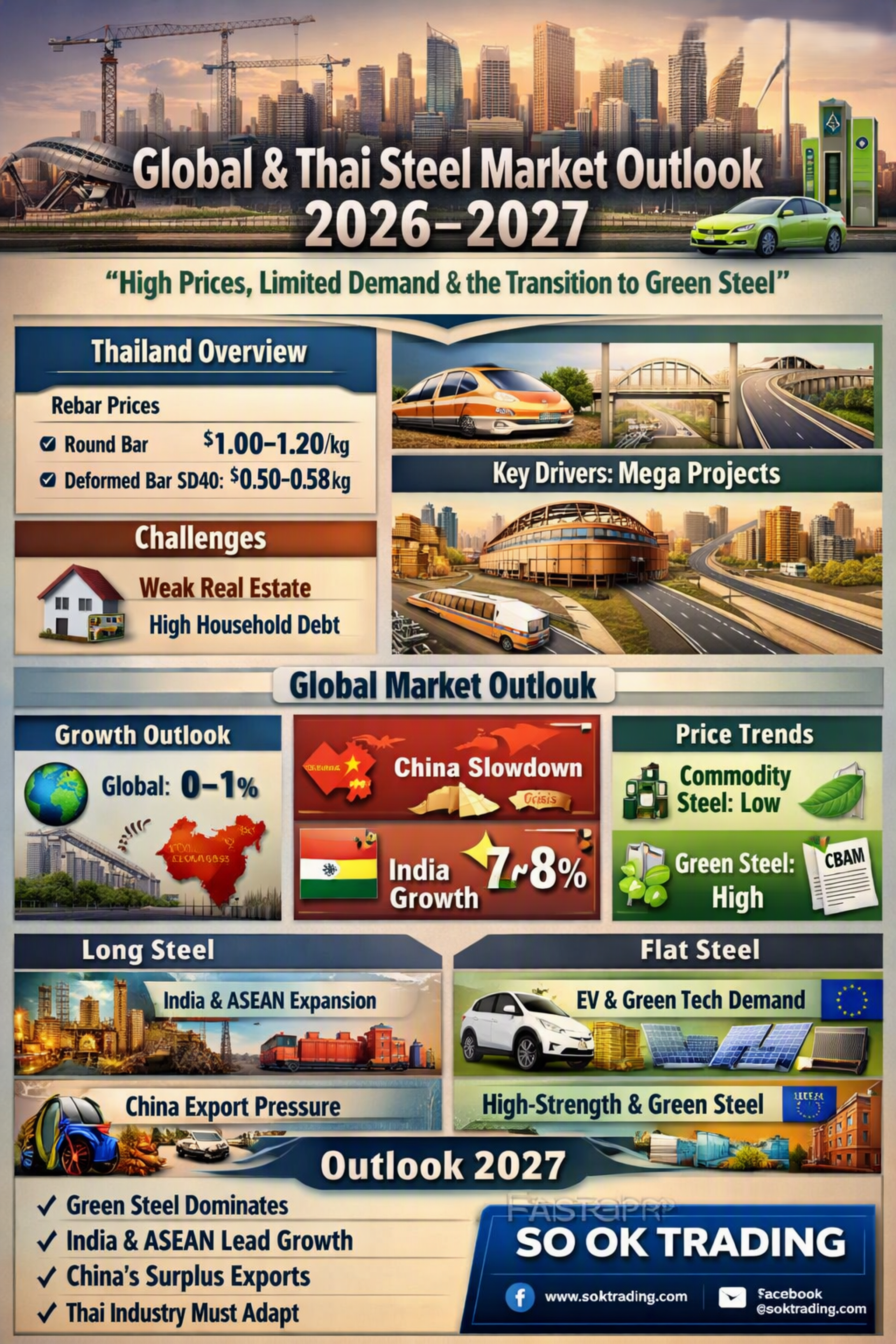
“Thai & Global Rebar Market: High Prices, Limited Demand, and the Transition to Green Steel”
Introduction
In 2026, both Thailand and the global steel industry face mounting pressures — soaring energy costs, geopolitical uncertainties, and new environmental measures such as the EU’s CBAM. Meanwhile, global steel demand remains limited, with uneven growth across regions, pushing the market into a major adjustment phase.
Thailand Overview
Prices remain elevated:
Round Bar (6 mm, TIS): 36–42.50 THB/kg
Deformed Bar SD40 (DB12–DB20): 18.40–20.50 THB/kg
Domestic demand has slightly recovered thanks to government infrastructure projects, but Thai mills still produce only 35–43% of total market needs. Over 12 million tons must be imported.
Key Drivers: Mega Projects such as high-speed rail, mass transit, and highways Challenges: Weak private real estate, high household debt, and a slowing automotive industry
Thai Steel Segments
Long Steel: Demand surged +31% YoY from construction and state projects, but faces challenges from imported prefabricated steel lacking TIS standards.
Flat Steel: Growth limited to +2.7% YoY due to the automotive slowdown, especially the EV transition reducing steel per vehicle. Still supported by appliances and CBAM-driven Green Steel adoption.
Global Outlook 2026–2027
The global steel market is entering a Green Steel transition era:
Demand Growth: Global expansion only 0–1%. China slows permanently due to property crisis, while India grows 7–8% annually from infrastructure investment.
Price Trends: Commodity steel pressured by oversupply and price wars. Premium and Green Steel remain high due to technology costs and CBAM compliance.
Long Steel: Regional divergence — India and ASEAN expand strongly, while China’s slowdown drives surplus exports, prompting anti-dumping measures worldwide.
Flat Steel: Driven by EVs and renewable energy. Steel per vehicle decreases, but demand for UHSS and Green Steel rises, supported by wind, solar, and hydrogen infrastructure.
Conclusion
Both Thailand and the global steel industry face two major pressures:
High prices from energy costs and environmental regulations
Limited, uneven demand growth across regions
Thailand’s long steel remains supported by government projects, while flat steel must accelerate its Green Steel transition to stay competitive. Globally, India and clean energy industries will drive growth, while China’s property slump and cheap exports remain key risks.
Outlook for 2027
2027 will mark a structural transformation in the steel industry:
Green Steel becomes the new competitive standard
India and ASEAN lead long steel growth
China continues surplus exports, pressuring global prices
Thailand must reform production structures and TIS standards to compete
SO OK TRADING: Your Trusted Business Partner FAST • SHARP • RELIABLE www.sooktrading.com sooktrading@sooktrading.com | sooktrading@outlook.com