“SO OK TRADING’s Insight: Green Industry Transforming Thai Business Towards a Sustainable Future — The New Rules of the Net Zero Era”
In‑Depth Article: Key Trends in Green Industry & Circular Economy 2026–2030
SO OK TRADING | 26 OCTOBER 2026
The world is undergoing a profound transformation — shifting from viewing the “environment” merely as a cost, to recognizing it as an essential business strategy that cannot be ignored. As a result, Green Industry and the Circular Economy have become central pillars for every organization seeking to survive and remain competitive in the global market.
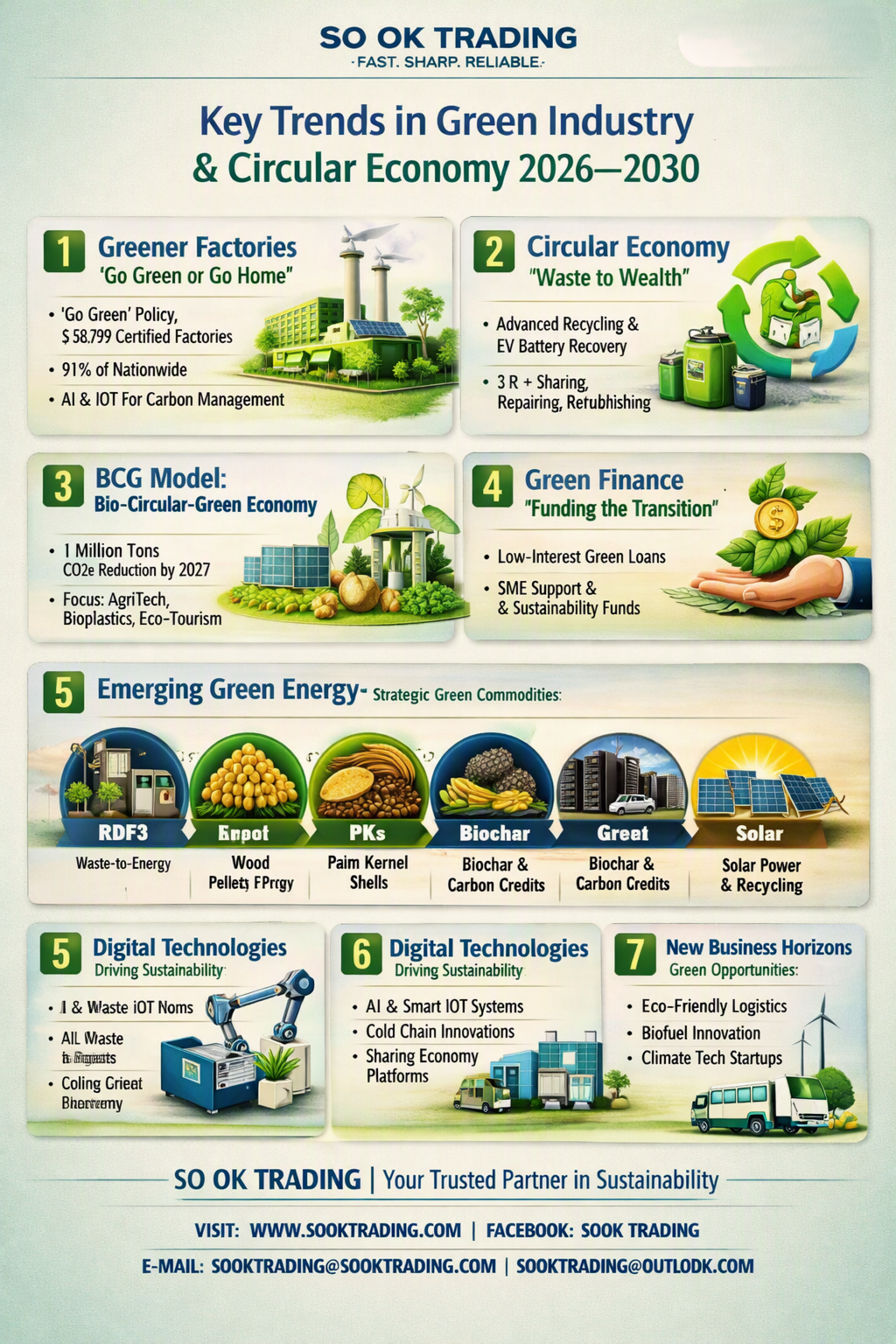
1. Greener Factories: “Go Green or Go Home”
Government Policy: The Department of Industrial Works drives the “Go Green” initiative, shifting from regulator to enabler.
Certification: Over 58,799 factories nationwide are now certified as Green Industry, representing more than 91% of all factories.
Digital Tools: AI and IoT integrated with online pollution monitoring systems enable precise carbon reduction planning.
2. Circular Economy: From Waste Reduction to Value Creation
From Symbolism to Profitability: Recycling steel, managing EV batteries, and producing high‑value recycled plastics generate tangible economic returns.
New Business Models: Beyond the 3R (Reduce, Reuse, Recycle), models now include Sharing, Leasing, Repairing, and Refurbishing, aiming for near‑zero waste.
3. BCG Model (Bio‑Circular‑Green Economy)
National Target: Reduce greenhouse gas emissions by at least 1 million tons CO₂e by 2027.
Focus Industries (S‑Curves): Agriculture & food, bioenergy, integrated healthcare, and eco‑tourism.
4. Green Finance: Funding the Transition
Low‑interest green loans and clean energy technology investment support.
Special emphasis on helping SMEs reduce costs and embrace sustainability.
5. Green Energy & Fuel Trends (2026–2030)
Renewable energy and biomass fuels are evolving from “alternative fuels” into Strategic Green Commodities, traded across borders to avoid carbon tariffs.
RDF3: Rising star in waste‑to‑energy, directly reducing landfill waste.
Wood Pellets: Export surge to EU and Japan, subject to strict traceability standards (EUDR).
PKS (Palm Kernel Shells): Stable fuel but limited supply, driving prices upward.
Biochar: Dual revenue stream from fuel sales and premium carbon credits.
Solar Cells: Mandatory for factories worldwide, with recycling of expired panels emerging as a new trend.
6. Digital Technologies Driving Sustainability
AI & IoT: Precision control of energy use in factories.
Smart Cold Chain: Reducing food and energy losses.
Sharing Platforms: Transitioning from product sales to Product‑as‑a‑Service models.
7. New Business Opportunities & Long‑Term Benefits
Cost Reduction & Profit Growth: Efficient resource management reduces reliance on volatile raw materials.
New Market Creation: Green logistics, biofuel ventures, and climate tech startups.
Alignment with National Goals: Supporting Net Zero emission targets.
Conclusion
Green Industry and the Circular Economy are shifting from “voluntary” to “mandatory.” Combining renewable energy sources — such as Solar + Biomass/RDF — will be the winning formula for modern factories aiming for Net Zero, while securing competitive advantages in the global market.
SO OK TRADING | Your Trusted Business Partner — FAST. SHARP. RELIABLE.
Visit Us: WWW.SOOKTRADING.COM E‑MAIL INQUIRY: SOOKTRADING@SOOKTRADING.COM | SOOKTRADING@OUTLOOK.COM FACEBOOK: SO OK TRADING