“High Oil Prices Today = Inflation Tomorrow: Global Energy Volatility and Thailand’s Strategic Response in Q4 2026” SO OK TRADING|October 9, 2026
Global Oil Prices, October 9, 2026: Extreme Volatility and Impact on Thailand
By SO OK TRADING
Introduction
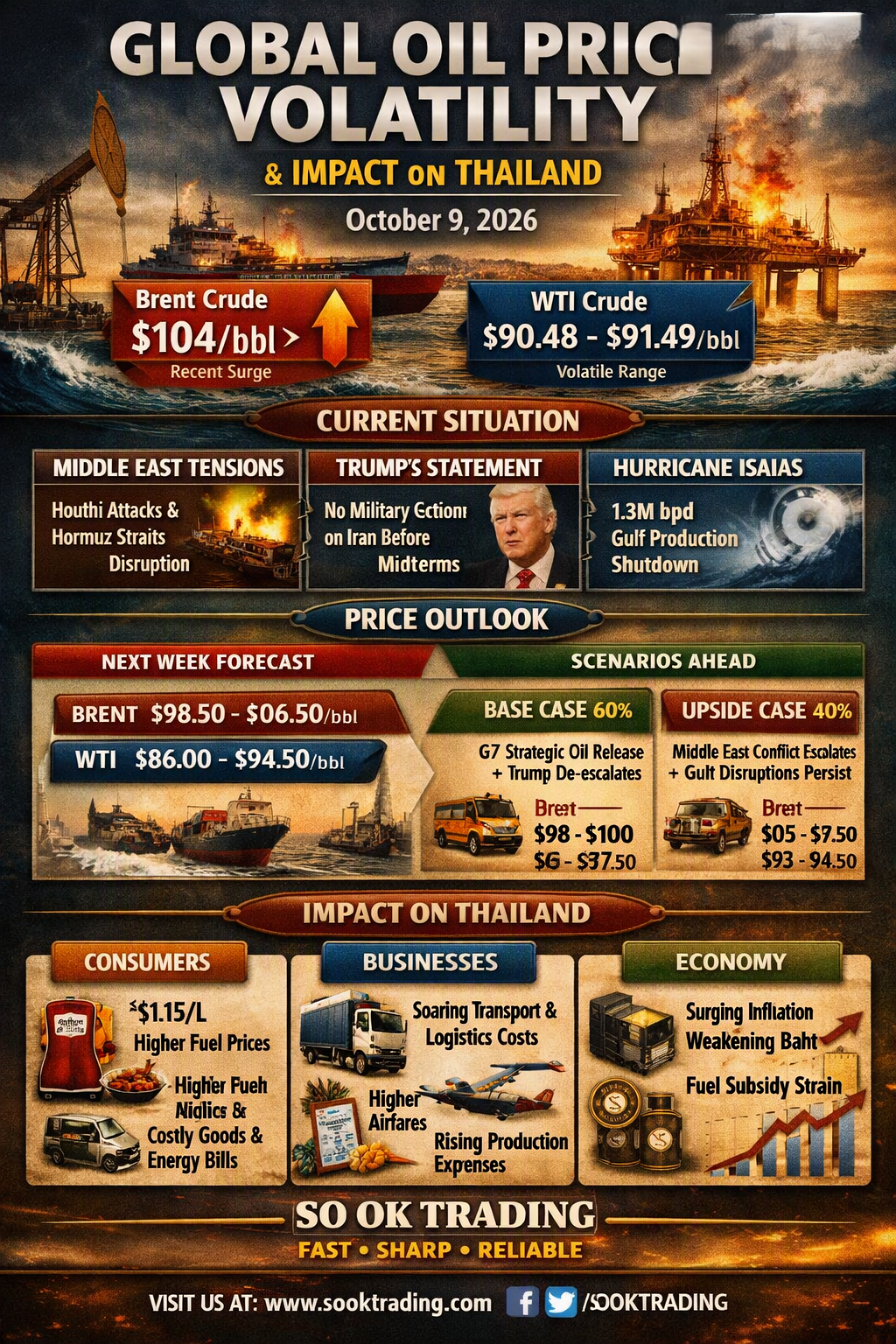
In October 2026, the global oil market is facing severe volatility. Brent Crude surged past $104 per barrel before easing slightly, while West Texas Intermediate (WTI) traded in the range of $90.48 – $91.49 per barrel. This reflects the tug-of-war between tight supply conditions in the Middle East and the United States, and positive signals from ongoing political negotiations.
Current Situation
Middle East Tensions
Houthi attacks on targets in Saudi Arabia and Riyadh
Tanker strikes in the Hormuz Strait, a route that carries 20% of global oil shipments
Resulting in record-high tanker freight rates and marine insurance premiums
Statement by President Donald Trump
Confirmed no military action against Iran before the U.S. midterm elections
Helped ease panic and reduce upward price pressure
Hurricane Isaias
Impacted Gulf of Mexico oil platforms, halting over 1.3 million barrels per day of production
Equivalent to 62.9% of regional output
Price Outlook and Analysis
Leading financial and energy institutions forecast continued high volatility with both upward and downward pressures:
U.S. EIA: Strongly bullish, Brent average $105 in Q4
Goldman Sachs: Medium-term bearish, Brent down to $85 by December
Deloitte: WTI average $90, holding at elevated levels
LiteFinance: WTI range $78.42 – $99.69, highly volatile
Forecast Range for October 12–16, 2026
Brent: $98.50 – $106.50
WTI: $86.00 – $94.50
Scenario Analysis
Temporary Price Correction (Base to Downside Case) — 60% Probability
Drivers: G7 releasing 100 million barrels of strategic reserves + Trump’s de-escalation statement
Impact: WTI may test $86.00 – $87.50, Brent $98.50 – $100.00
Continued Price Surge (Upside Case) — 40% Probability
Drivers: Renewed tanker attacks in the Hormuz Strait or delayed recovery of Gulf oil platforms
Impact: WTI may rise to $93.00 – $94.50, Brent $105.00 – $106.50
Key Pivot Points
WTI: $90.00
Brent: $101.50 → Sustained levels above these thresholds would favor upward momentum.
Impact on Thailand
Consumers and Households
Diesel surpassing 42 THB/liter, gasoline at 41 THB/liter → rising living costs
Electricity tariffs (Ft) expected to increase with higher energy costs
Behavioral shifts: greater reliance on public transport, accelerated adoption of electric vehicles (EVs)
Businesses and Industries
Logistics and Transport: Rising costs squeeze margins
Airlines and Tourism: Higher jet fuel prices push airfares up, dampening travel demand
Agriculture and Chemicals: Fertilizer, plastics, and machinery costs increase
Macroeconomy and Government Finance
Inflation pressures: Bank of Thailand may raise policy rates
Fuel Fund crisis: Heavy subsidies risk deep deficits
Trade deficit widening: As a net energy importer, Thailand faces higher foreign currency outflows, weakening the baht
Conclusion
As of October 2026, the global oil market remains in a state of high-range consolidation, with strong forces on both sides. If WTI holds above $90 and Brent above $100, the impact on Thailand will be significant — higher living costs, rising business expenses, and fiscal instability.
“High Oil Prices Today = Inflation Tomorrow” This is the warning sign for Thailand’s economic future.
SO OK TRADING: Your Trusted Business Partner FAST • SHARP • RELIABLE VISIT US AT: www.sooktrading.com Facebook: SOOK TRADING