Share

“Global Oil Prices Fall, Naphtha Recovers – The Turning Point for Energy and World Economy in H2 2026” SO OK TRADING: July 4, 2026
Last updated: 4 Jul 2026
204 Views

 Global Oil Prices Fall, Naphtha Supply Recovers – Energy & Petrochemical Markets Shift Direction
SO OK TRADING: July 4, 2026

 
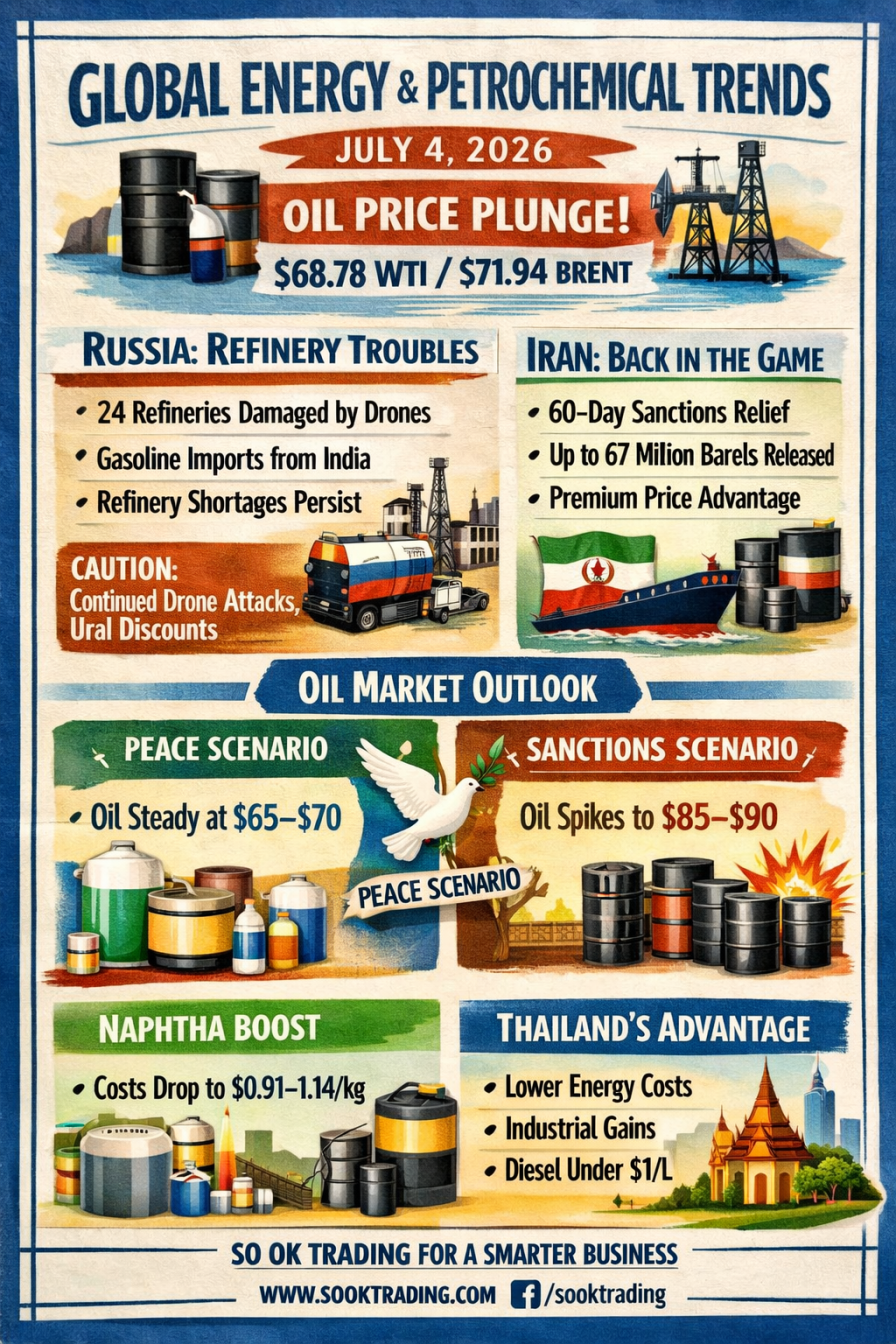
In early July 2026, the global energy market is at a major turning point. WTI crude has dropped to $68.78/barrel, while Brent crude is down to $71.94/barrel, the lowest levels since before the war. This is not just a correction — it is a “major reset” of geopolitics and the world economy.

 
Why Oil Prices Dropped
US–Iran peace talks → Strait of Hormuz reopened
OPEC+ boosts production → +3.3 million barrels/day
Morgan Stanley warns → Oversupply risks ahead
 
Russia: Crude Surplus, Refined Fuel Shortage
24 of 33 refineries damaged by Ukrainian drone strikes → massive loss of refining capacity
Russia forced to import gasoline from India, which refines Russian crude and sells it back
Rare Reversal: A top crude producer now importing refined fuel
Outlook Russia:

Continued refinery attacks → prolonged refined fuel crisis
Increasing reliance on China, with Ural crude discounts to compete against Iran
 
Iran: Back in the Global Market
US issued GL X, temporarily lifting sanctions for 60 days
40–67 million barrels of crude released into the market
Shift from discounted sales to premium pricing (+20%)
India and Japan resumed imports, while China lost its bargaining power
Outlook Iran:

Successful negotiations → oil stabilizes at $65–70/barrel
Failed negotiations → oil surges to $85–90/barrel
 
Oil Market Crossroads
Scenario 1: Lasting Peace → Stable prices, easing global inflation
Scenario 2: Sanctions Return → Price spike, Q3 global shock
 
️ Naphtha: Petrochemical Feedstock
Prices eased as Middle East crisis subsided → now $0.91–1.14/kg
Spread widened → lower costs, stronger margins for petrochemicals
Asian petrochemical plants recovering, though supply chains remain fragile
Outlook Naphtha:

Prices likely to continue downward with crude
Plastics and packaging industries benefit from reduced costs
 
Thailand: Golden Economic Opportunity
Lower global oil prices → reduced energy import costs
Private sector pushing government to adjust retail fuel pricing and Ft formula
Fuel Fund revenues rising → potential to cut diesel prices below 33 THB/liter
 
✨ Summary
The global energy market is entering a “new game” with both opportunities and risks:

Global Oil → Falling prices, but risk of sharp rebound if talks fail
Russia → Crude surplus but refined fuel shortage, reliant on India and China
Iran → Legal exports return, pressuring Russia and OPEC+
Naphtha → Lower prices, boosting petrochemical and plastics industries
Thailand → Direct benefits from reduced energy costs, a golden moment to restructure and strengthen competitiveness
 
✨ SO OK TRADING Your trusted partner in energy & industrial raw materials FAST • SHARP • RELIABLE www.sooktrading.com Facebook: SO OK TRADING

Related Content
HNY 2026 with a First Analysis on Thai Baht Value
he Thai baht in Q1 2026 is expected to strengthen against the US dollar, driven primarily by a weaker dollar globally, a seasonal tourism boost, and expectations of US Federal Reserve rate cuts. This strength is occurring despite a weak domestic economic outlook and the Bank of Thailand's (BoT) likely continued easing of its policy rate. Exchange Rate Drivers and Forecast External Factors: The primary driver for the strengthening baht is external, mainly the broad weakness of the US dollar as global markets price in expected Fed rate cuts. The baht is also correlated with global gold prices, which have been climbing. Tourism High Season: The period extending into Q1 2026 is the high season for tourism, which typically brings in foreign currency and supports the baht's value. Policy Divergence: The BoT is expected to continue its easing cycle, potentially cutting the policy rate further to 1.00% by Q1 2026 to stimulate the sluggish domestic economy. This divergence from a potentially less aggressive US Fed in Q1 could support the baht in the short term, though some analysts warn the currency could weaken later in 2026. Forecasts: Projections for 2026 generally place the baht in a range of 30.80–33.00 per US dollar. Some models estimate it could trade around 31.06 by the end of Q1. A persistently strong baht below 31 per US$ is seen as a significant risk to the Thai export and tourism sectors. Key Economic Context Weak Growth: Thailand's economy is expected to slow down to a 5-year low growth rate of around 1.6-1.8% in 2026, pressured by US tariffs, global trade tensions, and high household debt. The central bank chief expects an improvement in Q1 2026 after a weak second half of 2025. Political Uncertainty: A general election expected in February 2026 could also introduce volatility, though some historical trends suggest the baht may strengthen following the formation of a new government. Low Inflation: Headline inflation is projected to remain subdued or even negative, providing the central bank with justification for further rate cuts to stimulate demand. In summary, Q1 2026 is characterized by a strong and volatile baht driven by external factors, contrasting sharply with a weak domestic economy and accommodative monetary policy.
1 Jan 2026
China 2026: Rebalancing the World, Reshaping the Economic Game — Thailand Must Be Ready (Article by SO OK TRADING)
China 2026: A Year of Rebalancing and Quality-driven Transition China’s economy is entering a new era that emphasizes quality over quantity. Despite challenges such as deflation, a fragile real estate sector, EV price wars, and tariff pressures from the United States, China continues to move forward with confidence. The country is investing heavily in new economic drivers like semiconductors, clean energy, and artificial intelligence, while stimulating domestic consumption and boosting exports of high-value products.
14 Feb 2026
“Land of Tropical Fruits: Thai Fruits Rising as Global Brands — From Orchards to Luxury Markets, Winning Hearts Worldwide with Durian, Mangosteen, and Mango, the Global Stars of 2026” Article by SO OK TRADING · March 11, 2026
Thai Fruit Trends 2025–2026 are entering an exciting new era, full of global business opportunities! SO OK TRADING presents an overview of Thailand’s rapidly growing fruit export market, both in volume and quality. Durian, mangosteen, and Nam Dok Mai mango have become the “superstars” across international markets.
11 Mar 2026
This website uses cookies for best user experience, to find out more you can go to our Privacy Policy and Cookies Policy
Powered By MakeWebEasy Logo MakeWebEasy