“RDF‑3 & Wood Pellet: From Waste to Clean Energy — Transforming Thailand’s Industry Towards a Net Zero Future by SO OK TRADING” October 7, 2026
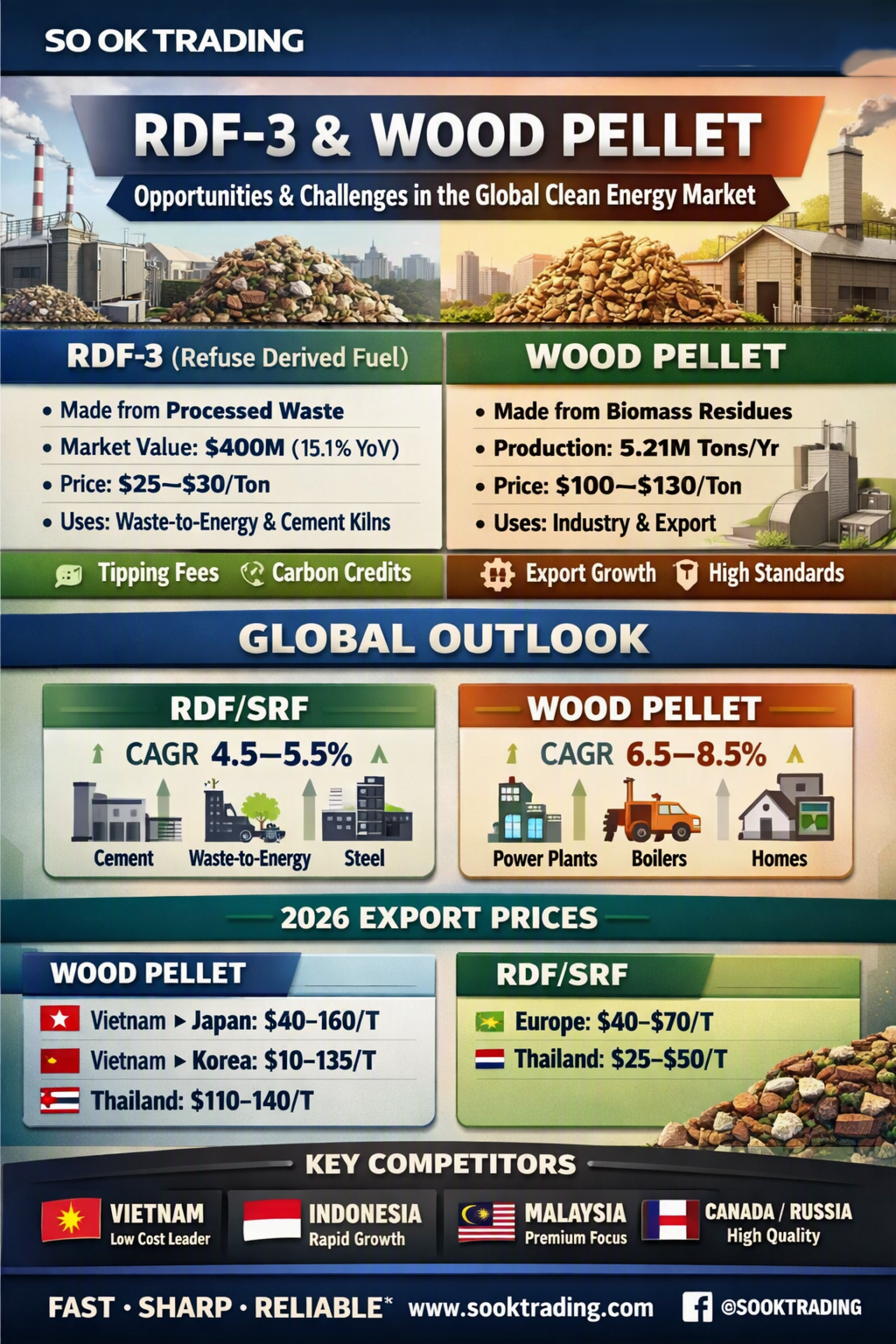
RDF‑3 & Wood Pellet: Opportunities and Challenges in the Global Clean Energy Market
SO OK TRADING | October 7, 2026
Introduction
As the world accelerates its Energy Transition to achieve the Net Zero Carbon goal, alternative fuels such as RDF‑3 (Refuse Derived Fuel) and Wood Pellet (biomass fuel) have become central to reducing reliance on coal and heavy fuel oil in both industrial and power generation sectors.
Driven by Thailand’s Net Zero 2065 policy, the Carbon Tax, and the EU’s CBAM (Carbon Border Adjustment Mechanism), businesses worldwide are being compelled to shift decisively toward clean energy — and Thailand is at the forefront of this transformation.
RDF‑3 (Refuse Derived Fuel)
Characteristics: Produced from municipal/industrial waste that has been sorted and finely shredded, offering stable calorific value.
Thai Market:
Market size: 14.5 billion THB, +15.1% YoY
Main users: Waste‑to‑Energy plants (64%) and cement factories (36%)
Price: 900–1,100 THB/ton (premium SRF: 1,300–1,600 THB/ton)
Business Opportunities: Dual revenue streams from tipping fees, fuel sales, and carbon credits.
Challenges: Inconsistent waste sorting quality and high transport costs.
Wood Pellet (Biomass Fuel)
Characteristics: Produced from rubberwood residues and agricultural by‑products.
Thai Market:
Production capacity: 5.21 million tons/year, +340.4% YoY
Main users: Industrial boilers in food, textiles, and agro‑processing sectors
Price: 3,500–4,500 THB/ton (average 4,100 THB/ton)
Business Opportunities: Strong export growth, especially to Japan, South Korea, and Europe.
Challenges: Strict EUDR regulations and FSC/PEFC certification requirements.
Global Outlook and Industry Trends
RDF/SRF
CAGR: 4.5–5.5% annually through 2032
Key buyers: Cement plants, Waste‑to‑Energy facilities, steel and chemical industries
Mega‑trend: Transition to high‑grade SRF and expansion of cross‑border trade
Wood Pellet
CAGR: 6.5–8.5% annually, market value projected to reach USD 20 billion by 2030–2032
Key buyers: Coal power plants (Co‑firing), industrial boilers, residential heating
Mega‑trend: Enforcement of strict sustainability standards (FSC, PEFC, SBP, EUDR)
Export Prices (2026)
Wood Pellet
Vietnam → Japan: USD 140–160/ton (peak demand ~USD 199/ton)
Vietnam → Korea: USD 110–135/ton
Thailand: USD 110–140/ton
RDF/SRF
Europe: USD 40–70/ton (premium SRF)
Thailand: 900–1,900 THB/ton (domestic use)
Key Regional Competitors
Vietnam: >60% share in Japan/Korea, cost‑leadership strategy
Indonesia: PKS + Wood Pellet, fastest growth in ASEAN
Malaysia: Premium market focus, long‑term contracts with Japanese firms
Russia/Canada: High‑quality supply
Conclusion
Both RDF‑3 and Wood Pellet are becoming vital alternative fuels in the clean energy era. RDF‑3 is best suited for domestic use, replacing coal in power plants and cement industries, while Wood Pellet holds strong potential for exports to Japan, South Korea, and Europe. If Thai producers can meet stringent environmental standards and differentiate on quality, they will secure access to premium markets and build long‑term business resilience.
✨ Key Strategy for Thailand: Compete not on price with Vietnam, but on “clean, 100% FSC/PEFC‑certified, traceable wood” to build trust and penetrate the global clean energy market sustainably.
✨ FAST • SHARP • RELIABLE SO OK TRADING — Your Trusted Business Partner in the Clean Energy Era www.sooktrading.com Facebook: SOOK TRADING