Share

“SO OK TRADING Analysis: Middle East Crisis OCT 2026 — From Ceasefire Rejection to Energy War and Global Economic Shockwaves in Oil, Gold, and Logistics”
Last updated: 5 Oct 2026
64 Views

Middle East Crisis 2026: From Ceasefire Rejection to Full-Scale War Risk and Global Economic Shockwaves
 
✨ Introduction As of October 5, 2026, the Middle East is entering one of its most critical turning points in decades. The United States, under President Donald Trump, has rejected Iran’s proposed 7‑day ceasefire plan, rapidly escalating tensions across diplomatic, military, and economic dimensions.

This confrontation between two major powers in the region not only threatens political stability but also sends shockwaves through oil prices, gold markets, and international logistics systems. Global markets are already reacting to the rising uncertainty day by day.

At a time when the world is closely watching the Strait of Hormuz — the vital artery of global energy trade — U.S. and allied maneuvers, along with Iran’s and the Houthis’ responses in Yemen, are becoming decisive factors for the global economy in the final quarter of 2026.

 
⚔️ Current Situation

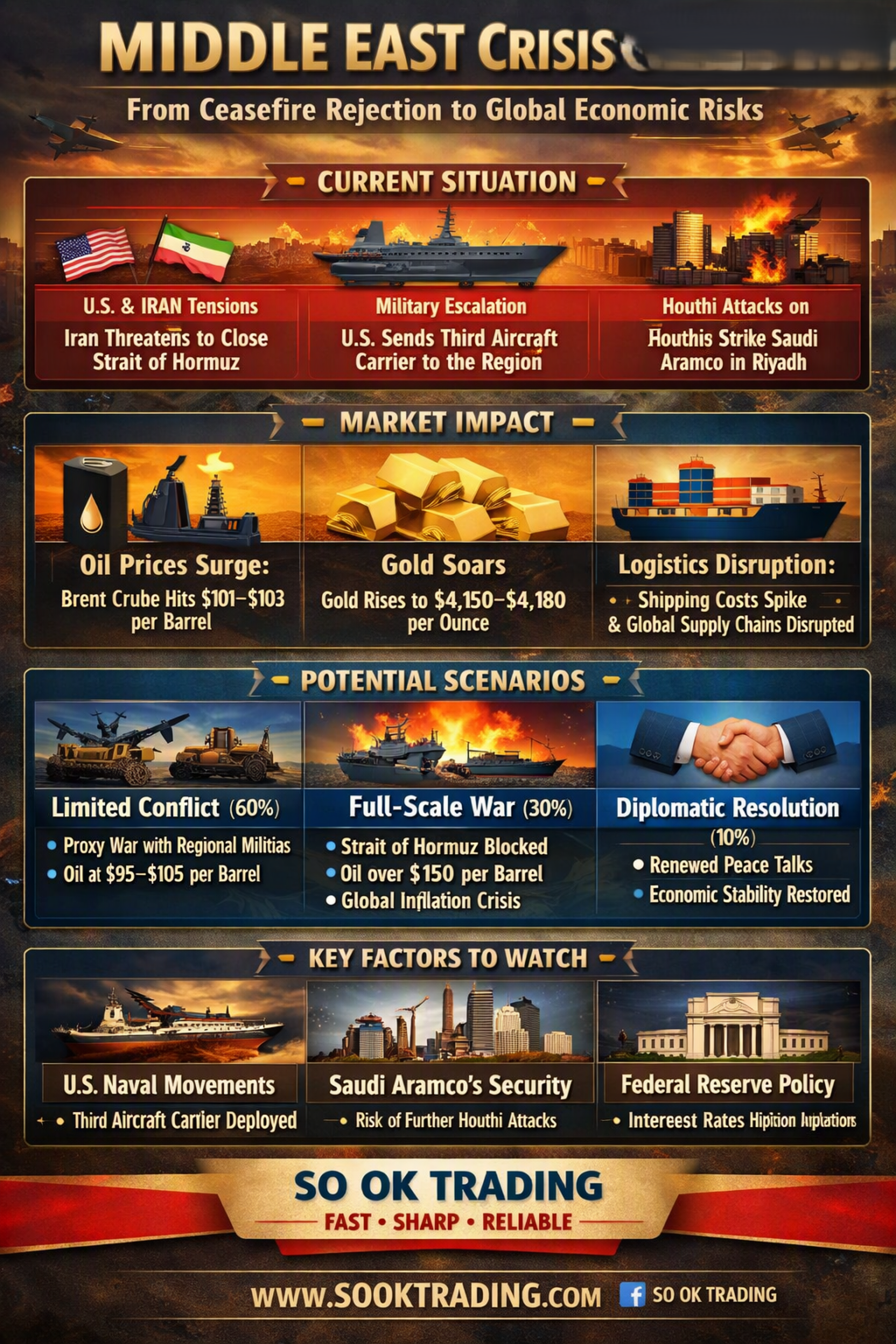
U.S.–Iran Diplomatic Breakdown: Iran has threatened to close the Strait of Hormuz if the U.S. continues military operations, a move widely seen as a declaration of “full‑scale war.”
U.S. Military Deployment: Vice President J.D. Vance convened an emergency meeting at Camp David, preparing to deploy a third aircraft carrier to the region by November.
Houthi–Saudi Arabia Frontline: Houthi rebels attacked Saudi Aramco’s refinery in Riyadh for the first time in four years. Saudi forces retaliated immediately, shaking energy security across the Arabian Peninsula.
 
⛽ Oil and Global Energy Markets

Brent Crude Surge: Prices rebounded above $100 per barrel (range $101–$103) despite G7’s emergency oil release.
Logistics Costs Rising: Exports through the Strait of Hormuz recovered to 18.5 million barrels/day, but insurance and freight premiums rose more than tenfold.
Supply Constraints: OPEC+ maintained production targets, while China temporarily halted refined‑oil exports.
Impact on Thailand: The Fuel Fund Committee raised domestic fuel prices by 0.75 baht per liter.


Related Content
“Post-Ceasefire World 2026: Gold Surges, Oil Plunges, Stocks Rally — 48 Hours That Shake Global Markets” — Article by SO OK TRADING, April 8, 2026
Post-Ceasefire World: A Turning Point for the Global Economy Following the announcement of a two-week temporary ceasefire between the United States and Iran, the world now stands at a critical crossroads. The upcoming peace talks in Pakistan may mark the first step toward lasting peace and the easing of sanctions that have long shaken the global economy. Oil prices have plunged more than 15%, gold has surged above $4,800 per ounce, the U.S. dollar has weakened, and global stock markets have entered Risk-on mode, with investor confidence returning. SO OK TRADING provides a comprehensive overview of the impacts on gold, stocks, currencies, and oil, along with insights into the opportunities and risks the world must watch closely over the next 48 hours. FAST • SHARP • RELIABLE Your trusted business partner — SO OK TRADING
8 Apr 2026
SO OK INSIGHT: Thailand Flood Crisis 2026 – Lessons from Nature Shaking the Foundations of the Thai Economy October 5, 2026
Flood Crisis 2026: When Nature Challenges Thailand’s Economic Structure SO OK TRADING | October 5, 2026 Thailand is facing one of the most significant flood events of the decade — a moment when nature becomes a major test for the country’s economic framework and water management systems, demanding resilience against sudden change. Persistent monsoon rains combined with cold air masses from China have triggered the phenomenon known as the “Three Waters”: Northern Runoff: The Chao Phraya Dam forced to discharge at 2,500 m³/s. Accumulated Rainfall: Heavy downpours intensifying waterlogged lowlands. Coastal Surge: High tides between October 5–10 slowing drainage into the Gulf of Thailand. Together, these factors have created immense natural pressure, leading to widespread flooding across more than 27 provinces in the North, Central, and Eastern regions. This analysis from SO OK TRADING explores the 2026 flood crisis in depth — from meteorological causes and current conditions to economic impacts and future outlook. It highlights that this flood is not merely a natural disaster, but a warning signal underscoring the urgent need for Thailand to strengthen its economic structure and resource management systems to withstand a rapidly changing world.
5 Oct 2026
“Thailand’s Corn Power: From Fields to Global Markets – In-Depth Corn Market Outlook 2026: Thailand on the World Stage  Article by SO OK TRADING”
Thailand’s Corn Industry: Global Market By SO OK TRADING Thailand is one of the world’s key players in the corn industry, contributing both to livestock feed and human consumption exports. Sweet corn, in particular, has secured Thailand’s position as the No.1 exporter worldwide. This infographic highlights the Thai–global corn market in five essential dimensions: - Feed Corn: 7 million rai cultivated, yet domestic output still falls short of demand. - Consumption Corn: Thailand leads in sweet corn exports, with potential expansion into bioplastics and textiles. - Cost & Environmental Challenges: High production costs, PM2.5 pollution, and new “No Burning” certification standards. - Imports: 3–4 million tons annually from Laos, Myanmar, and Cambodia, subject to moisture standards and strict traceability. - Market Prices: Bullish trend both domestically and globally (CBOT), signaling strong demand and tight supply.
21 Feb 2026
This website uses cookies for best user experience, to find out more you can go to our Privacy Policy and Cookies Policy
Powered By MakeWebEasy Logo MakeWebEasy