Share

“Super Week Reshaping Global Finance – Thai Baht Volatile and Weakening Under Pressure”
Last updated: 12 Sept 2026
164 Views

 CURRENCY & EXCHANGE RATE OUTLOOK

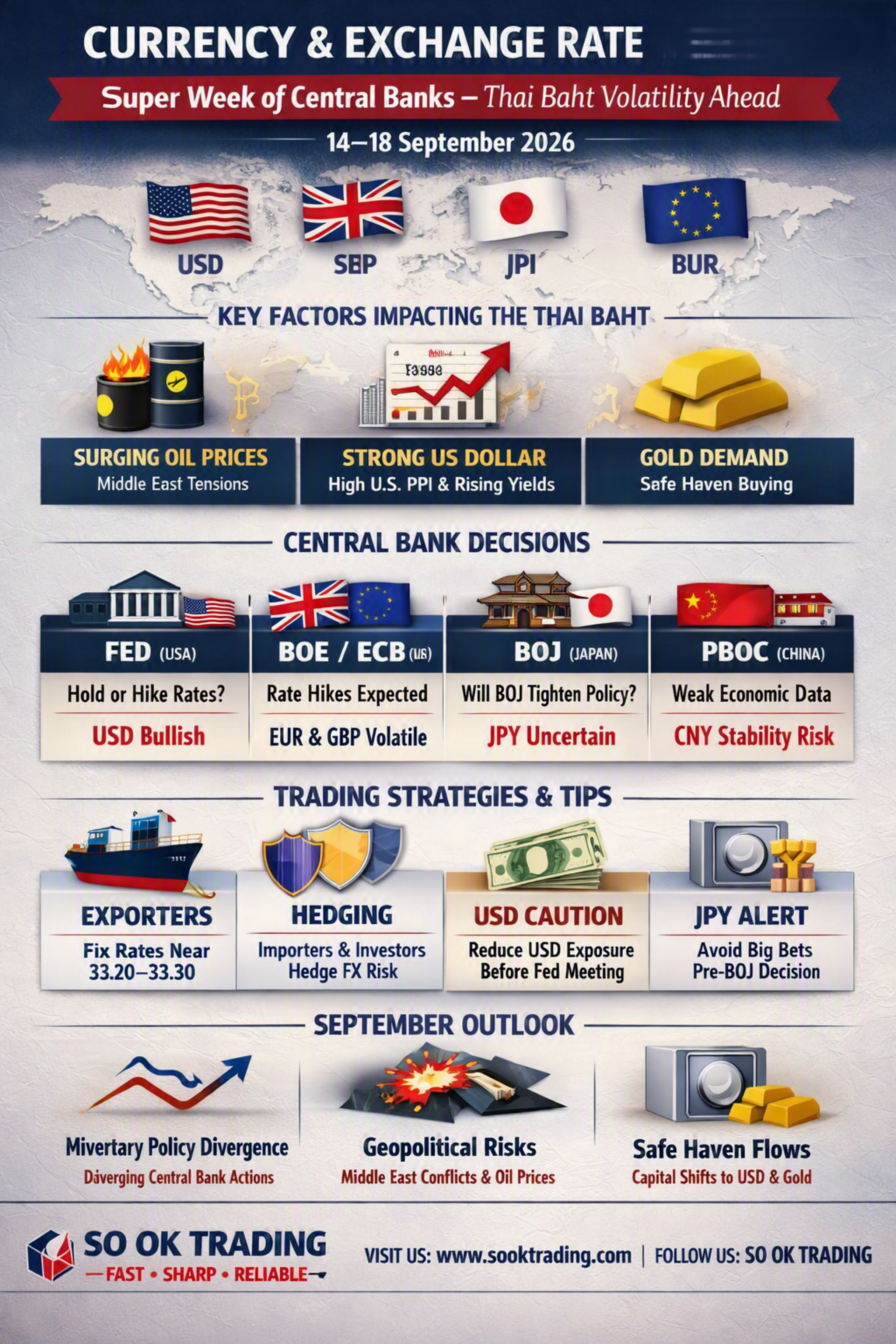
“Super Week of Global Central Banks – Thai Baht Volatile in a Weakening Range” SO OK TRADING | 14–18 September 2026

 
Introduction
September 14–18, 2026 has been dubbed the “Super Week” in global financial markets, as the world’s major central banks — the Federal Reserve (Fed), Bank of England (BoE), Bank of Japan (BOJ), and the European Central Bank (ECB) — convene simultaneously to decide monetary policy. These decisions will not only set the course for interest rates but also directly impact the U.S. Dollar Index (DXY) and the Thai Baht, which is currently under pressure on the weaker side.

 
Key Drivers & Currency Direction
Kasikorn Bank projects the Thai Baht to trade within 32.70–33.30 THB/USD during this week, with persistent depreciation pressure. The main factors include:

Oil Prices: Crude surging past $100/barrel due to Middle East tensions, weighing on Thailand’s trade balance.
U.S. Dollar Strength: Supported by stronger-than-expected August PPI and rising bond yields.
Gold Prices: Elevated levels provide partial relief, slowing Baht depreciation but not reversing the trend.
Regional Highlights:

United States (USD): Fed may hold rates high or hike again, keeping USD bullish.
Europe & UK (EUR, GBP): ECB’s recent hike already priced in; EUR remains vulnerable to USD strength. BoE’s decision and UK CPI are key.
Japan (JPY): BOJ meeting is a major risk. A rate hike would strengthen JPY sharply; a hold could trigger a USD/JPY rebound.
China (CNY): August data (new loans, industrial output, retail sales) will guide RMB sentiment.
 
Strategies for Businesses & Investors
Exporters: Consider locking exchange rates near 33.20–33.30.
Importers: Hedge early as Baht risks breaking resistance.
Foreign Investors: FX hedging is essential to protect returns.
USD Holders: Reduce exposure before Fed meeting; USD may strengthen further.
JPY Traders: Avoid large speculative bets ahead of BOJ decision.
 
Weekly Summary
This week marks a critical turning point of the year. Markets will shift from speculation to reality once central bank decisions are announced. The Thai Baht is expected to remain volatile and weak, while the U.S. dollar may strengthen in the short term. Businesses and investors must adopt robust risk management strategies, especially those engaged in international trade and cross-border investments.

 
September 2026 Outlook – Global Rebalancing
The entire month of September is defined by “Global Rebalancing”, driven by three key forces:

Monetary Policy Divergence: Fed remains hawkish due to inflation, while Asia and Europe pursue differing paths.
Geopolitical Risks: Middle East tensions push oil prices higher, pressuring Asian currencies including the Baht.
Fund Flows & Safe Havens: Capital continues to flow into USD and gold, leaving emerging market currencies under stress.
Forecasts:

THB/USD: 32.50–33.50 range, with mild rebound possible if gold rallies.
DXY: 98.50–100.50 range, supported by bond yields and inflation.
EUR & GBP: Sensitive to USD strength.
JPY & CNY: Key drivers of Asian sentiment.
 
✨ Strategic Takeaway: September 2026 will be a month of heightened volatility. Exporters, importers, and investors should adopt proactive hedging strategies and maintain flexible positioning. The Baht remains under depreciation pressure but may see short-term rebounds depending on gold prices and central bank outcomes.

 
SO OK TRADING — FAST • SHARP • RELIABLE Visit: www.sooktrading.com Follow: SO OK TRADING (Facebook)

Related Content
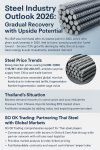
Steel Industry Outlook 2026: Gradual Recovery with Rising Price Potential BY SOOK TRADING
Steel Industry Outlook 2026: Gradual Recovery with Rising Price Potential The year 2026 marks a turning point for the global steel industry. After hitting its lowest point in 2025, the market is entering a “new equilibrium,” with demand gradually recovering and prices showing signs of stable upward movement. Global steel demand is forecast to grow 1.3%, reaching 1,773 million tons. India will be the main driver, with growth of 9% fueled by infrastructure investments in roads, railways, and energy. The United States and Europe are also expected to recover steadily, supported by interest rate cuts, clean energy projects, and the automotive sector—1.8% growth in the US and 3.2% in the EU. China, while still facing a slowdown in real estate, will see demand decline ease to -1%, supported by infrastructure projects and steel exports. Meanwhile, Southeast Asia and the Middle East are expected to contribute to diversified demand growth through infrastructure and energy investments. On the pricing side, steel bars (Rebar) are expected to average 16,000–17,000 THB/ton (450–530 USD/MT). Iron ore costs are projected at 83–95 USD/ton, with new supply from Guinea and Australia helping to stabilize input costs. Although trade barriers in the US and EU may keep domestic prices above global levels, the market is moving toward a more stable balance. In Thailand, steel demand is expected to grow modestly, driven by construction and automotive industries, with a base of 16.2 million tons in 2025. However, cheap Chinese steel could account for up to 50% of the market, putting pressure on local producers. Thai businesses must adapt by developing value-added specialty products, enhancing quality standards, and targeting premium and niche export markets such as ASEAN, the Middle East, and Africa. SO OK Trading: Partnering Thai Steel with Global Markets SO OK Trading supports Thai steel producers with comprehensive solutions: - Market Connectivity: Linking Thai producers with buyers in China and East Asia through an extensive partner network and integrated rail–sea–road logistics. - Market Analysis & Pricing Strategy: Providing insights into steel and iron ore price trends, with index-linked pricing recommendations to reduce volatility. - Stable Contracts & Compliance: Assisting in contract structuring, export documentation, standards, and certifications to ensure reliable trade. - Customer Development: Delivering tailored technical and commercial proposals to meet the needs of Chinese buyers seeking specialty steel. SO OK Trading is more than an exporter—it is a trusted business partner, helping Thai steel enterprises compete with stability and sustainability in the global steel market.
15 Jan 2026
Global Markets Risk-Off – THB Breaks 33, JPY Safe Haven Surge, USD Weakness: A Week of Volatility SO OK TRADING | 10 AUG 2026
Global Markets Risk-Off – THB Strength, JPY Safe Haven, USD Weakness 10–14 August 2026: Weekly Currency Outlook By SO OK TRADING This week, global markets have fully entered a Risk-Off mode. Weak U.S. labor data triggered a sharp decline in the U.S. Dollar, while investors shifted into safe-haven assets such as the Japanese Yen and Gold. Meanwhile, the Thai Baht broke below 33 THB/USD, marking its strongest level in six weeks. Global fund flows are shifting direction: investors are reducing exposure to high-risk technology stocks and reallocating into safer assets. The Thai equity market remains range-bound, though refinery and export sectors continue to benefit from elevated oil prices. In this article, SO OK TRADING provides a comprehensive overview of major currencies (USD, EUR, GBP, JPY, CNY, AUD), along with short-term outlooks and strategies for importers, exporters, and investors seeking to adjust portfolios amid heightened volatility in mid-August. SO OK TRADING — FAST • SHARP • RELIABLE
10 Aug 2026
“Aluminum Heats Up! MJP Surges to a 11-Year High – Tracking Premiums and Global Prices in Q3/2026 as Supply Tightens, Thailand Must Adapt | SO OK TRADING Global Aluminum Market Analysis” 11 JUNE 2026
Aluminum Heats Up! MJP Premium Set to Reach a New High Again in Q3/2026 The global aluminum market remains red-hot — Japan’s MJP Premium is expected to surge to a new 11-year high, while LME Cash Price holds firm at $3,450–$3,700/MT, up more than 19% since the start of the year! Supply disruptions in the Middle East, Guinea’s bauxite export restrictions, and Europe’s CBAM policy are driving the global metals market into a true era of “tight supply.”
11 Jun 2026
This website uses cookies for best user experience, to find out more you can go to our Privacy Policy and Cookies Policy
Powered By MakeWebEasy Logo MakeWebEasy