Global Oil Market on Fire! Geopolitical Forces Driving Prices — Oil Market Insight 2026 by SO OK TRADING: FAST • SHARP • RELIABLE | September 3, 2026
Deep Dive into Global Oil Prices (September 3, 2026) : SO OK TRADING
September 3, 2026
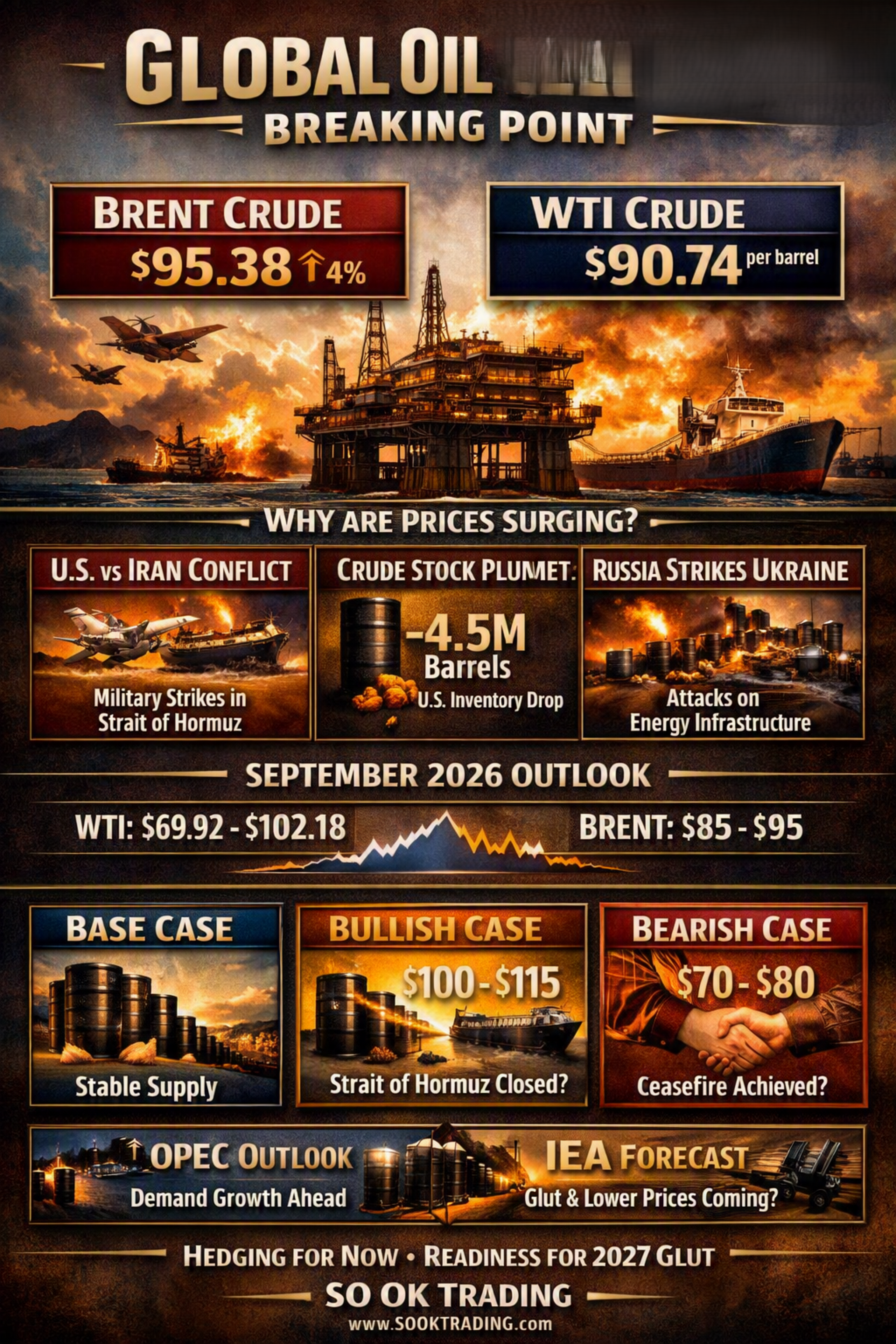
The global oil market is filled with tension and volatility, clearly reflected in crude prices. Brent crude surged nearly 4% to $95.38 per barrel, while WTI held steady at $90.74 per barrel. Despite a slight dip from the previous day, the overall atmosphere remains a “heated market,” dominated by geopolitical factors.
Why Are Oil Prices Surging?
The driving force behind this spike is the renewed military clashes between the U.S. and Iran. The U.S. launched strikes on Iran’s southern coast, while Iran retaliated by attacking U.S. bases. This conflict has drawn global attention to the Strait of Hormuz, a critical route for over 20% of the world’s oil shipments. If this passage is blocked, prices could easily soar to $110–$120.
Additionally, U.S. crude inventories fell by 4.5 million barrels, far more than expected, providing strong upward momentum. At the same time, Russia continues to strike Ukraine’s energy infrastructure, adding further pressure to global supply.
September 2026 Outlook
Analysts expect prices to remain elevated throughout September:
WTI: $69.92 – $102.18
Brent: $85 – $95
The main driver is Middle East tension, but U.S. monetary policy also plays a role. The Fed is likely to raise interest rates to combat inflation, strengthening the dollar and putting downward pressure on commodities.
Possible Scenarios for Q4/2026
Base Case: Brent holds at $85 – $95, with military protection ensuring safe transport.
Bullish Case: If negotiations fail and the Strait of Hormuz is closed, Brent could surge to $100 – $115.
Bearish Case: If a ceasefire or peace talks succeed, Brent may drop to $70 – $80.
OPEC vs IEA Perspectives
OPEC: Optimistic, expecting demand growth and predicting 2027 as a year of major recovery, with prices staying high to benefit exporters.
IEA: Pessimistic, forecasting oversupply. By 2027, global production may exceed 110 million barrels/day, pushing Brent down to an average of $69.
Financial Institutions’ View
Echoing the IEA, J.P. Morgan cut its Brent forecast for late 2026 from $95 → $78 per barrel, citing weaker-than-expected Asian demand and limited OECD stockpile drawdowns.
Strategy for Businesses
Short-term: Hedge against sharp price swings driven by war headlines.
Long-term: Prepare for lower energy costs in 2027 as the market faces oversupply.
When Will the Strait of Hormuz Stabilize?
Sep–Nov 2026: Tensions remain high, U.S.–Iran clashes continue.
Dec 2026 – mid-2027: U.S. naval escorts improve transport safety, though not fully calm.
2028 onward: Alternative pipelines completed, Iran loses leverage, and lasting stability returns.
✍️ Conclusion
In 2026, global oil prices are driven by geopolitical risk premiums, especially the conflict in the Strait of Hormuz. But by 2027, the world will face a new reality — oversupply, which will exert clear downward pressure on prices.
SO OK TRADING : Your Business Partner FAST • SHARP • RELIABLE www.sooktrading.com Facebook: SO OK TRADING