“Antimony: The Strategic Mineral of the Future — Transforming Global Industry and Driving Clean Energy from Thailand’s Border” Insight by SO OK TRADING | September 2, 2026
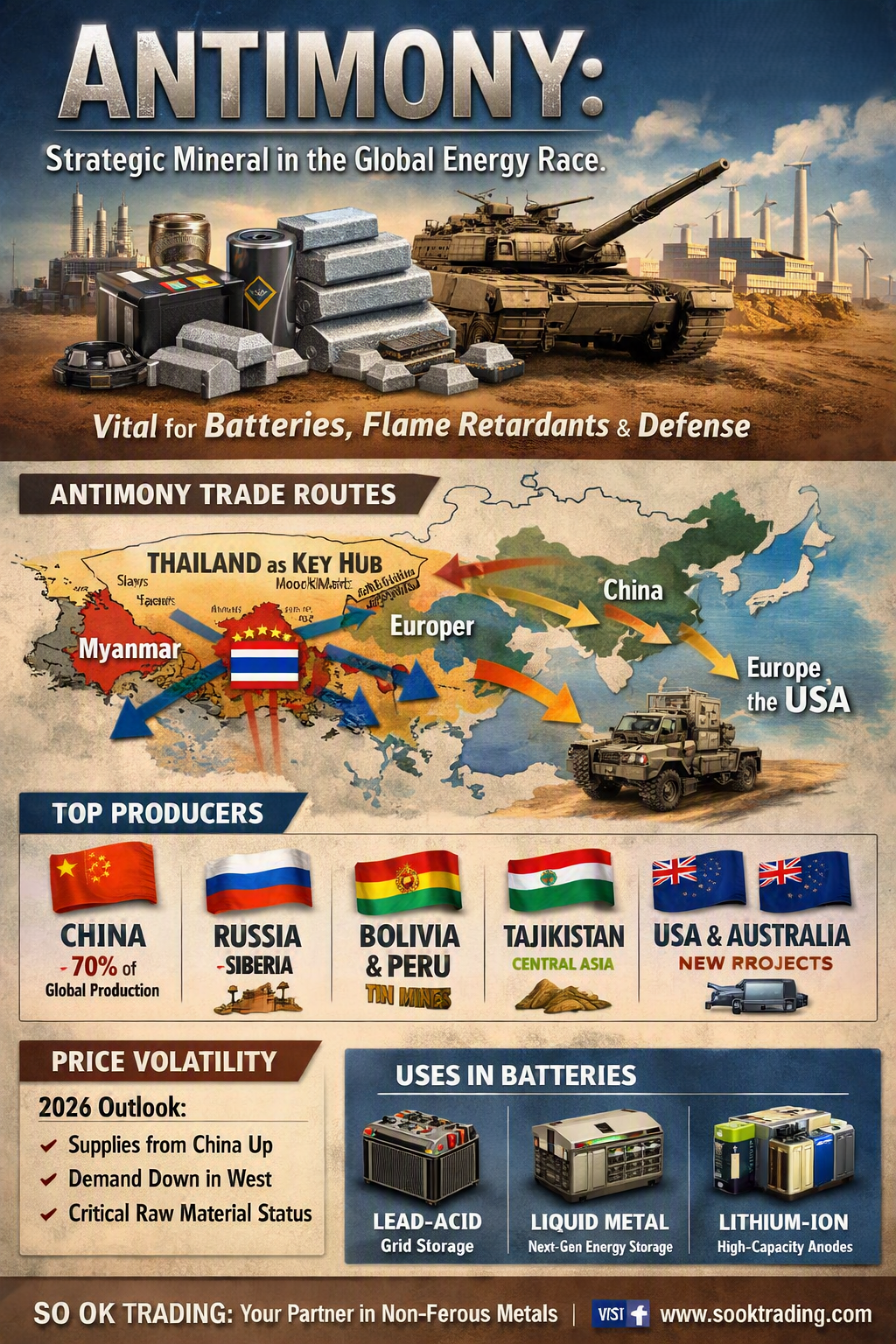
Antimony: Strategic Mineral from Thailand’s Border to the Global Clean Energy Battlefield
From Thailand to the World Market — Clean Energy and Military Security SO OK TRADING | September 2, 2026
Introduction
Antimony is being elevated from a basic mineral to a strategic resource with critical roles in both clean energy industries and national defense. Surging demand from next-generation batteries, flame retardants, and military applications has turned Antimony into a resource fiercely contested by global powers. Although Thailand does not possess primary Antimony mines, it plays a vital role as a hub for imports and processing from Myanmar and Laos, supplying the global market.
Outlook and Price Trends
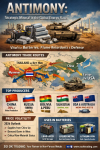
Antimony ingot prices soared to a record high in 2025, exceeding USD 59,000 per ton in the European market amid concerns over China’s export restrictions. By 2026, however, prices corrected sharply, now ranging between USD 13,000 – 28,000 per ton.
China: Prices fell fastest as raw ore imports surged over 200%, easing supply.
Europe & USA: Demand slowed as battery and flame-retardant producers reduced stockpiling.
Thailand: Prices fluctuated in line with China but retained a border-transport premium.
Despite the correction, prices are expected to remain elevated over the next 6–12 months. Antimony is classified as a Critical Raw Material, tightly controlled under China’s Whitelist Policy. Geopolitical tensions and trade wars will continue to drive volatility.
Thailand’s Import Landscape
Myanmar: Key sources include areas opposite the Three Pagodas Pass (Sangkhlaburi, Kanchanaburi), as well as Kayin, Shan, and Kayah States.
Laos: Major deposits are found in Vientiane (Sangthong), Luang Prabang–Houaphan, and Khammouane–Bolikhamsai.
Trade: Thailand imports hundreds of tons of raw Antimony ore annually for domestic processing.
Regulation: Imports require permits from the Department of Primary Industries and Mines to prevent smuggling.
Myanmar vs Laos
Myanmar: Mines concentrated along the western border, dominated by local capital and Thai–Chinese traders. Ore is mostly hand-sorted raw material.
Laos: Mines in the north and central regions, controlled by Chinese and Vietnamese investors. Production includes both raw ore and refined ingots, transported to China or exported via Vietnam.
Antimony Mining in Thailand
Thailand has virtually no new Antimony mines due to environmental concerns and licensing challenges. Domestic factories focus on processing imported ore into Antimony Oxide and ingots, which are then exported to the US and global markets. Thailand has thus become a key midstream processing hub, especially as China tightens export controls.
Role in Battery Industries
Lead-Acid Batteries: Antimony strengthens electrode grids and extends lifespan.
Liquid Metal Batteries: Antimony serves as a cathode material, ideal for city-scale energy storage.
Next-Generation Lithium-Ion Batteries: Antimony is being developed as a high-capacity, fast-charging anode material.
Global Antimony Sources
China: Dominates with over 70% of global production.
Russia: Reserves in Siberia and the Far East.
Bolivia & Peru: Co-production with tin and copper mines.
Tajikistan: Major exporter in Central Asia.
USA & Australia: Investing in new projects to reduce reliance on China.
Conclusion
Antimony is no longer just a basic raw material — it has become a strategic mineral linking economic growth, clean energy, and military security. Thailand, as an import and processing hub, plays a pivotal role in the global supply chain. With China’s strict export controls, Southeast Asia is emerging as a critical resource region under close global watch.
Looking ahead, Antimony prices will remain highly volatile due to geopolitical factors and supply constraints. Yet, demand from Liquid Metal Batteries, next-generation Lithium-ion batteries, and the defense industry ensures that Antimony will remain a mineral the world cannot ignore.
SO OK TRADING Your trusted partner in strategic non-ferrous metals FAST • SHARP • RELIABLE www.sooktrading.com Facebook: SO OK TRADING