“Metal Revolution: Non-Ferrous Metals Driving Thailand’s Economy 2026–2032 into the Era of Clean Energy • EV • AI • Circular Economy”: SO OK TRADING | 31 AUG 2026
Thailand Economy 2026–2032: Non-Ferrous Metals and the Transition to the Clean Energy & Digital Era
SO OK TRADING | FAST • SHARP • RELIABLE August 31, 2026
Introduction Thailand’s economy in 2026 is projected to grow only 1.6%–2.2%. Yet the real story lies not in GDP figures but in the ongoing “structural transformation”: the shift to clean energy, the expansion of electric vehicles (EVs), and investments in digital/AI infrastructure. Within this context, five non-ferrous metals—aluminum, copper, zinc, lead, and antimony—play a critical role in linking Thailand’s economy to global megatrends.
⚡ Aluminum: The Star of EVs and Circular Economy Aluminum is emerging as the “core material” of Thailand’s new industries.
Drivers:
High-pressure die-cast (HPDC) components essential for EV lightweighting
Solar power structures and high-voltage cables
Eco-friendly packaging based on closed-loop recycling
Demand Trends:
OEMs and parts manufacturers shifting to high-quality aluminum
Scrap recycling as a key to cost reduction and carbon footprint mitigation
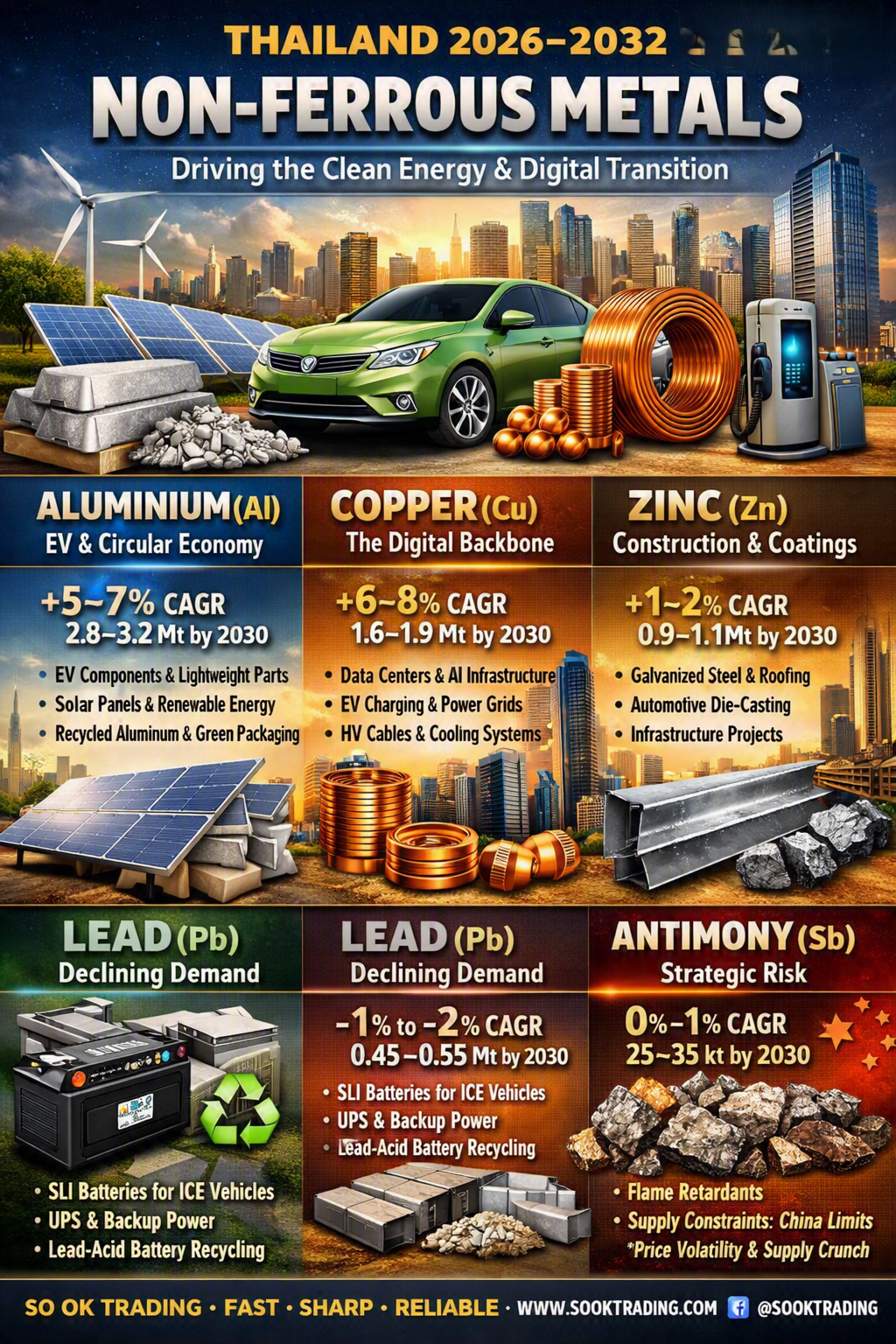
Forecast: 2.8–3.2 million tons by 2030, CAGR 5–7%
Copper: The Backbone of the Digital Economy Known as “Dr. Copper,” it reflects global economic health. In Thailand, copper anchors the green economy and AI infrastructure.
Drivers:
Cooling and power distribution systems in hyperscale data centers
EV charging infrastructure, smart grids, high-voltage transmission networks
HVAC and cooling industries
Demand Trends:
Copper cathode imports remain high
Scrap market growing 7.6% annually, fierce competition for Bare Bright
Forecast: 1.6–1.9 million tons by 2030, CAGR 6–8%
️ Zinc: Stable Demand in Construction and Anti-Corrosion Over 70% of Thailand’s zinc is used in galvanized steel for anti-corrosion.
Drivers:
Recovery in real estate and mega-projects
New industrial standards (MOK) strengthening quality benchmarks
Automotive parts (zinc die-cast)
Demand Trends:
Growth aligned with construction index
Forecast: 0.9–1.1 million tons by 2030, CAGR 1–2%
Lead: Survival in an Era of Replacement Global lead demand is declining, but Thailand still requires it in certain industries.
Drivers:
~40 million internal combustion vehicles needing SLI batteries
Backup power systems such as UPS
Domestic supply from recycled batteries
Demand Trends:
Expanding investment in closed-loop recycling plants
Shrinking demand as ICE vehicles decline
Forecast: 0.45–0.55 million tons by 2030, CAGR -1% to -2%
⚠️ Antimony: A Strategic Metal with Supply Risks Antimony is the non-ferrous metal with the highest geopolitical risk in 2026.
Drivers:
Used as flame retardant in plastics, cables, and car seats
Export restrictions from China driving price surges
Demand Trends:
Exploration of halogen-free/antimony-free substitutes
Rising costs pushing up end-product prices
Forecast: 25,000–30,000 tons by 2030, CAGR 0–1% (high price volatility)
Conclusion Thailand’s non-ferrous metals industry is entering the era of “Green & Strategic Shift.”
Aluminum & Copper: Rapid growth driven by EVs and data centers
Zinc: Stable growth supported by construction demand
Lead: Declining but sustained through recycling markets
Antimony: Facing supply shortages and price volatility
Thai companies must secure sustainability and global competitiveness through recycling, cost risk management, and development of alternative materials.
SO OK TRADING — Thailand’s True Partner in Non-Ferrous Metals Business www.sooktrading.com Facebook: SO OK TRADING FAST • SHARP • RELIABLE