“Premium Aluminum: Global Market Battle from China to the World — SO OK TRADING Insight Opening New Perspectives on the Aluminum Industry” : August 30, 2026
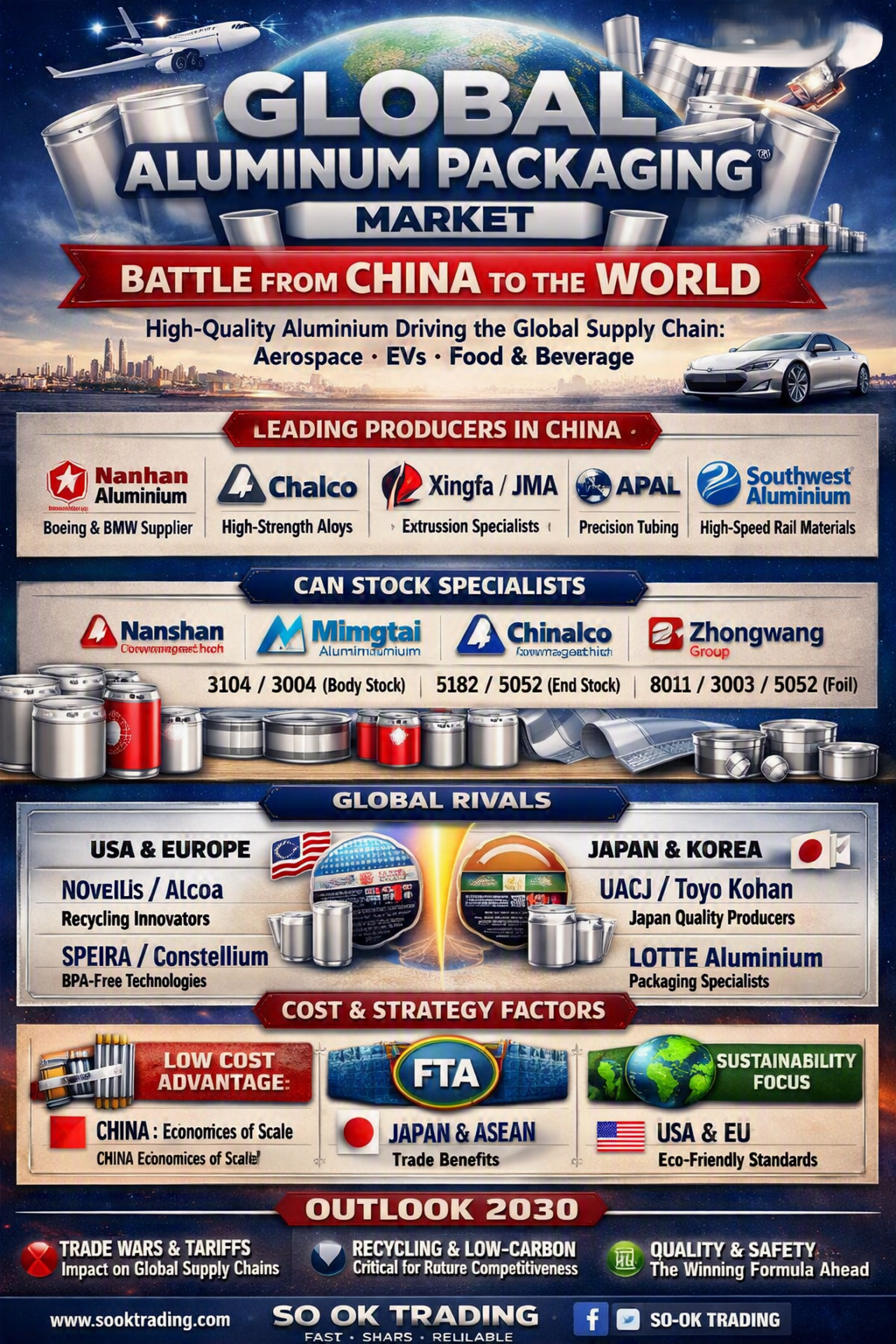
Aluminum for Packaging Industry: Global Market Battle from China to the World
SO OK TRADING | August 30, 2026
Introduction
High-quality aluminum has become the backbone of the global supply chain, spanning aerospace, electric vehicles (EVs), and food & beverage packaging. The demand for materials that are strong, lightweight, and safe for consumers continues to rise.
China has emerged as the leader in cost efficiency and massive production capacity, while manufacturers in Japan, Thailand, Europe, and the United States maintain their advantage through strict quality standards and advanced innovation. As a result, the global aluminum market is now a stage for strategic competition between cost, quality, and sustainability.
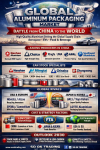
Leading Producers in China
Top manufacturers certified under international standards such as IATF 16949 (Automotive) and AS9100 (Aerospace) include:
Shandong Nanshan Aluminium – Fully integrated, globally recognized, supplier to Boeing, Airbus, BMW, Volkswagen
Chalco (Aluminum Corporation of China) – State-owned giant, specializing in high-strength alloys
JMA Aluminium / Guangdong Xingfa – Experts in extrusion profiles for architecture and industry
APAL – Leader in precision aluminum tubing for thermal systems
Southwest Aluminium (Group) – Strategic supplier for high-speed rail and aerospace
Can Stock Specialists in China
Nanshan Aluminium – Produces 3104/3004 (can body), 5182/5052 (can lid)
Henan Mingtai Aluminium – High cost-efficiency and large-scale capacity
Chinalco Henan Luoyang / Southwest Aluminium – High-purity materials, reducing fracture rates
Zhongwang Holding – Ultra-large rolling mills, ideal for high-speed production lines
Key Alloy Grades
Can Body: 3104 / 3004
Can Lid: 5182 / 5052
Tab: 5182
Food Can/Foil: 8011 / 3003 / 5052
Global Producers Outside China
United States
Novelis / Ball Metalpack – Pioneers in closed-loop recycling
Alcoa – Giant in low-carbon aluminum innovation
Europe
Speira (Germany/Norway) – Strict BPA-Free standards, high precision
Constellium (France) – Leader in lightweighting technology
Asia-Pacific
UACJ (Japan/Thailand) – Thai production base, guaranteed Japanese quality
Toyo Kohan (Japan) – Specialists in easy-open ends and laminated aluminum
LOTTE Aluminium (South Korea) – Strong in thin foil and food packaging
Cost Structure and Pricing
Global Pricing Formula:
All−inPrice=LMEBasis+RegionalPremium+ConversionCost
China: Conversion Cost $450–650/ton (economies of scale, vertical integration)
Japan/Thailand: $700–900/ton (FTA duty-free advantage)
Europe/USA: $850–1,100+/ton (strict standards, sustainability image)
Hidden Cost Factors
Anti-Dumping Duties (China faces up to 50% in the US)
FTA Benefits (Thailand–ASEAN duty-free)
Technical Support (Japan/US suppliers provide on-site assistance)
Outlook: High-Quality Aluminum Market Trends
China: Maintains cost advantage but faces anti-dumping and trade war pressures
Japan/Thailand: Benefit from FTA and strict QC, ideal for ASEAN markets
Europe/USA: Higher costs but differentiated by sustainability and food safety
Global Trend: Recycling and low-carbon innovation will be decisive; manufacturers combining quality + sustainability will dominate the future
Conclusion
Choosing a high-quality aluminum supplier is not just about price — it requires balancing cost, quality, and trade risks.
For low cost and massive supply → China is the answer
For quality and legal stability → Japan, Thailand, Europe, and the US are stronger choices
In the long run, sustainability and food safety will determine the winners in the global aluminum market
✨ SO OK TRADING — FAST • SHARP • RELIABLE Your trusted partner in the Aluminum for Packaging Industry www.sooktrading.com Facebook: SO OK TRADING