Share

“Copper Cathode 2026: The Strategic Metal Transforming Global Supply Chains and Powering the Future of AI & EV” Insight by SO OK TRADING | 8 AUG 2026
Last updated: 8 Aug 2026
1959 Views

Copper Cathode: The Strategic Metal of the Future
SO OK TRADING | 8 AUGUST 2026

 
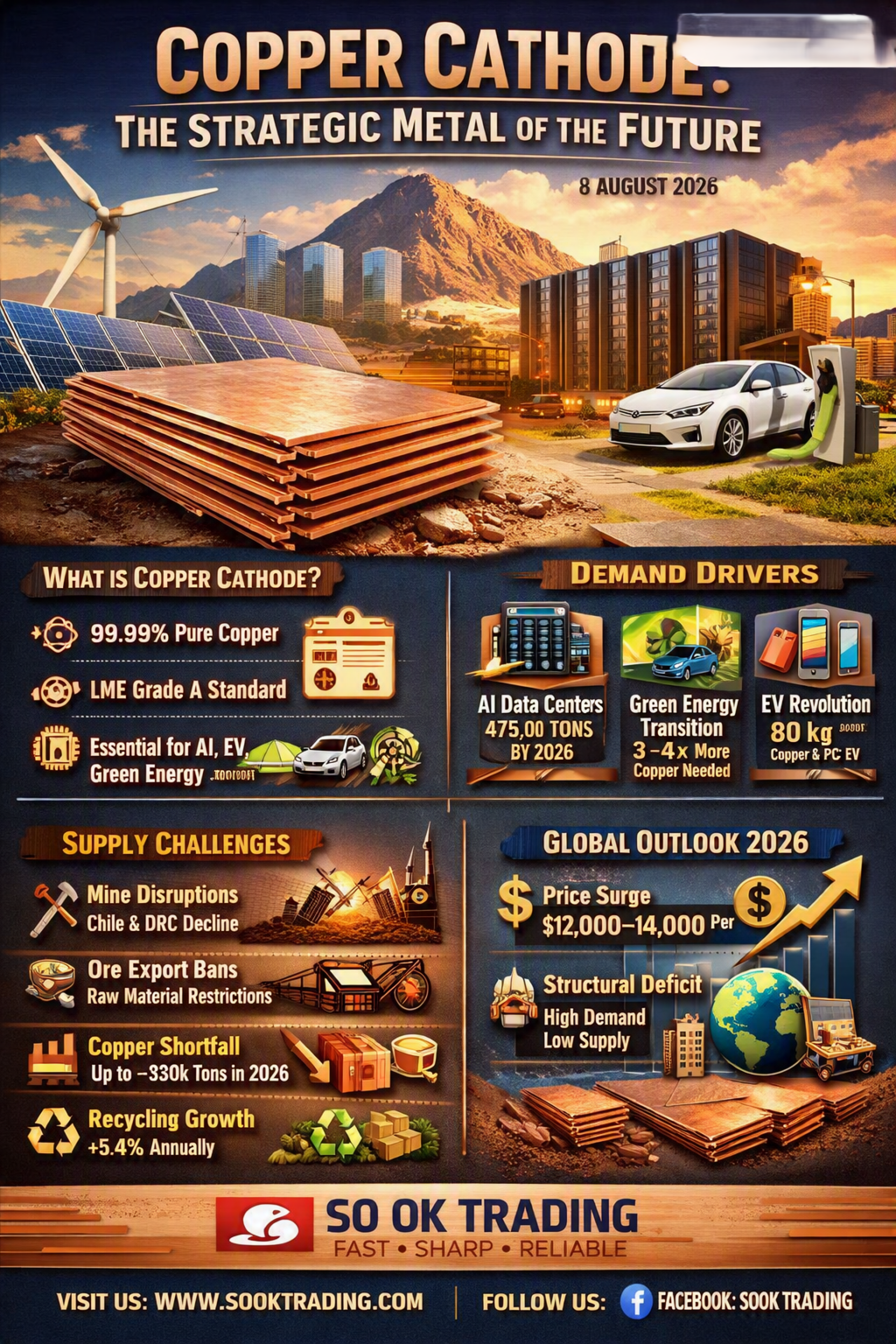
Copper Cathode is a sheet of copper with purity reaching 99.99%, produced through the electrolysis process. This ensures ultra-clean copper, free from impurities, ready to be used in modern industries — from electrical wiring and electronic devices to electric vehicles. Its key strengths include excellent electrical and thermal conductivity, high ductility, and strong resistance to corrosion.

Copper is no longer just an ordinary industrial metal. It is rapidly becoming a “strategic metal” driving the global digital economy and clean energy transition.

 
⚙️ LME Grade A: Gateway to the Global Market
Copper Cathode trading worldwide must comply with LME Grade A standards, requiring minimum purity of 99.99% and strict impurity limits (e.g., lead ≤ 5 ppm, sulfur ≤ 15 ppm). Physical specifications include sheet size 914×914 mm, thickness 10–12 mm, average weight ~125 kg, and minimum delivery lots of 25 tons — ensuring efficient transport and storage in commodity warehouses.

 
Pricing Structure and Premiums
The actual transaction price, known as the All-in Price, consists of the LME/CME benchmark plus premiums or discounts reflecting logistics, taxes, and local demand.

In 2026, premiums surged to record highs:

Europe: $315–345/ton
China: $335–350/ton (spot discounts possible)
US Midwest: highest globally
Southeast Asia: $70–120/ton, rising in line with global markets
 
Demand: Copper’s Soaring Role
Global megatrends are driving unprecedented demand:

AI Data Centers: projected consumption of 475,000 tons in 2026
Green Energy Transition: wind and solar require 3–4x more copper than fossil fuels
EV Revolution: each EV uses ~80 kg of copper, far more than conventional cars
Electronics: smartphones, computers, and PCBs all rely on high-purity copper
 
Supply: Constraints and Challenges
On the supply side, challenges are mounting:

Declining ore grades in major mines in Chile and Peru
Export bans on raw ore from countries such as the DRC
Large-scale mine disruptions, causing shortages of 100,000–330,000 tons in 2026
Growth in copper recycling, expanding at ~5.42% annually
 
Global Outlook 2026
The copper market faces a structural deficit, with prices soaring to $12,000–14,000/ton. Key drivers include AI data center expansion, clean energy transition, and mining constraints. Secondary copper (recycling) is emerging as a critical solution to ease shortages.

 
Thailand: EV and Clean Energy Hub
Thailand has no upstream copper mines and relies 100% on imports. Yet it plays a vital role in midstream and downstream industries such as busbar production, wiring, and EV components.

Market size: ~$1.4 billion, growing 5.5–8.5% annually
EV hub of ASEAN: each EV requires 3–4x more copper than gasoline cars
Infrastructure projects — high-speed rail, EV charging stations, solar farms — are boosting copper demand
 
Conclusion and Recommendations
2026 marks the transformation of Copper Cathode from a standard industrial metal into a strategic asset, as vital as oil or semiconductors.

For Thai businesses:

Manage price risks through hedging and forward contracts
Build partnerships with domestic copper recycling supply chains to reduce costs
Recognize Copper Cathode not merely as “raw material,” but as the core of the new economy, powering AI, EVs, and clean energy
 
SO OK TRADING: Your Trusted Business Partner ⚙️ FAST • SHARP • RELIABLE Visit us: www.sooktrading.com Follow us: Facebook | SO OK TRADING




Related Content
“SO OK TRADING Presents the Aluminum Ingot Perspective: The Strategic Metal Driving the Future of Thai and Global Industries” : 17 AUG 2026
Aluminum Ingot — The Strategic Raw Material Driving Modern Industry From clean energy and electric vehicles to consumer electronics and packaging, aluminum stands as the essential metal behind today’s innovations. With its unique properties — lightweight, highly conductive, corrosion-resistant, and infinitely recyclable — aluminum has become a strategic material recognized worldwide. SO OK TRADING invites you to explore the world of Aluminum Ingot — a raw material that is rapidly becoming the cornerstone of the clean energy economy and the industries of the future, along with strategic insights into opportunities in Thailand and across ASEAN.
17 Aug 2026
ALUMINUM PRICE TREND 2026
An analysis of the aluminum market in 2026 indicates a likely continued market deficit and upward price pressure, driven by constrained supply and resilient demand from green energy sectors. However, significant volatility is expected due to policy uncertainties and the potential for new Indonesian supply to eventually balance the market. Key Drivers and Projections for 2026 Supply Side Analysis Capacity Constraints: China's primary aluminum output is approaching its self-imposed 45 million-tonne capacity cap, limiting global supply growth. Power Challenges: Smelters outside of China face intense competition for power from energy-intensive sectors like AI data centers, which are willing to pay higher prices for long-term contracts. This has kept significant capacity offline in Europe and the US. Production Disruptions: Outages and potential shutdowns at existing smelters in Iceland and Mozambique further tighten the market. Scrap Supply Pressure: The EU's planned implementation of the Carbon Border Adjustment Mechanism (CBAM) and potential scrap export tariffs in spring 2026 are expected to impact global scrap flows, creating regional shortages and price volatility. New Capacity: Indonesia is a key source of new supply, with several projects in the pipeline. However, analysts suggest the pace of the ramp-up may be slower than expected due to infrastructure and policy challenges, meaning it is unlikely to fully offset near-term tightness. Demand Side Analysis Green Transition Demand: Demand from "green" sectors such as solar panels, new energy vehicles, and energy transition infrastructure remains strong, providing fundamental support for the market. Substitution Effect: Aluminum's wide price discount relative to copper has encouraged substitution in electrical applications, acting as a tailwind for demand and prices. Construction and Automotive: The construction and automotive industries continue to be major consumers, with growing demand for lightweight, low-carbon aluminum products. Price Forecasts and Volatility The market is expected to remain in a deficit in 2026, with estimates ranging from 200,000 to 600,000 tonnes. This structural tightness is leading most analysts to forecast sustained or rising prices. Bullish Views: Analysts at Bank of America project prices of $3,000/tonne as early as 2026. J.P. Morgan also expects prices to approach $3,000/tonne in Q1 2026. ING forecasts an average price of $2,900/tonne for the year. Bearish/Conservative Views: Goldman Sachs is an outlier, forecasting prices to decline to $2,350/tonne by Q4 2026, anticipating a market surplus later in the year. SMM forecasts a "high first, then lower" pattern, with prices finding equilibrium in the $2,700–$2,800/tonne range by year-end. Premiums: Regional premiums, particularly the US Midwest premium, are expected to remain high and volatile due to tariffs and regional supply dynamics, creating a disconnect from the LME benchmark price. In essence, 2026 is projected to be a year of high volatility where participants need to focus on scenario readiness rather than relying on a single price forecast, as geopolitical and energy policies significantly influence regional supply and costs
31 Dec 2025
This website uses cookies for best user experience, to find out more you can go to our Privacy Policy and Cookies Policy
Powered By MakeWebEasy Logo MakeWebEasy