Share

“Aluminum Scrap: The White Gold of a Green World — Driving the Future with Circular Economy and Creating Sustainable Value for Business and the Planet” SO OK TRADING | 31 July 2026
Last updated: 31 Jul 2026
1658 Views

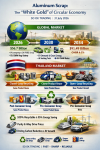
Aluminum Scrap – “White Gold” of the Global Circular Economy SO OK TRADING | 31 July 2026

 
The Importance of Aluminum Recycling
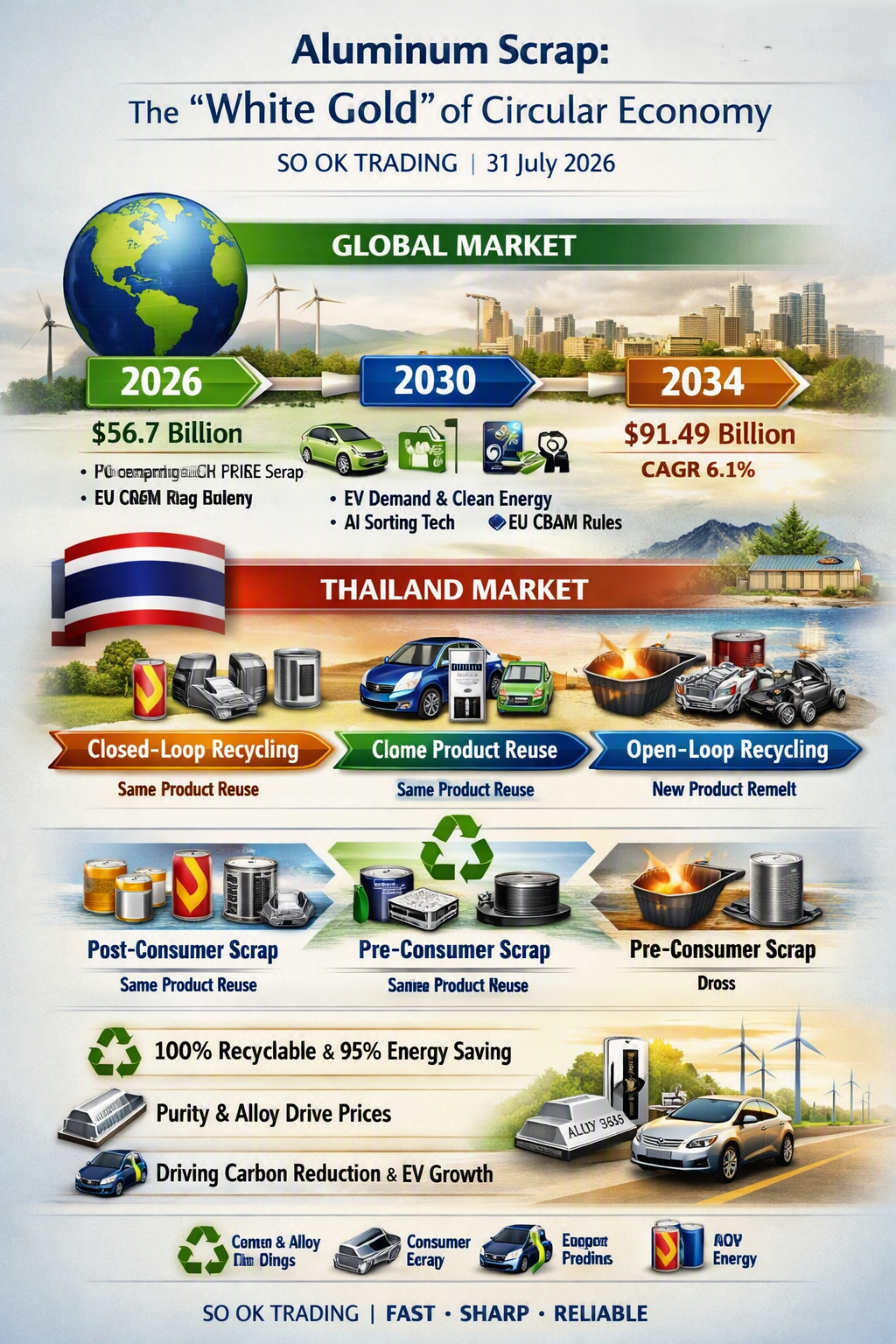
Aluminum is a remarkable metal that can be 100% recycled without losing quality, while saving up to 95% of energy compared to production from bauxite ore. This is why aluminum scrap has become a strategic raw material in an era where the world is accelerating carbon reduction and advancing the Circular Economy.

In 2026, aluminum scrap earned the title of “White Gold”, as global demand surged across industries such as electric vehicles (EVs), eco-friendly packaging, and clean infrastructure.

 
Classification of Aluminum Scrap
Aluminum scrap originates from diverse sources and can be divided into two major categories:

Post-Consumer Scrap: UBC cans, old building structures, wires, and end-of-life automotive parts.
Pre-Consumer Scrap: Factory offcuts, machining shavings, and aluminum dross.
Recycling methods include:

Closed-Loop Recycling: Products recycled back into the same product, e.g., UBC cans → new cans.
Open-Loop Recycling: Mixed scrap melted into new products, e.g., window frames or machinery parts.
 
Market Classification & Standards
In trading markets, aluminum scrap is classified by quality and cleanliness:

Solid & Extrusion Scrap: High purity, premium price.
Cast & Automotive Scrap: Engine parts, alloy wheels.
Packaging Scrap: UBC cans, household foil.
Contaminated Scrap: Bottle caps, machining shavings, Zorba.
International standards ISRI Codes are used to define pricing: TALON (wires), TUTU (extrusion), TENSE (cast), TROMA (wheels), TALC (UBC cans), TEENS (shavings).

 
Aluminum Scrap Market Outlook 2026–2034
Global Outlook

2026: Market size USD 56.77 billion
2034: Market size projected at USD 91.49 billion (CAGR 6.1%)
Key drivers: rising primary aluminum prices (USD 3,200–3,600/ton), EU CBAM regulations, EV and clean energy demand, AI sorting technology achieving 98% purity for Zorba.
Thailand Outlook

No bauxite mines; reliant on imports and domestic recycling.
Emerging as ASEAN’s hub for aluminum scrap import and processing.
EV production hub and advanced recycling plants expanding in the EEC (Chonburi, Rayong).
Thai UBC cans recognized as premium-grade — clean, dry, and highly demanded globally.
Government promoting Circular Economy with a target recycling rate of 50% in the coming years.
 
Key Takeaways 2026–2034
Aluminum: King of Sustainability — endlessly recyclable, saving massive energy.
Value Defined by Purity — alloy series and contamination levels drive pricing.
White Gold of the Future — a strategic resource powering carbon reduction and EV growth.
 
✨ SO OK TRADING – FAST • SHARP • RELIABLE Your trusted business partner in the infinite world of recyclable metals.

VISIT US: www.sooktrading.com FACEBOOK: SO OK TRADING

Related Content
From Steel Oversupply Crisis to Low-Carbon Opportunities: Insight Report 2026–2027 — Global & Thailand Steel Industry Turning Point Toward Sustainability | SO OK TRADING | September 26, 2026
**Global & Thailand Steel Industry Outlook 2026–2027 From Oversupply Crisis to Green Steel Transition** Article by SO OK TRADING | September 26, 2026 The global steel industry is at a critical turning point. Oversupply pressures (Global Oversupply) and sluggish demand recovery continue to weigh heavily on the market, while China remains a dominant player, exporting massive volumes of steel worldwide and driving down prices across regions. In Thailand, the steel sector faces a dual squeeze: rising production costs and the influx of cheap imported steel. This has forced Thai producers to rethink strategies in order to maintain competitiveness in an increasingly challenging environment. SO OK TRADING’s analysis of the 2026–2027 outlook highlights “Green Steel” (low-carbon steel) as the key to reshaping both the Thai and global steel industries. Transitioning toward sustainable production and adopting new technologies will be essential for regaining competitiveness and securing long-term resilience in the global market. ✨ SO OK TRADING — Your Business Partner FAST | SHARP | RELIABLE
26 Sept 2026
SO OK INSIGHT: Global Oil Prices Plunge – When Geopolitics Reshapes the Industrial World   (27 May 2026)
SO OK INSIGHT: Global Oil Prices Plunge – Geopolitical Easing Reshapes the Energy World (27 May 2026) Article Global crude oil prices have dropped to their lowest level in five weeks. Brent crude fell below $100 per barrel, while WTI settled at $92.78 per barrel. The decline follows progress in peace talks between the United States and Iran, raising hopes for reopening the Strait of Hormuz and easing supply concerns. This adjustment reflects more than just market volatility — it highlights a geopolitical shift that directly impacts global commodities, from naphtha and petrochemicals to fertilizers and alternative energy sources. For Thailand, this situation could become a golden opportunity. Lower oil prices reduce energy costs and pave the way for economic recovery in the second half of 2026. SO OK TRADING FAST • SHARP • RELIABLE
27 May 2026
“Aluminum: The Metal of the Future — Driving the Green Transition and Clean Energy Towards a Sustainable Global Hub” SO OK TRADING: 18 OCT 2026
Global and Thai Aluminum Industry: Roles, Challenges, and Future Outlook in the Era of Green Transition SO OK TRADING | 18 October 2026 Aluminum — the strategic metal of the 21st century — is rapidly becoming the backbone of the modern global economy. With its unique properties of being lightweight, strong, corrosion-resistant, and infinitely recyclable, aluminum is now indispensable across industries ranging from electric vehicles (EVs) and renewable energy, to green construction and eco-friendly packaging. In 2026, the world is undergoing a critical transformation — shifting from conventional metal production to the rise of “Green Aluminum”, which emphasizes reduced carbon emissions and clean energy utilization. China dominates the global market, accounting for 57% of total production, while regions such as India, Russia, the Middle East, Europe, and North America are accelerating technological advancements to compete in sustainability-driven markets. Thailand’s aluminum industry is also evolving rapidly to meet the growing demand from the EV supply chain and the adoption of Circular Economy practices, focusing on recycling and lowering carbon footprints. This positions Thailand as a rising hub for downstream aluminum processing within ASEAN.
18 Oct 2026
This website uses cookies for best user experience, to find out more you can go to our Privacy Policy and Cookies Policy
Powered By MakeWebEasy Logo MakeWebEasy