“Aluminum Scrap: The White Gold of a Green World — Driving the Future with Circular Economy and Creating Sustainable Value for Business and the Planet” SO OK TRADING | 31 July 2026
Aluminum Scrap – “White Gold” of the Global Circular Economy SO OK TRADING | 31 July 2026
The Importance of Aluminum Recycling
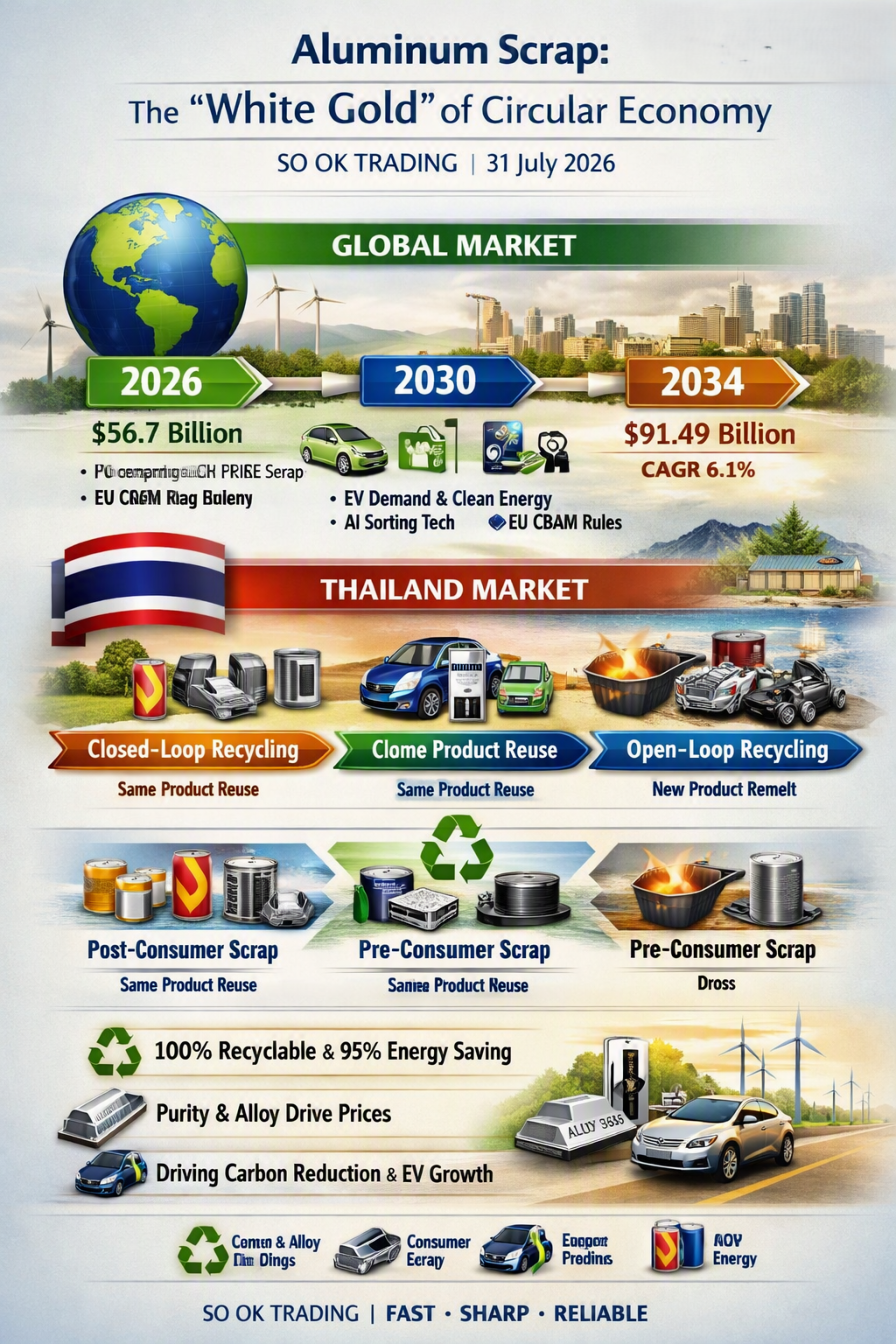
Aluminum is a remarkable metal that can be 100% recycled without losing quality, while saving up to 95% of energy compared to production from bauxite ore. This is why aluminum scrap has become a strategic raw material in an era where the world is accelerating carbon reduction and advancing the Circular Economy.
In 2026, aluminum scrap earned the title of “White Gold”, as global demand surged across industries such as electric vehicles (EVs), eco-friendly packaging, and clean infrastructure.
Classification of Aluminum Scrap
Aluminum scrap originates from diverse sources and can be divided into two major categories:
Post-Consumer Scrap: UBC cans, old building structures, wires, and end-of-life automotive parts.
Pre-Consumer Scrap: Factory offcuts, machining shavings, and aluminum dross.
Recycling methods include:
Closed-Loop Recycling: Products recycled back into the same product, e.g., UBC cans → new cans.
Open-Loop Recycling: Mixed scrap melted into new products, e.g., window frames or machinery parts.
Market Classification & Standards
In trading markets, aluminum scrap is classified by quality and cleanliness:
Solid & Extrusion Scrap: High purity, premium price.
Cast & Automotive Scrap: Engine parts, alloy wheels.
Packaging Scrap: UBC cans, household foil.
Contaminated Scrap: Bottle caps, machining shavings, Zorba.
International standards ISRI Codes are used to define pricing: TALON (wires), TUTU (extrusion), TENSE (cast), TROMA (wheels), TALC (UBC cans), TEENS (shavings).
Aluminum Scrap Market Outlook 2026–2034
Global Outlook
2026: Market size USD 56.77 billion
2034: Market size projected at USD 91.49 billion (CAGR 6.1%)
Key drivers: rising primary aluminum prices (USD 3,200–3,600/ton), EU CBAM regulations, EV and clean energy demand, AI sorting technology achieving 98% purity for Zorba.
Thailand Outlook
No bauxite mines; reliant on imports and domestic recycling.
Emerging as ASEAN’s hub for aluminum scrap import and processing.
EV production hub and advanced recycling plants expanding in the EEC (Chonburi, Rayong).
Thai UBC cans recognized as premium-grade — clean, dry, and highly demanded globally.
Government promoting Circular Economy with a target recycling rate of 50% in the coming years.
Key Takeaways 2026–2034
Aluminum: King of Sustainability — endlessly recyclable, saving massive energy.
Value Defined by Purity — alloy series and contamination levels drive pricing.
White Gold of the Future — a strategic resource powering carbon reduction and EV growth.
✨ SO OK TRADING – FAST • SHARP • RELIABLE Your trusted business partner in the infinite world of recyclable metals.
VISIT US: www.sooktrading.com FACEBOOK: SO OK TRADING