Share

“ALUMINUM NEXT – CANNED REVOLUTION: The Power of Thailand’s Packaging Industry Towards a Sustainable Future 2035”
Last updated: 27 Jul 2026
74 Views

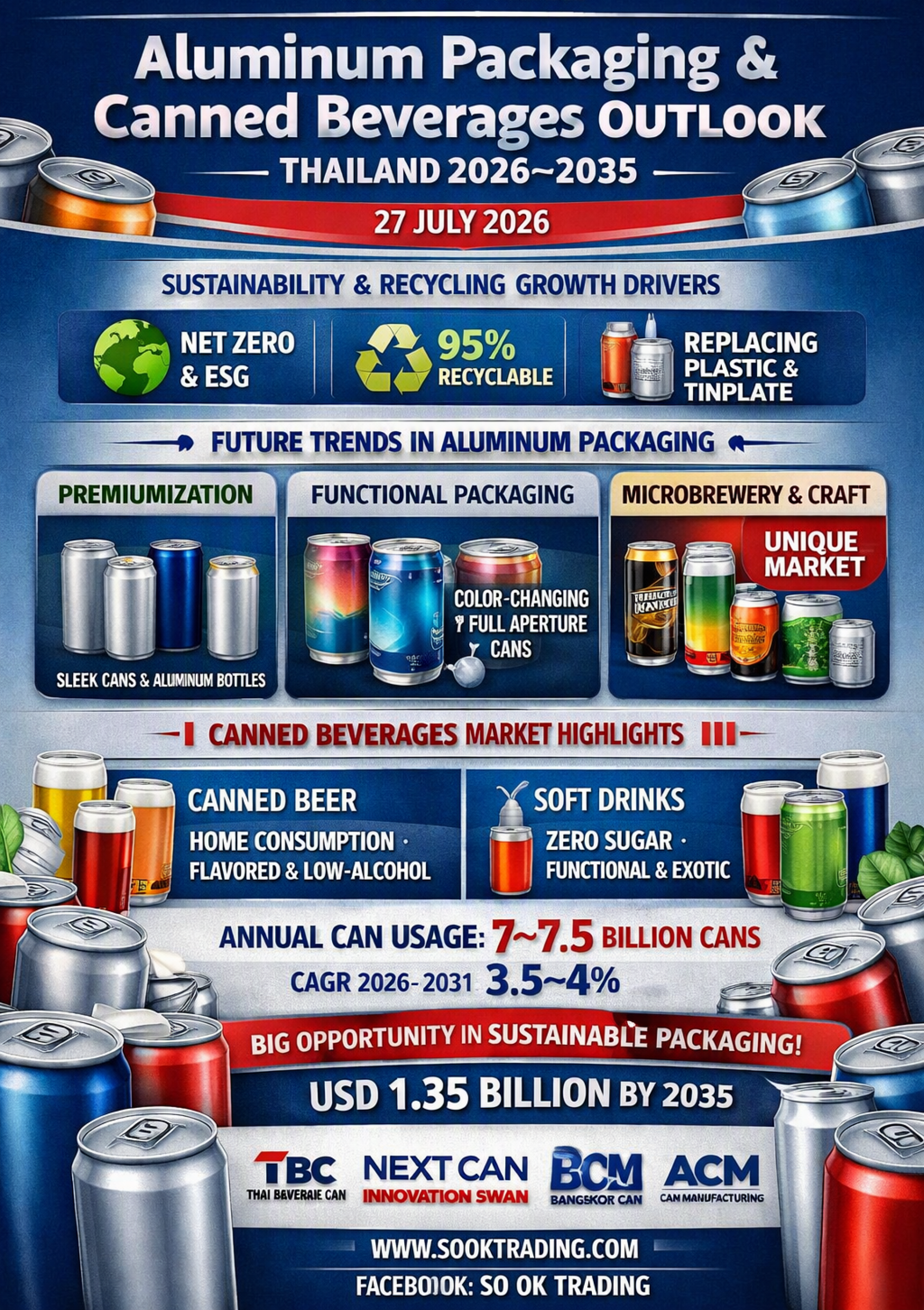
Outlook: Thailand’s Aluminum Packaging & Canned Beverage Industry 2026–2035
SO OK TRADING : July 27, 2026

 
Aluminum Packaging → Usage in Thailand
Continuous Growth Aluminum remains the “star” of global packaging thanks to its 100% recyclability and alignment with the principles of the Circular Economy.

 
Key Drivers: Aluminum Packaging in Thailand
Net Zero & ESG Trends → Manufacturers must adopt eco-friendly materials
High Energy & Raw Material Costs → Recycled aluminum reduces costs by more than 95%
→ Aluminum is expected to increasingly replace other packaging types such as plastic and tinplate
 
Future Directions: Aluminum Packaging in Thailand
Premiumization Modern can designs (sleek, slim, tall) will be widely used in premium beverages. Aluminum bottle cans will expand in premium and luxury drink markets.
Functional Packaging Innovations such as color-changing cans when chilled, full-aperture lids, and ESG-compliant packaging will gain traction.
Microbrewery & Craft Market Small breweries and niche brands will leverage cans to reach home consumers, creating a unique market segment.
 
Canned Beverages & Aluminum Packaging Trends in Thailand
Beer Cans

Growth driven by home consumption and portability
Future trends: flavored beers (fruit-based), low/no alcohol beers, craft beer cans
Target groups: Gen Z, Millennials, women, and light drinkers
Soft Drink Cans

Driven by sugar tax and health trends
Zero-sugar formulas will become the new standard
Functional soft drinks (with added vitamins, relaxation extracts) will expand
Exotic flavors (green tea, specialty fruits) will differentiate products
Usage & Growth

Total consumption: 7–7.5 billion cans/year (2026 data)
Market share: cans account for ~25% of Thailand’s beverage market (vs. ~60% in Vietnam and ~70% in Cambodia) → huge growth potential
 
Major Producers of Aluminum Beverage Cans in Thailand
TBC (Thai Beverage Can) → Capacity over 7 billion cans/year (Chang Beer, Beer Lao, Oishi, canned coffee, etc.)
NEXT CAN INNOVATION + SWAN → Focus on energy drinks (Red Bull), canned coffee, soft drinks, and export markets
BCM (Bangkok Can Manufacturing) → Focus on Singha Beer, Asahi Beer, soft drinks, etc.
ACM (Asia Can Manufacturing – Carabao Group) → Capacity over 1 billion cans/year, focusing on Carabao brand beverages; a new player in the market
 
Market Growth Outlook
CAGR: 3.5–4% (2026–2031)
Key drivers: tourism recovery, rising temperatures, health trends, expansion of functional drinks and RTD beverages
 
Future Applications of Aluminum Packaging in Thailand
Lifestyle Integration → Cans will symbolize modern lifestyles, combining health, convenience, and premium image
ESG & Sustainability → Thai producers aim to use 74–80% recycled cans by 2030
Smart Packaging → QR codes, AR experiences, and supply chain tracking will be adopted
Global Competitiveness → Thailand has strong potential to become ASEAN’s can production hub, especially in beer and soft drink markets
 
Summary & Opportunities
Thailand’s can usage is still low compared to neighboring countries → enormous growth potential
Competition will shift from “price” to “quality + sustainability”
Recycling, lightweighting, and packaging innovation will dominate the market
ESG, carbon credits, and recycled content will be key differentiators
Market Outlook Between 2026–2035, Thailand’s aluminum beverage packaging market is expected to reach USD 1.35 billion.

 
✨ Conclusion Aluminum packaging and canned beverages will become the cornerstone of Thailand’s beverage industry, meeting consumer demands for health, convenience, and sustainability. Companies that successfully combine new flavors + packaging innovation + ESG compliance will win the loyalty of the new generation of consumers.

 
SO OK TRADING : Your Business Partner FAST SHARP RELIABLE

Website: WWW.SOOKTRADING.COM
Facebook: SOOK TRADING
SO OK TRADING : With over 15 years in the aluminum packaging industry for both beverages and food, we are the trusted partner for your business.

Related Content
SO OK Trading: The Golden Bridge Connecting Thai Fruits to China : A New Era of Thai Agricultural Exports via High-Speed Rail to China and East Asia
SO OK Trading: Leader in Exporting Fresh Thai Durian to China With the Thai–Lao–China high-speed rail and advanced Cold-Chain Logistics, we deliver premium-quality fresh durian to Chinese consumers in less than 15 hours. Freshness, rich flavor, and international standards are guaranteed. Thai Durian — The King of Fruits - Premium taste loved by Chinese consumers - Competitive pricing with continuously rising demand - Guaranteed quality in every fruit, delivered directly from Thai orchards to the Chinese market Why Choose SO OK Trading - Expertise in the Chinese market, with deep understanding of consumer behavior and premium fruit trends - Modern logistics systems that preserve freshness at every stage - Extensive partner network connecting Thai farmers with major Chinese buyers - Logistics costs reduced by 50–70%, plus tax incentives from China starting in 2026 SO OK Trading is more than just an exporter — we are your trusted business partner. We deliver premium-quality fresh durian from Thailand to consumers in China and East Asia with stability and sustainability.
15 Jan 2026
ALUMINUM PRICE TREND 2026
An analysis of the aluminum market in 2026 indicates a likely continued market deficit and upward price pressure, driven by constrained supply and resilient demand from green energy sectors. However, significant volatility is expected due to policy uncertainties and the potential for new Indonesian supply to eventually balance the market. Key Drivers and Projections for 2026 Supply Side Analysis Capacity Constraints: China's primary aluminum output is approaching its self-imposed 45 million-tonne capacity cap, limiting global supply growth. Power Challenges: Smelters outside of China face intense competition for power from energy-intensive sectors like AI data centers, which are willing to pay higher prices for long-term contracts. This has kept significant capacity offline in Europe and the US. Production Disruptions: Outages and potential shutdowns at existing smelters in Iceland and Mozambique further tighten the market. Scrap Supply Pressure: The EU's planned implementation of the Carbon Border Adjustment Mechanism (CBAM) and potential scrap export tariffs in spring 2026 are expected to impact global scrap flows, creating regional shortages and price volatility. New Capacity: Indonesia is a key source of new supply, with several projects in the pipeline. However, analysts suggest the pace of the ramp-up may be slower than expected due to infrastructure and policy challenges, meaning it is unlikely to fully offset near-term tightness. Demand Side Analysis Green Transition Demand: Demand from "green" sectors such as solar panels, new energy vehicles, and energy transition infrastructure remains strong, providing fundamental support for the market. Substitution Effect: Aluminum's wide price discount relative to copper has encouraged substitution in electrical applications, acting as a tailwind for demand and prices. Construction and Automotive: The construction and automotive industries continue to be major consumers, with growing demand for lightweight, low-carbon aluminum products. Price Forecasts and Volatility The market is expected to remain in a deficit in 2026, with estimates ranging from 200,000 to 600,000 tonnes. This structural tightness is leading most analysts to forecast sustained or rising prices. Bullish Views: Analysts at Bank of America project prices of $3,000/tonne as early as 2026. J.P. Morgan also expects prices to approach $3,000/tonne in Q1 2026. ING forecasts an average price of $2,900/tonne for the year. Bearish/Conservative Views: Goldman Sachs is an outlier, forecasting prices to decline to $2,350/tonne by Q4 2026, anticipating a market surplus later in the year. SMM forecasts a "high first, then lower" pattern, with prices finding equilibrium in the $2,700–$2,800/tonne range by year-end. Premiums: Regional premiums, particularly the US Midwest premium, are expected to remain high and volatile due to tariffs and regional supply dynamics, creating a disconnect from the LME benchmark price. In essence, 2026 is projected to be a year of high volatility where participants need to focus on scenario readiness rather than relying on a single price forecast, as geopolitical and energy policies significantly influence regional supply and costs
31 Dec 2025
“Battery Recycling: From Old Waste to a Moving Gold Mine – Thailand Rising as ASEAN’s Future Hub” By SO OK TRADING
Battery Recycling = The Moving Gold Mine of the Future From old batteries to precious resources! Did you know? Expired car batteries are not waste, but treasure troves of rare metals. More than 90% can be recovered — including lithium, cobalt, nickel, and lead. Thailand is rapidly becoming the ASEAN hub for EV battery recycling, driven by global automaker investments and the EV 3.5 policy that attracts advanced technologies.
7 Mar 2026
This website uses cookies for best user experience, to find out more you can go to our Privacy Policy and Cookies Policy
Powered By MakeWebEasy Logo MakeWebEasy