“Rare Earth Recycling: Transforming Clean Energy Industry — Neodymium & Dysprosium, Keys to the Future”
♻️ Rare Earth Recycling: Neodymium & Dysprosium — Industry of the Future
SO OK TRADING | July 20, 2026
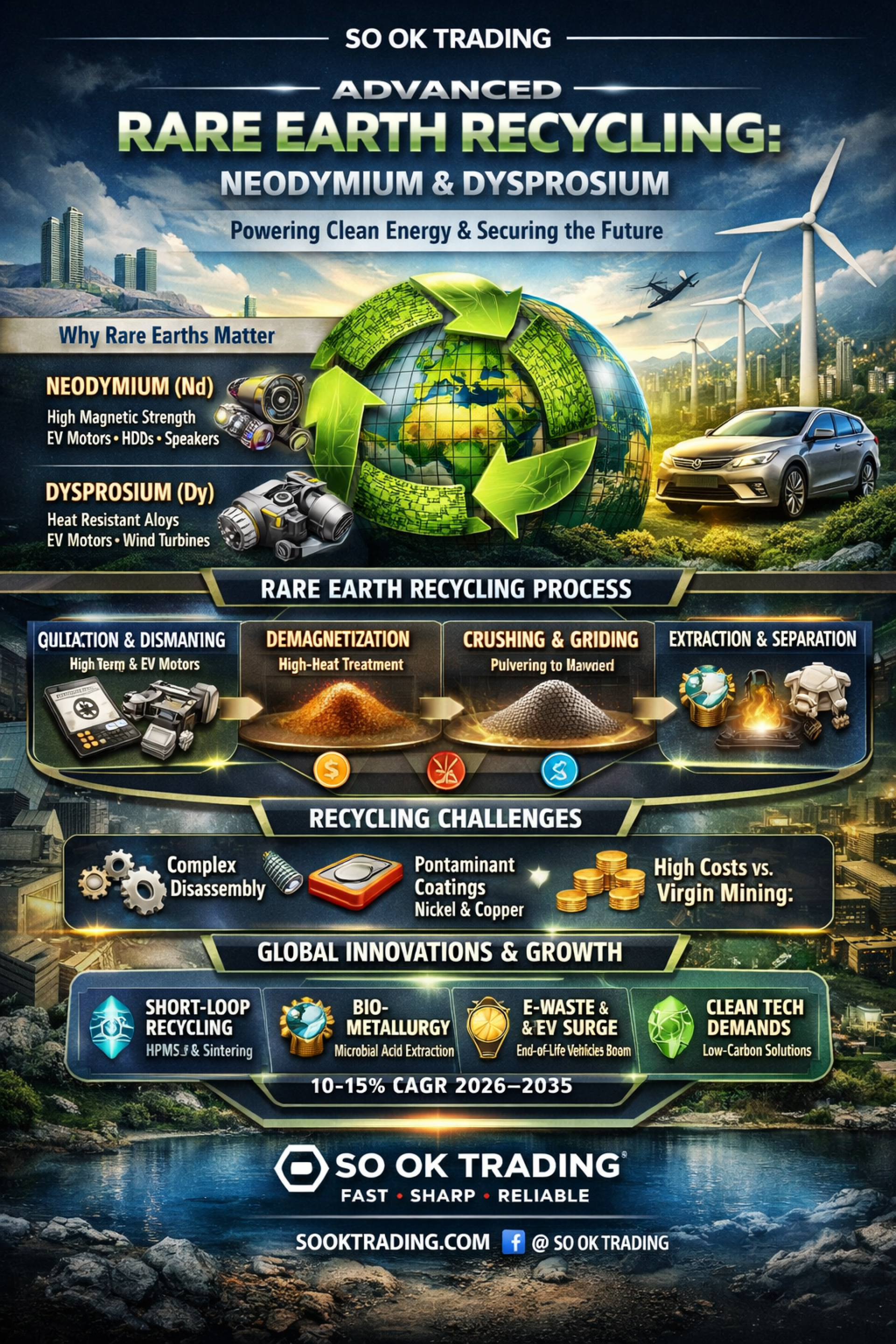
Why Are Rare Earths Important?
Neodymium (Nd) and Dysprosium (Dy) are at the heart of modern technology because they are used in high‑performance permanent magnets (NdFeB) found in almost everything around us — from hard disk drives, EV motors, wind turbines, speakers, headphones, to household appliances.
Neodymium (Nd): Provides strong magnetic force, used in EV motors, HDDs, speakers, and headphones.
Dysprosium (Dy): Enhances heat resistance, essential for EV motors and wind turbines that operate under continuous heavy loads.
Recycling is therefore not just about the environment — it is about maintaining global supply chain stability and reducing dependence on energy‑intensive new mining.
Rare Earth Recycling Process (Nd & Dy)
Collection & Dismantling – Extract magnets from electronic devices.
Demagnetization – High‑temperature treatment (Curie Temperature) to neutralize magnetic force.
Grinding into Powder – Increases surface area for chemical reactions.
Extraction & Separation
Hydrometallurgy: Acid leaching and organic solvents.
Pyrometallurgy: High‑temperature smelting.
HPMS: Hydrogen gas breaks magnets into powder.
Calcination – Heating at ~800°C to obtain high‑purity oxides.
⚖️ Challenges in Rare Earth Recycling
Complex disassembly (adhesives, bolts).
Surface coatings such as nickel/copper contaminate the process.
Recycling costs remain higher than purchasing virgin materials.
Global Trends & Innovations
Short‑Loop Recycling: HPMS + sintering, saving over 80% energy.
Bio‑Metallurgy: Microorganisms produce organic acids to extract Nd & Dy.
AI & Robotics: Vision AI and automated disassembly robots.
Market forecast: 10–15% CAGR (2026–2035).
Global Market Drivers
De‑Risking from China: China controls 70–80% of rare earth production → US, EU, and Japan accelerate investment in recycling plants to secure supply chains.
EU Critical Raw Materials Act: Requires clean‑energy products to contain at least 15–25% recycled rare earths by 2030.
E‑Waste & EV Wave: First‑generation EVs (2015–2018) reach end‑of‑life in 2026 → massive inflow of EV motor magnets into recycling.
Environmental Pressure: Factories worldwide must adopt low‑acid, low‑carbon recycling technologies.
Key Global Players
Cyclic Materials (Canada/US): MagCycle℠ and REEPure℠ technologies.
HyProMag / Mkango Resources (UK/Germany): Leaders in HPMS.
USA Rare Earth (US): Colorado plant successfully producing Dy and NdPr outside China.
Umicore (Belgium): Global giant in metals and recycling.
Thailand’s Situation
Thailand is beginning to move seriously into rare earth recycling:
Research & Government
DPIM: Studying commercial feasibility of extracting Neodymium Oxide from waste magnets.
Suranaree University of Technology: Research on recycling NdFeB magnets from e‑waste.
Chulalongkorn University: In‑depth studies on rare earths and environmental impacts.
Private Sector & Collaboration
Japanese recyclers + DIW: Establishing EV motor magnet recycling plants.
Large e‑waste recycling factories: Previously exported components abroad, now investing in specialized domestic facilities.
Chatree REE Mine
Located in central Thailand.
Expected to supply 5% of global demand by 2026.
Supports clean energy, EV industry, and sustainable agriculture.
Reduces reliance on Chinese imports, strengthens Thailand’s supply chain security.
Global & Thai Outlook
Global: Rare earth recycling is shifting from an “environmental option” to a national security infrastructure. Countries mastering short‑loop technology and logistics will lead the clean‑energy market in the next decade.
Thailand: Has the potential to become ASEAN’s hub for EV and e‑waste recycling. By combining Chatree REE Mine + domestic recycling plants, Thailand can build a complete circular supply chain with both new resources and recycling capacity.
Conclusion
Recycling Neodymium & Dysprosium is not merely waste management — it is about building global economic resilience and clean‑energy security. With the right strategy, Thailand could become a key player in Asia’s rare earth supply chain.
SO OK TRADING Your Trusted Business Partner FAST • SHARP • RELIABLE www.sooktrading.com Facebook: SO OK TRADING