“Japan 2026: The Comeback! Economic Recovery, Rising Interest Rates, Defying Global Trends, and Entering a New Era of Clean Energy & Economic Transformation”
Japan 2026: Rising Amid Inflation, Interest Rate Hikes, and Defying Global Trends Article by SO OK TRADING | June 29, 2026
Signs of Recovery in Japan’s Economy
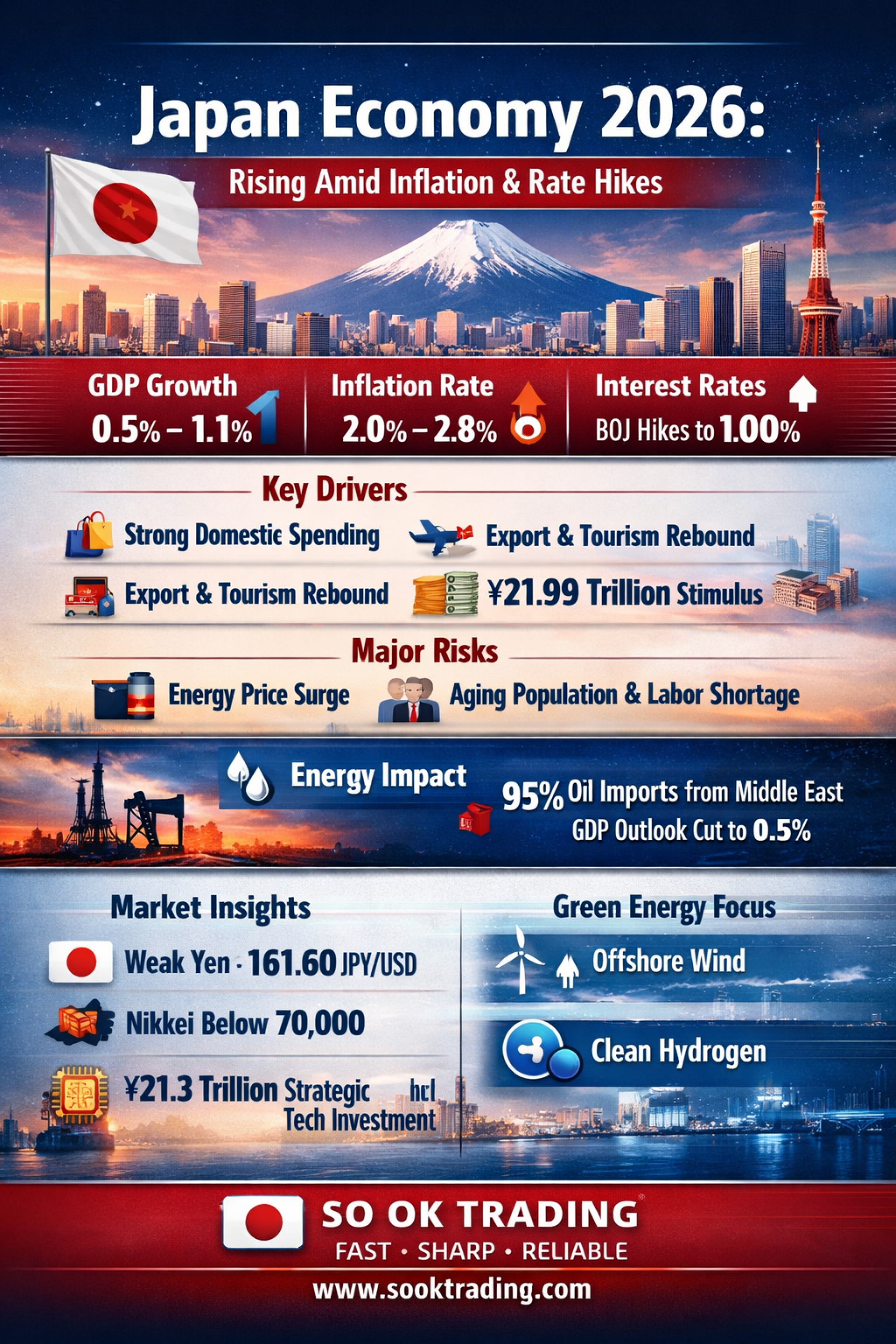
Japan’s economy in 2026 is showing steady signs of recovery. Although growth remains moderate, resilience is evident amid global pressures. Financial institutions forecast real GDP growth between 0.7%–1.1%, driven by strong domestic consumption and robust exports.
Key Drivers of Growth
Domestic Consumption: Consumers have returned to spending, pushing first-quarter growth beyond expectations.
Exports and Services: Exports continue to support the economy, while tourism and services are rebounding.
Government Stimulus: The government has injected over ¥21.99 trillion to ease living costs and stimulate growth.
⚠️ Risks to Watch
Rising Inflation: Global oil prices have pushed Tokyo’s inflation rate to 2.0%–2.8%.
Tight Monetary Policy: The Bank of Japan (BOJ) raised interest rates to 1.00%, the highest in 31 years, with further hikes expected by year-end.
Demographic Challenges: An aging society and labor shortages remain long-term structural issues.
Impact of Middle East Conflict
Japan imports 95% of its crude oil from the Middle East, leaving it vulnerable to volatility. Rising energy costs have pressured production and household expenses, prompting analysts to cut GDP forecasts to 0.5% for the year.
Financial Markets and Investment
Japanese Yen (JPY): Despite rate hikes, the yen remains weak, hovering near 161.60 JPY/USD.
Nikkei 225: The index fell below 70,000 points due to sell-offs in technology and export stocks.
Strategic Industries: The government allocated ¥21.3 trillion to support 17 key industries, including AI, semiconductors, and quantum technology.
Renewable Energy: The Long-Term Solution
Japan is accelerating its path toward Carbon Neutrality, investing in:
Offshore Wind Power
Clean Hydrogen
This marks a major energy restructuring aimed at reducing dependence on the Middle East and ensuring long-term economic stability.
Outlook: Economy and Interest Rates
GDP growth is expected to remain modest at 0.5%–1.0%.
Inflation is accelerating within the 2.0%–2.8% range.
BOJ raised rates to 1.00% in June 2026 and is projected to hike again to 1.25% in Q4.
Medium-term rates could reach 1.50%–1.75% by 2027.
Comparison with Other Major Economies
United States: Stronger growth (1.8%–2.2%) with energy independence; entering a rate-cut cycle.
Europe/Germany: Slower recovery (0.8%–1.2%) and vulnerable due to energy dependence.
China: Higher growth (4.0%–4.5%) but facing structural real estate issues and the middle-income trap.
Japan: Strengths in robotics, AI, and semiconductors, but weaknesses in demographics and energy reliance.
Conclusion
Japan in 2026 represents a nation “recovering amid challenges.” Despite inflationary and energy risks, strategic investments in industries and renewable energy are laying the foundation for long-term growth. By raising interest rates against global trends, Japan is striving to secure economic stability and break free from the deflationary trap that has persisted for decades.
SO OK TRADING: Your Trusted Business Partner FAST • SHARP • RELIABLE www.sooktrading.com Facebook: SO OK TRADING