Share

“Post-Middle East Conflict 2026: Economic Recovery, Lower Costs, Revived Logistics, and Capital Flows — New Opportunities for Thai and Global Businesses” : SO OK TRADING · June 27
Last updated: 27 Jun 2026
105 Views

Post-Middle East Conflict 2026: Lower Costs, Revived Logistics, Capital Flows Back — New Opportunities for Thai and Global Businesses” : SO OK TRADING · June 27

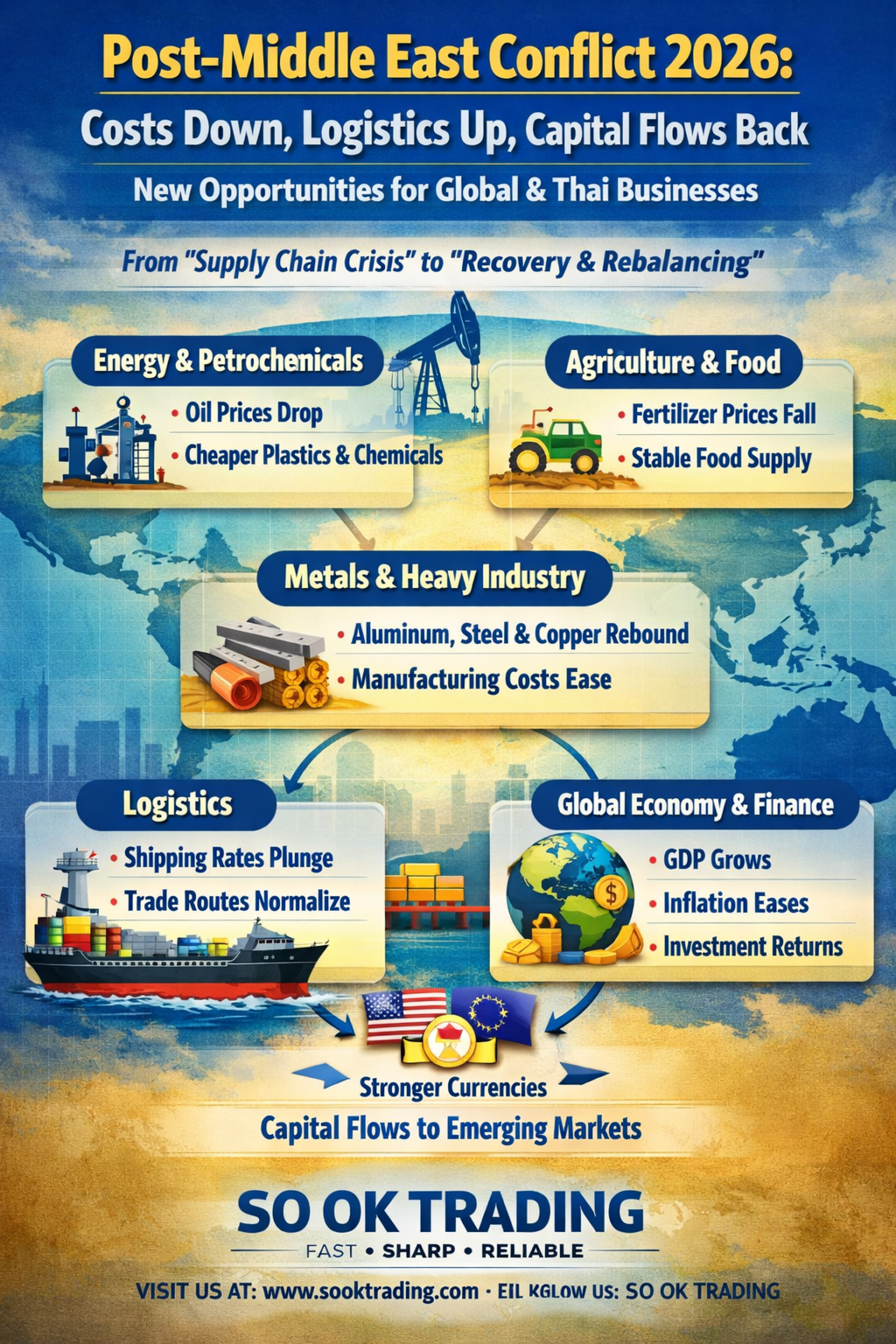
As the Middle East conflict eases, the world is shifting from a “supply chain crisis” to a phase of “recovery and rebalancing.” This transition impacts every industry — from energy and metals to agriculture and global finance.

 
⛽ Energy & Petrochemicals: Cost Pressure Eased

Crude Oil: Prices are trending downward as supply risks fade and shipping through the Strait of Hormuz normalizes.
Naphtha: Costs for plastics and petrochemicals decline as Middle Eastern refineries resume full exports, giving Asian producers a competitive edge.
Fertilizers & Agriculture: Food Price Risks Reduced

Key raw materials such as natural gas and sulfur return to global markets.
Fertilizer prices gradually stabilize, lowering farmers’ costs and easing long-term food price risks.
️ Metals & Heavy Industry: Recovery Brings New Opportunities

Aluminum: Prices cool as Middle Eastern smelters ramp up production.
Steel: Supply from Iran and Turkey flows smoothly into global markets, pushing prices down.
Copper: Demand rebounds, driven by investment in EVs and clean energy.
Logistics: Shipping Costs Plunge

Safe passage through the Suez Canal reduces transport costs immediately.
Container circulation normalizes, easing pressure on global trade.
Other Industries: Rubber & Cassava Starch

Synthetic Rubber: Production costs fall in line with lower oil and naphtha prices.
Natural Rubber: Exports from Thailand and Indonesia flow more smoothly, stabilizing demand.
Industrial Cassava Starch: Lower energy and freight costs boost competitiveness in Western markets.
Global Economy & Finance

Global GDP 2026: IMF projects 3.1%, World Bank 2.5%, avoiding severe recession.
Inflation: Still high at 4.4% in 2026, but expected to decline significantly in 2027.
Monetary Policy: The Fed and ECB maintain high interest rates but may begin easing toward year-end.
Thai Baht & Financial Markets

Thai Baht: Long-term strengthening expected from trade balance recovery, though short-term weakness persists due to Fed rate hike signals.
Capital Flows: Investment funds return to emerging markets, benefiting Thailand.
Global Stock Markets: Logistics and consumer sectors gain, while energy and shipping stocks face profit-taking.
Gold: Prices retreat as geopolitical risk premiums fade.
 
✅ Conclusion
The easing of the Middle East conflict marks a critical turning point: global production costs decline, logistics normalize, and investor confidence rebounds. While short-term monetary pressures remain, the medium- to long-term outlook presents a golden opportunity for businesses ready to adapt and leverage lower costs.

 
SO OK TRADING Your business partner in a fast-changing world www.sooktrading.com Facebook: SO OK TRADING FAST • SHARP • RELIABLE




Related Content
“Oil Shortage Crisis: Oil Prices Boil! Global Shock, Thailand Hit Hard — Oil as the Catalyst of the World Economy : Article by SO OK TRADING : April 6, 2026”
Global Oil Price Crisis: A Turning Point for the World and Thailand’s Economy On April 6, 2026, the world is facing the largest oil price crisis in years. Brent and WTI crude prices have surged to $110–114 per barrel, driven by escalating tensions in the Middle East and the closure of the Hormuz Strait — a vital route that carries over 20% of global energy shipments. The impact is spreading worldwide — from China, Japan, and South Korea to Thailand, where diesel prices have already exceeded 50 THB per liter and may reach 60 THB in April. This surge is pushing inflation higher and slowing economic growth. SO OK TRADING provides a comprehensive analysis of this crisis: the driving factors, its impact on Thailand’s economy, and the outlook for Q2 2026, helping businesses and entrepreneurs prepare for this major transformation in the global energy landscape. SO OK TRADING : FAST • SHARP • RELIABLE Your trusted business partner in every global market situation
6 Apr 2026
Thai Fruits: Deliciousness from Thailand, Nature’s Harvest, Reaching the World Discover Thai fruits and explore export & trade opportunities with SO OK TRADING
Thai Fruits: Thai Products Entering the Global Market Overview of Thai Fruits Thailand is renowned as the “Kingdom of Fruits,” thanks to its favorable climate and fertile soil, producing a wide variety of fruits. Durian, mangosteen, mango, coconut, and pineapple are highly celebrated both domestically and internationally. Export Market Overview - Japanese Market - Bananas, mangoes, mangosteen, and pineapples are especially popular. - The JTEPA agreement provides tariff benefits, while GI certification enhances trust in quality. - Meets Japanese consumers’ demand for health and premium quality. - Chinese Market - Durian, mangosteen, longan, and Nam Dok Mai mango are the main export products. - China is Thailand’s largest importer of fruits. - The China–Laos Railway improves logistics, ensuring freshness. - Western Markets (Europe, USA, Australia) - Young coconuts, mangosteen, mangoes, pineapples, and dragon fruit attract strong attention. - Consumers emphasize health, organic products, and sustainability. - Growing demand for processed goods such as freeze-dried fruits and juices. Export Opportunities and Development Directions - Quality Differentiation: Build premium fruit brands to enhance competitiveness. - Smart Agriculture: Use AI and drones to reduce costs and improve efficiency. - Product Innovation: Develop dried fruits, bottled juices, and superfood series. - Sustainability: Address environmental regulations (EUDR) and carbon footprint requirements. - Logistics Upgrades: Cold chain and railway transport to ensure freshness. ✨ Summary With strengths in quality, innovation, and sustainability, Thai fruits are poised to further expand their global market influence in 2026 and beyond. Japan, China, and Western markets each present unique advantages and opportunities, giving Thai fruit exports strong strategic potential for growth.
23 Jan 2026
This website uses cookies for best user experience, to find out more you can go to our Privacy Policy and Cookies Policy
Powered By MakeWebEasy Logo MakeWebEasy