“Catching Global Economic Signals – Dollar Surge, U.S. Strong, China Steadies, Thailand Must Reshape Its Strategy in the Global Economic Arena”

Strong Dollar – U.S. Resilient, China Steadies, Global Pressures Mount, Thailand Faces Dual Impacts
Global Economic Analysis by SO OK TRADING | June 19, 2026
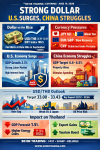
U.S. Dollar Continues to Strengthen Latest update (June 19, 2026): USD/THB trades in the range of 32.78 – 32.83, while the Dollar Index (DXY) remains above 100.5. Markets anticipate another 0.25% rate hike in September, as new Fed Chair Kevin Warsh emphasizes the need to control inflation.
Currency Pressures from Global Rivals
JPY: Weak beyond 161 per USD, amplifying dollar strength.
EUR & GBP: Under pressure from slow recovery and dovish monetary signals.
CNY: Despite dollar pressure, remains relatively stable thanks to China’s stimulus measures.
U.S. Economy – Stronger Than Expected
GDP 2026: Projected growth of 2.3%, far above G7 peers (Germany 0.8%, Japan 0.7%).
Key Drivers: Strong labor market and expanding service sector.
Monetary Policy: Fed maintains high interest rates to curb inflation, attracting global capital inflows. ➡️ The dollar serves as a safe-haven asset, reflecting U.S. economic resilience.
China – Stabilizing Amid Pressures
GDP 2026 Target: 4.5 – 5.0%, though IMF and World Bank forecast 4.4 – 4.5%.
Challenges: Property sector slump, weak domestic demand.
Support Factors: Strong exports in semiconductors and AI-related products.
Policy Response: Monetary easing and fiscal deficit expansion (up to 4% of GDP). ➡️ The yuan (CNY) weakens against the dollar but remains stable regionally, as China advances de-dollarization.
USD/THB Outlook
Resistance: 33.00 – 33.43
Support: 32.12 – 32.65 Drivers:
Wide U.S.–Asia interest rate gap
Slow recovery in Europe and Japan Risks: Rising oil prices from geopolitical tensions could widen Thailand’s trade deficit and push the baht below 33.00 sooner than expected.
Impact on Thailand – Forecast Figures
GDP 2026: Bank of Thailand revises down to 1.5% due to energy costs and production pressures.
Negative Side: Higher import costs and consumer burden, inflation rising to 2.9%.
Positive Side: Weaker baht boosts export revenues and supports inbound tourism.
Global Economic Comparison
U.S.: GDP +2.3%, high interest rates attract capital.
Global Average: GDP +2.5 – 2.6%, slowed by energy costs and emerging market debt.
Thailand: GDP +1.5%, limited recovery under external pressures.
China: GDP +4.4 – 4.5%, facing structural challenges.
⚖️ Exchange Rate Risk Management Strategies (THB – USD)
Exporters: Leverage weaker baht to lock in profits and expand markets.
Importers: Secure long-term contracts to mitigate cost risks.
Investors: Watch resistance at 33.00 – 33.43 and support at 32.12 – 32.65 for tactical positioning.
✨ Conclusion The strong dollar today is not just a currency figure — it is a symbol of U.S. economic strength and simultaneously a pressure point for global and Thai economies. Thai businesses must adapt wisely: seize opportunities in exports and tourism while managing risks from rising energy costs.
SO OK TRADING Your Trusted Business Partner FAST • SHARP • RELIABLE www.sooktrading.com Facebook: SO OK TRADING