“Recycled Lead Transforming the Green Industry – From Scrap Batteries to Future Energy: Remelted Lead Driving the Circular Economy of Global Industry” SO OK TRADING | 18 JUNE 2026

Remelted Lead & Market Outlook 2026
Recycled Lead – The Green Industry and Circular Economy Taking Center Stage in the New Industrial Era Article by SO OK TRADING | 18 June 2026
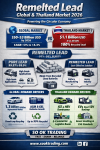
What is Remelted Lead?
Produced by smelting scrap lead such as old car batteries or lead pipes.
Purity ranges from 97%–99% (with impurities such as antimony, tin, arsenic, and copper).
Available in small ingots (25–35 kg) for easy handling, and large blocks (250–1,000 kg) requiring cranes.
“Remelt Lead Ingots have lower purity (97%–99%), are cheaper, and often contain higher levels of impurities.”
Remelt Lead Ingots are suitable for small furnaces and direct use in battery production, while Remelt Lead Blocks are large and must be reprocessed into ingots according to specific requirements.
⚖️ Difference Between Remelt Lead and Pure Lead
Remelt Lead → Lower cost, used as raw material in the Circular Economy.
Pure Lead → Refined to 99.97%–99.99% purity, suitable for high-quality applications such as branded automotive batteries.
Main Applications of Lead (Remelted & Pure)
Battery factories → Lead-acid battery plates.
Heavy industry → Counterweights for cranes and ships.
Medical → Radiation shielding panels in X-ray rooms.
Metallurgy → Welding wire and ammunition.
Lead’s Role in Thailand’s Circular Economy
Thailand no longer has lead mines → 100% of lead comes from recycling or imported Pure Lead.
Scrap car batteries (ULAB) account for 80–90% of recycled raw materials.
Types of factories:
Secondary Smelters → Produce Remelt Lead (97–99%).
Refining Plants → Refine Pure Lead (99.99%) for major domestic and international brands.
Market Outlook: Global & Thailand
Global Market Outlook
Lead-acid battery market → USD 50–53 billion, growing at CAGR 3%–4.3%.
58% of global lead consumption is for batteries.
Demand drivers:
Over 1.3 billion vehicles worldwide → batteries replaced every 2–5 years.
Growth of AGM & Gel battery technologies for modern cars with idling stop systems.
Closed-loop recycling → EU/US laws mandate 95–99% recycling of expired batteries.
Global lead price (LME) → USD 1,900–2,100 per ton.
Thailand Market Outlook
Largest lead-acid battery production base in ASEAN → Market value USD 1.1 billion.
Supply chain:
Secondary Smelters → Remelt Lead 97–99%.
Refining Plants → Pure Lead 99.99% supplied to major brands.
Demand drivers:
ICE and hybrid vehicles still dominate.
EVs still require 12V lead batteries.
Logistics & e-commerce growth → demand for electric forklifts in warehouses.
Factory trends → Investment in Green Smelting and air treatment systems to meet ESG standards and reduce reliance on costly imported raw materials.
Conclusion
Remelted Lead is not just scrap metal — it is a critical gear in Thailand’s and the world’s Circular Economy.
Lower cost → ideal raw material.
Nearly 100% recyclable → aligns with sustainability goals.
Even in the EV era dominated by lithium-ion, lead remains indispensable as backup and safety power.
Lead has not disappeared — it has shifted from being a “primary energy source” to a “safety backup and reserve power,” continuing to generate immense value for global industries.
Interested in REMELT LEAD INGOTS or REMELT LEAD BLOCKS? SO OK TRADING offers high-quality products ready for supply. Thank you very much.
SO OK TRADING: Your Trusted Business Partner FAST • SHARP • RELIABLE www.sooktrading.com Facebook: SO OK TRADING