Share

“Gold in the Era of Global Peace – Revitalizing Power, Reshaping the Economy, Unlocking New Investment Opportunities” SO OK TRADING: June 18, 2026
Last updated: 18 Jun 2026
119 Views

“Gold After Global Peace – From Crisis to a New Investment Opportunity”
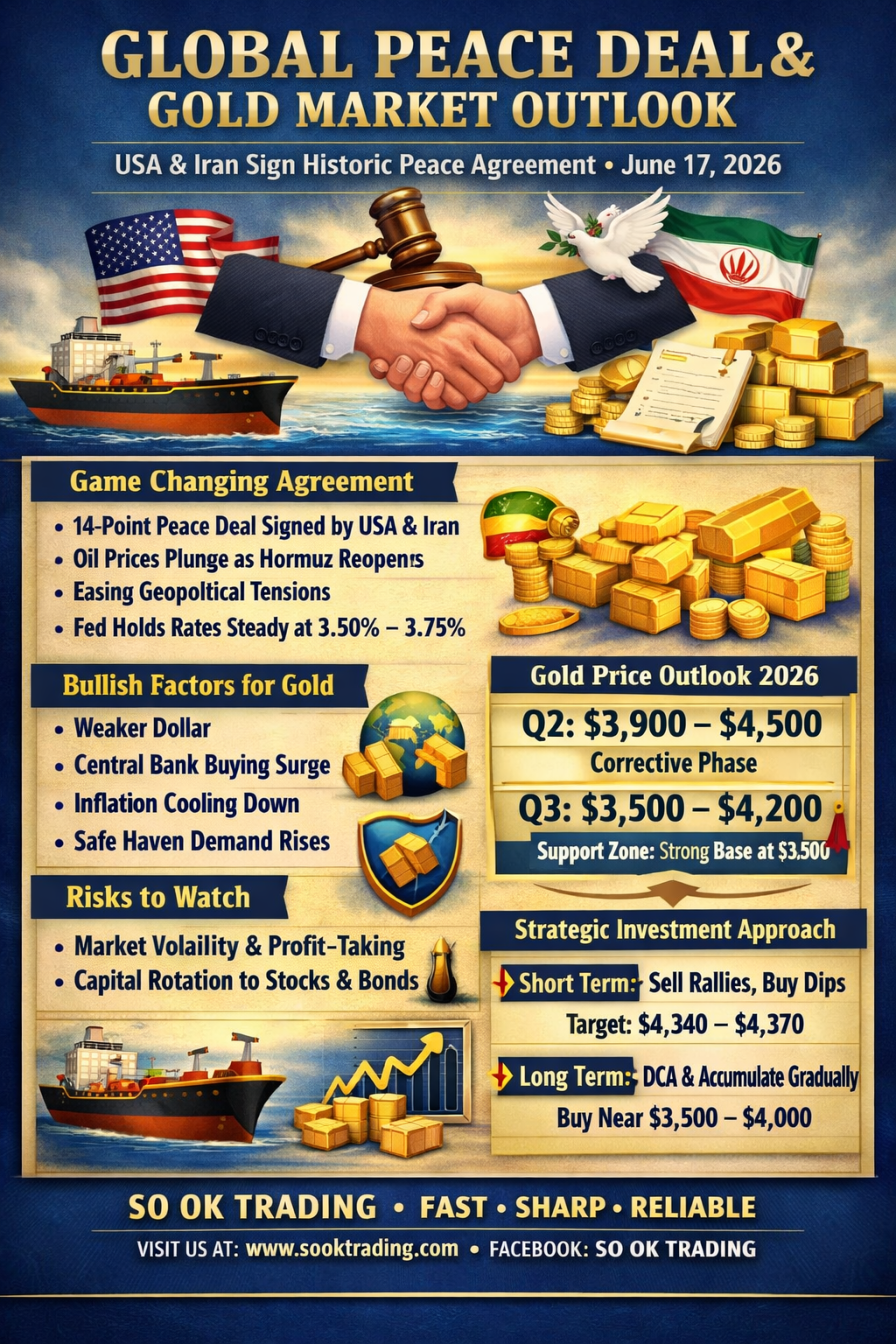
The new FED Chair announced interest rates will be held steady, and the USA and Iran signed a 14‑point Global Peace Agreement yesterday, June 17, 2026.

 
✨ A Major Turning Point: U.S.–Iran Peace

The signing of the peace agreement not only ends geopolitical tensions but also creates massive positive ripple effects across the global economic structure. Gold, though traditionally a safe‑haven asset, is now receiving fresh support from shifting macroeconomic factors.

 
Positive Factors Supporting Gold
FED pressure eased: Oil prices plunged after the reopening of the Strait of Hormuz, easing inflationary pressures and reducing the likelihood of further rate hikes.
Weaker dollar: Risk‑on sentiment is pulling the dollar down, giving gold room to strengthen.
Central bank buying: Reserve diversification continues, providing a solid demand base for gold.
Speculative buying on good news: Investors remain confident that gold could test new highs this year.
 
⚠️ Risks to Watch
Technical volatility: Gold prices may swing sharply due to short‑term profit‑taking.
Capital flow back to equities: Confidence in economic recovery could draw funds away from gold into stocks and bonds.
 
FED’s Hawkish Hold
Interest rates held at 3.50%–3.75% for the fourth consecutive time.
Dot Plot suggests another 0.25% hike later this year, with 9 of 18 members expecting it, as core inflation remains high at 4.2%.
Immediate impact: Dow Jones fell over 410 points, 2‑year bond yields surged to the highest in a year, gold dropped to $4,250 before rebounding to $4,300.
 
Gold Price Outlook Q2–Q3 / 2026
Q2 (Apr–Jun): Range $3,900–$4,500 → Adjustment phase from profit‑taking.
Q3 (Jul–Sep): Range $3,500–$4,200 → Citigroup expects a possible dip to $3,500, but strong structural support at $3,500–$3,700 should attract buying.
 
Global Economy After Peace (June 17, 2026)
Oil plunges → Inflation eases, logistics costs fall.
Higher‑for‑longer rates → FED focuses on core inflation control.
Capital flows back to equities → Tech and manufacturing sectors recover.
Supply chains gradually normalize → Global trade resumes at full strength.
 
Impact on Thailand’s Economy
Baht fluctuates within 32.00–33.00 per USD.
Energy costs fall → Relief for businesses, domestic inflation slows.
Exports rebound → Electronics, chips, and processed agriculture benefit.
Tourism surges → Foreign arrivals increase.
Thai stock market: SET Index may test new resistance levels.
 
Gold Investment Strategy – June 17, 2026
Short‑term (Trading): “Sell on rallies, buy on dips.” Watch spot resistance at $4,340–$4,370 (≈ 67,000 THB).
Medium‑long term (Accumulation): Avoid chasing highs; accumulate via DCA when spot nears $4,000.
 
The world is shifting from a “war crisis” to “structural recovery.” Gold may consolidate in the short term but remains supported by long‑term structural demand. Thailand’s economy stands to gain significantly from lower costs and stronger exports.

 
SO OK TRADING: Your Business Partner SO OK TRADING: FAST SHARP RELIABLE

VISIT US AT : WWW.SOOKTRADING.COM FACEBOOK : SO OK TRADING


Related Content
Copper Usage and Trend of it use and price
Copper's excellent electrical/thermal conductivity, corrosion resistance, and antimicrobial properties make it vital for electrical wiring, plumbing (pipes, fittings), and electronics; it's also crucial in construction (roofing, gutters), transportation (EVs, radiators), machinery (motors, pumps), and has uses in medicine (hospital surfaces), art, and agriculture (fungicides). Its role is growing with the energy transition (solar, wind, EV infrastructure). Key Applications by Industry Electrical & Electronics: Wires, cables, circuit boards, motors, transformers, switches, connectors (essential for data centers, AI, EVs). Construction: Plumbing (pipes), roofing, gutters, downspouts, architectural details, door handles (due to antimicrobial nature). Transportation: Vehicle wiring, motors, radiators, braking systems, marine hardware (anti-fouling). Industrial Machinery: Heat exchangers, pumps, valves, bearings, industrial piping. Medical: Hospital surfaces, doorknobs, equipment (reduces bacteria). Consumer Goods: Cookware, jewelry, musical instruments, tools, decorative items. Agriculture: Copper sulfate used as fungicide and algaecide. Why Copper is Used High Conductivity: Best for transferring electricity and heat efficiently. Corrosion Resistance: Resists weathering and soil corrosion, ideal for water/plumbing. Malleability & Ductility: Easy to shape and draw into wires. Antimicrobial: Kills microbes, reducing infection spread. Durability & Recyclability: Long-lasting and highly sustainable
21 Dec 2025
เกร็ดความรู้ ซิลิคอน by SO OK
ซิลิคอน (Silicon) คือธาตุสารกึ่งตัวนำสำคัญที่พบมากบนเปลือกโลก (ในรูปซิลิกา) ใช้ทำชิปอิเล็กทรอนิกส์, แผงโซลาร์เซลล์, แก้ว, เซรามิก, และผสมโลหะ; ส่วน ซิลิโคน (Silicone) คือพอลิเมอร์ที่ใช้ทำกาวอุดรอยรั่ว, สารหล่อลื่น, เครื่องสำอาง, ยา, และอุปกรณ์การแพทย์ คุณสมบัติเด่นคือทนความร้อน, ทนสารเคมี, เป็นฉนวนไฟฟ้า, ยืดหยุ่น, และกันน้ำ แม้ชื่อคล้ายกัน แต่คือคนละอย่าง. เกร็ดความรู้เกี่ยวกับ ซิลิคอน (Silicon - Si) (ธาตุ) ธาตุสำคัญ: เป็นธาตุที่พบมากเป็นอันดับสองในเปลือกโลก (รองจากออกซิเจน) มักอยู่ในรูปซิลิก้า (Silicon Dioxide - SiO2) เช่น ทราย, ควอตซ์. หัวใจอิเล็กทรอนิกส์: ซิลิคอนบริสุทธิ์พิเศษ (Doped Silicon) เป็นหัวใจของวงจรรวม (IC) และเซมิคอนดักเตอร์ในคอมพิวเตอร์, สมาร์ทโฟน, และแผงโซลาร์เซลล์. โลหะผสม: ผสมกับอะลูมิเนียมเพื่อทำชิ้นส่วนรถยนต์ และผสมเหล็กเพื่อทำเหล็กกล้า. เกร็ดความรู้เกี่ยวกับ ซิลิโคน (Silicone - พอลิเมอร์สังเคราะห์) คุณสมบัติมหัศจรรย์: ทนร้อน/เย็นจัด, กันน้ำ, ยืดหยุ่น, เป็นฉนวนไฟฟ้า, ทนสารเคมี, ไม่ติดไฟ. งานก่อสร้าง: กาวซิลิโคนใช้อุดรอยต่อกระจก, หน้าต่าง, หลังคา, ป้องกันน้ำรั่วซึม. เครื่องสำอาง: ทำให้ผลิตภัณฑ์เกลี่ยง่าย, เงางาม, ติดทนนาน (เช่น ลิปสติก), นุ่มลื่น (เช่น แชมพู). ทางการแพทย์: ใช้ในอุปกรณ์ทางการแพทย์, และซิลิโคนเจลสำหรับแผลเป็น. ระวังโรคปอด: การสูดดมฝุ่นผงซิลิก้า (ซิลิคอนไดออกไซด์) เป็นเวลานานในงานก่อสร้าง (เช่น โม่หิน) อาจทำให้เป็นโรคปอดฝุ่นหิน (Silicosis) ได้. ข้อแตกต่างที่สำคัญ ซิลิคอน (Silicon - Si): ธาตุโลหะ (สารกึ่งตัวนำ). ซิลิโคน (Silicone): สารประกอบพอลิเมอร์สังเคราะห์ที่มาจากซิลิคอน (มีออกซิเจนและคาร์บอน) มีความยืดหยุ่นและใช้งานหลากหลายกว่า.
11 Dec 2025
This website uses cookies for best user experience, to find out more you can go to our Privacy Policy and Cookies Policy
Powered By MakeWebEasy Logo MakeWebEasy