Share

“Q2/2026: Global Oil Waves Shift — From Peak to Stability, A New Signal for the Energy Market”
Last updated: 1 Jun 2026
143 Views

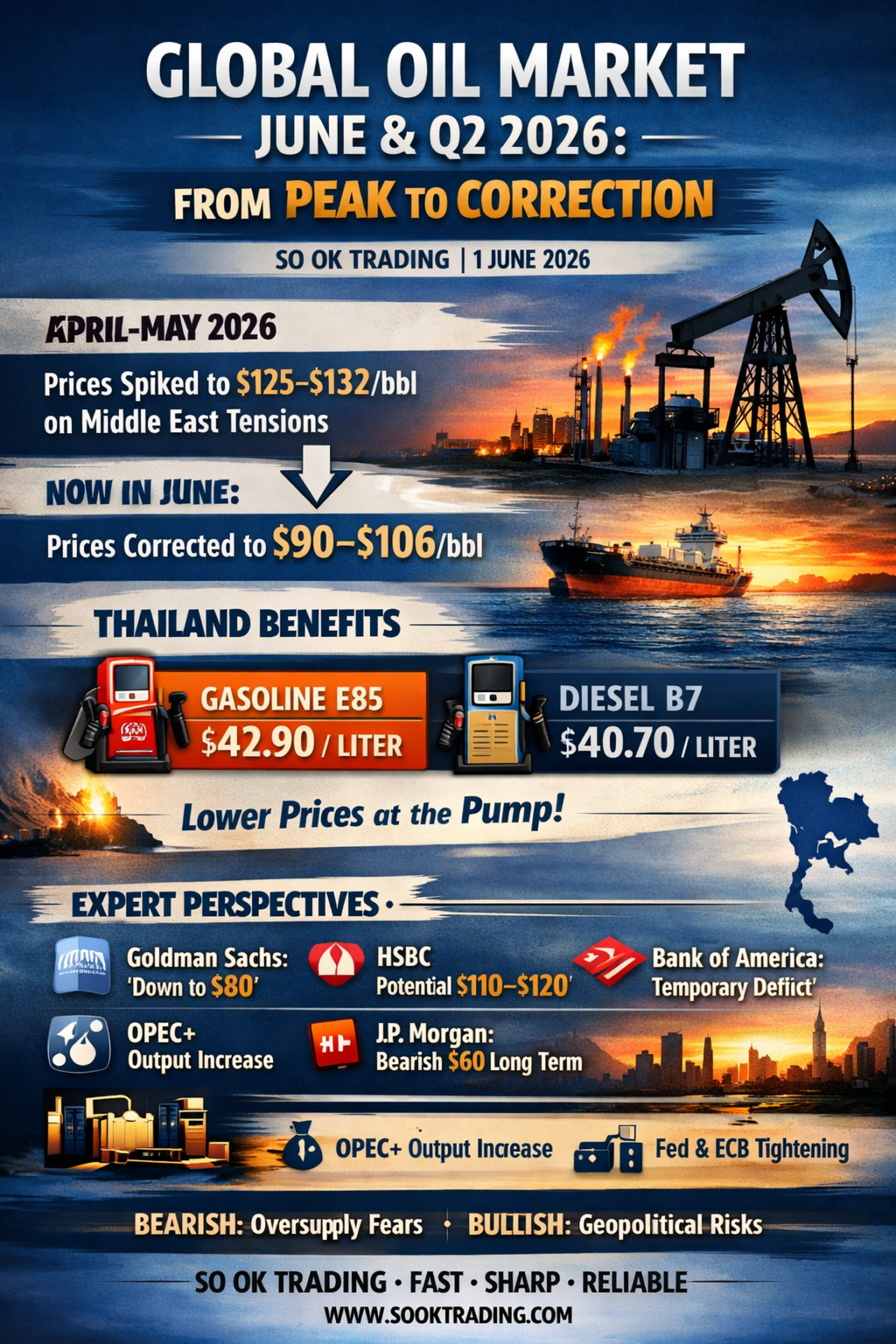
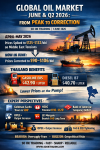
Global Oil Market June & Q2/2026: From Peak to Correction
SO OK TRADING | 1 JUNE 2026

From geopolitical crisis to market correction, global oil prices are showing signs of easing — and Thailand is reaping the benefits.

 
The Peak That Just Passed In April–May 2026, the global oil market was like a roller coaster. Crude oil (WTI & Brent) surged to $125–$132 per barrel amid Middle East tensions and the closure of the Strait of Hormuz, a vital artery of global energy transport. All eyes were on the looming risk of a severe supply shock.

But as June begins, the situation has started to ease. Shipping routes reopened, supply from the U.S. and non‑OPEC+ producers flowed back into the system, and prices corrected to $90–$106 per barrel.

 
⛽ Thailand Benefits Immediately

Gasoline & Gasohol: Down by 0.70–1.40 THB/L → Gasohol 95 now at 42.90 THB/L
Diesel B7: Fixed at 40.70 THB/L by government and the Oil Fund to control transport costs and inflation
 
Global Financial Institutions’ Outlook

Goldman Sachs: Risks easing → prices may slide to $80 in Q4
HSBC: Concern over slow supply recovery → rebound possible to $110–$120
J.P. Morgan: Long‑term bearish → average $60, risk of $30 by 2027
Bank of America: Temporary deficit in H1 → correction in H2
 
⚙️ Key Drivers in June 1️⃣ OPEC+ increases output by 188,000 bpd for the third consecutive month 2️⃣ Tight monetary policies from the Fed & ECB 3️⃣ OPEC+ Ministerial Meeting on June 7 to set Q3 production quotas

 
Big Picture The global oil market is shifting from “crisis surge” to “correction mode.” Thailand’s retail fuel prices are easing, reducing household and transport burdens. Yet the mid‑ to long‑term outlook remains split:

Bearish: Oversupply could drive prices lower
Bullish: Fragile geopolitics may trigger another rebound
 
SO OK TRADING Your trusted partner in the energy world FAST • SHARP • RELIABLE www.sooktrading.com Facebook: SO OK TRADING

Related Content
LEAD INGOT กับ อุตสาหกรรม BATTERY
Lead ingot คือ โลหะตะกั่วแท่งที่ใช้เป็นวัตถุดิบหลักในการผลิตแบตเตอรี่ตะกั่ว-กรด เนื่องจากมีความหนาแน่นสูงและคุณสมบัติทางเคมีที่เหมาะสม ทำให้เป็นส่วนประกอบสำคัญในแผ่นขั้วบวกและขั้วลบของแบตเตอรี่ Lead ingot ที่มีความบริสุทธิ์สูงจะช่วยให้แบตเตอรี่มีประสิทธิภาพและอายุการใช้งานยาวนานขึ้น การใช้งาน Lead ingot ในแบตเตอรี่ วัตถุดิบหลัก: ใช้เป็นวัตถุดิบตั้งต้นในการผลิตแบตเตอรี่ตะกั่ว-กรด ซึ่งใช้ในรถยนต์ ระบบสำรองไฟ (UPS) และระบบกักเก็บพลังงานแสงอาทิตย์ การผลิตแผ่นขั้ว: เป็นส่วนประกอบสำคัญในการผลิตแผ่นขั้วไฟฟ้าของแบตเตอรี่ ซึ่งเป็นส่วนที่เกิดปฏิกิริยาเคมี คุณภาพและประสิทธิภาพ: ความบริสุทธิ์ของตะกั่วใน lead ingot มีผลโดยตรงต่อประสิทธิภาพและอายุการใช้งานของแบตเตอรี่ การรีไซเคิล: นอกจากใช้ผลิตใหม่แล้ว ตะกั่วจากแบตเตอรี่ที่ใช้แล้วยังสามารถนำมารีไซเคิลและแปรรูปเป็น lead ingot เพื่อนำกลับมาใช้ใหม่ได้อีกครั้ง
27 Nov 2025
“Zinc 2026: From Galvanized Steel to the Heart of EV Batteries — An Ordinary Metal Becoming the Strategic Resource for Clean Energy in a Changing World”   Article by SO OK TRADING | April 3, 2026
In 2026, the zinc market is no longer just about prices and supply-demand balance. Zinc is undergoing a major transformation: from a basic industrial metal used in construction and galvanizing, it is evolving into a strategic resource of the future — powering the global shift toward clean energy and advanced technologies. Beyond its traditional role in protecting steel from corrosion, zinc is now at the center of innovation, from zinc-air batteries for electric vehicles (EVs) to renewable energy infrastructure such as solar panels and wind turbines. While the short-term challenge of oversupply looms large, the long-term opportunity is clear: zinc is becoming the backbone of a sustainable, low-carbon world.
3 Apr 2026
“War Shakes the Global Packaging Industry: Supply Chain Disruption, Plastic Shortage & Aluminum Squeeze – From Crisis to New Business Opportunities” Article by SO OK TRADING | March 26, 2026
“War Reshapes the Packaging Industry – Plastic Stumbles, Aluminum Faces Shortages” The Middle East conflict has severely disrupted global supply chains, striking hardest at petrochemicals and packaging. Plastic packaging is in critical shortage, while aluminum has been pulled in as the substitute material—only to face its own supply squeeze. Both stockpiling and new production are under pressure, especially in food and beverage packaging. This article by SO OK TRADING dives deep into the cascading impacts of war on the packaging industry, and highlights strategies and opportunities to pivot toward recycled packaging and innovative solutions in 2026.
26 Mar 2026
This website uses cookies for best user experience, to find out more you can go to our Privacy Policy and Cookies Policy
Powered By MakeWebEasy Logo MakeWebEasy