Wood Pellets: Clean Renewable Energy Driving Thailand’s Green Future SO OK TRADING : 11 MAY 2026
Wood Pellets: Renewable Energy Becoming a Mainstream Fuel
SO OK TRADING : 11 MAY 2026
Wood pellets, or compressed biomass, are being hailed as the “fuel of the future.” They not only address environmental concerns but also unlock massive business opportunities. Thailand, in particular, holds strong potential within ASEAN—both in production, exports, and expansion into the global clean energy market.
Types of Use
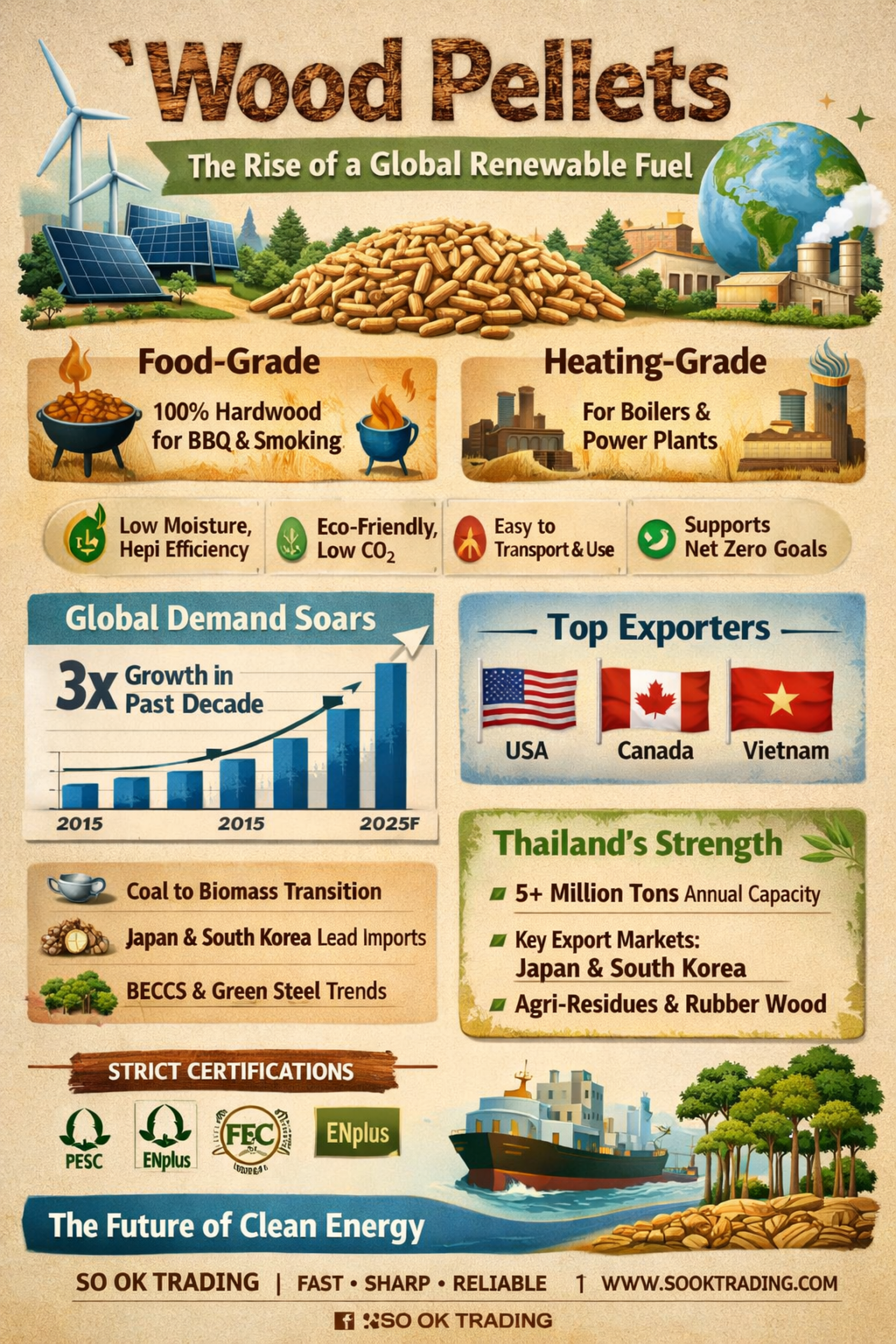
Food-Grade: For BBQ and smoking, made from 100% hardwood such as apple, hickory, and oak → delivers unique aroma and is safe for health
Heating-Grade: For boilers, power plants, and fireplaces → made from softwood or bark, offering high calorific value at affordable cost
✨ Why Wood Pellets Are Rising
High Efficiency: Low moisture, clean combustion, consistent heat
Eco-Friendly: Reduces CO₂ emissions, utilizes waste materials, lowers landfill problems
Convenience: Easy to pack and transport, compatible with automatic fuel feeding systems
Global Policy Alignment: Supports Net Zero goals and complies with Europe’s CBAM regulations
Prices and Market
Retail: 199–1,400 THB/bag (10–20 kg)
Industrial: 3,000–5,000 THB/ton
Export (F.O.B.): 4,400–5,000 THB/ton (137–142 USD)
Price Trend: Volatile with fossil fuels but remains high due to demand exceeding supply
Global Situation
Surging Demand: Coal-fired power plants in Europe, Japan, and South Korea are blending or switching to wood pellets to cut carbon
Strict Supply Chain: FSC/PEFC certification required to ensure sustainable wood sourcing
New Trends: Use in BECCS (Bioenergy with Carbon Capture and Storage) and low-carbon steel production
Global Competition: US and Canada lead in quality but face high transport costs, while Vietnam rises in Asia with competitive pricing
Thailand’s Situation
Main raw materials: Rubberwood, eucalyptus, acacia, agricultural residues
Production capacity: Up to 5.32 million tons/year
Export destinations: Netherlands (64.7%), South Korea (26.7%), Japan (7.8%)
Domestic market: Food, textile, and construction industries → cost reduction and CBAM compliance
Challenges: Raw material cost fluctuations, price competition with Vietnam
New opportunities: Developing “fast-growing tree farms” for dedicated fuel production and adding value to agricultural waste
️ Quality Standards
TIS 2772-2017: Calorific value ≥ 3,940 kcal/kg, moisture <10%, ash ≤3%
ENplus A1: Ash <0.7%, suitable for household use
ENplus A2: Ash <1.2%, suitable for large boilers
EN-B: Industrial grade, ash ≤2%
Business Opportunities and Future Outlook
Thai demand: Expected to reach 0.6 million tons by 2025
Export markets: Japan and South Korea remain key, with new opportunities in BECCS and steel production
Growth potential: Producers must achieve international standards (ENplus) and secure continuous raw material supply
New investments: Fast-growing tree farms and agricultural waste utilization
Global policy link: Carbon neutrality and CBAM are driving wood pellets into mainstream energy
Thai strategy: Build certified “Green Energy” brands to compete with Vietnam and Canada in Asia
Value creation: Producers can expand into carbon credits and environmental marketing to attract foreign investors
✨ Conclusion: Wood pellets are no longer just an “alternative fuel.” They are rapidly becoming a “mainstream energy source” adopted worldwide and in Thailand to reduce carbon emissions and energy costs. Thai producers have massive growth opportunities if they can maintain international standards, secure supply chains, and position themselves as renewable energy leaders in ASEAN.
SO OK TRADING : Your Trusted Business Partner SO OK TRADING : FAST SHARP RELIABLE WWW.SOOKTRADING.COM FACEBOOK : SO OK TRADING