Share

“Higher for Longer – The World Trapped in Stagnation and Stubborn Inflation: A New Era for Investors” Article by SO OK TRADING : April 30, 2026
Last updated: 30 Apr 2026
938 Views

“Higher for Longer – The World Trapped in Expensive but Stagnant Growth” Article by SO OK TRADING : April 30, 2026

 
Big Picture: Global Economy, April 2026
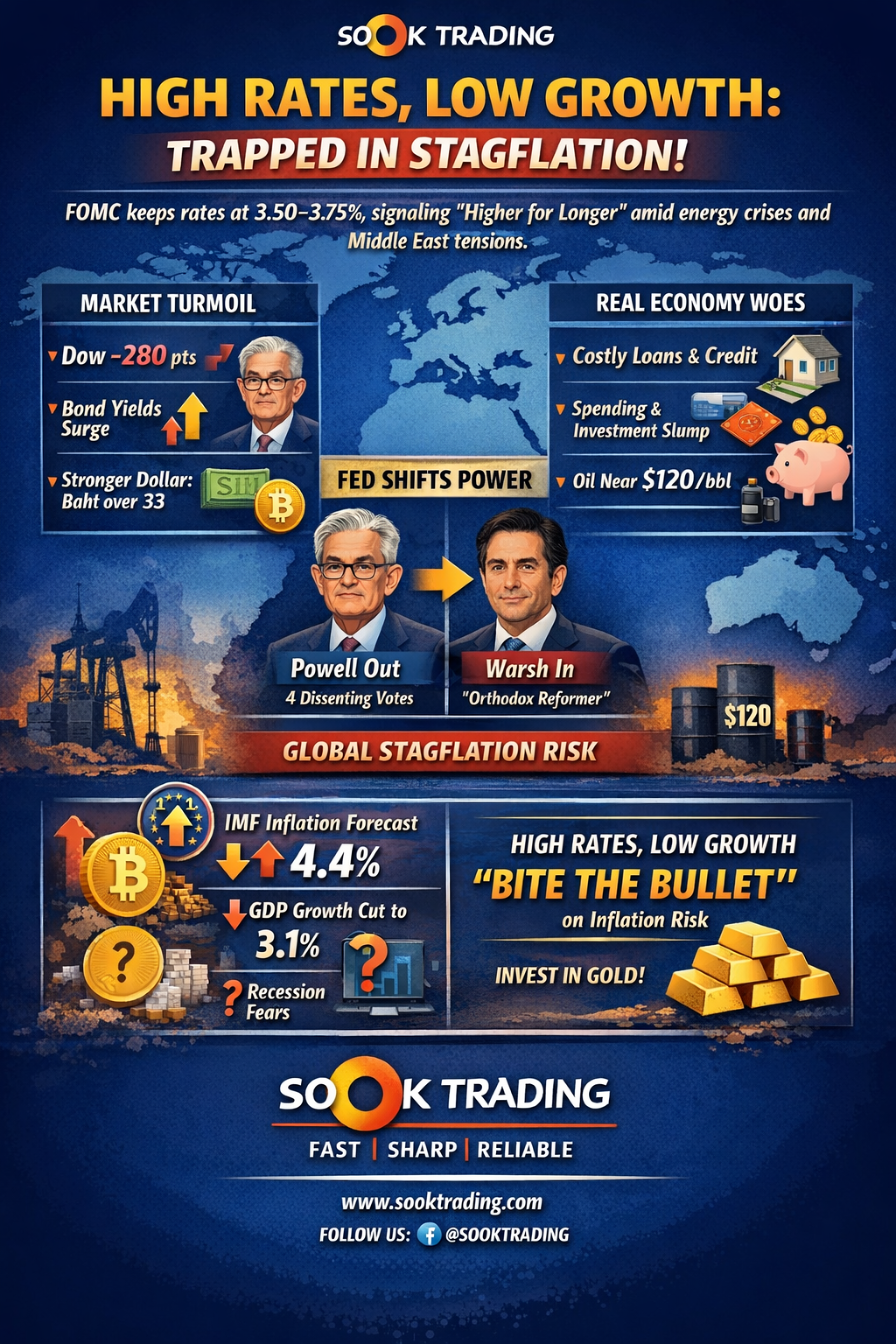
The FOMC meeting on April 28–29, 2026 marked a turning point. The Fed decided to keep interest rates at 3.50–3.75% for the third consecutive time, sending a clear signal that the world is entering the era of Higher for Longer — high interest rates maintained to fight stubborn inflation driven by surging energy prices and Middle East conflicts.

 
Financial Markets: Volatility to Watch
U.S. Stocks: Dow Jones fell 280 points as investors worried about costly financing.
Bonds: Treasury yields surged, reflecting expectations that rate cuts won’t come soon.
Currencies: The U.S. dollar strengthened, pressuring emerging market currencies; the Thai baht weakened past 33.
Crypto: Bitcoin dropped below $76,000 immediately after the meeting.
 
Real Economy: Debt Burden Persists
High Borrowing Costs: Mortgages, credit cards, and business loans remain expensive.
Consumption & Investment Slowdown: Households prioritize saving, businesses delay expansion.
Oil Prices Surge: Brent crude nears $120 per barrel amid Middle East tensions.
 
Fed Division – Powell Hands Over to Warsh
This meeting saw 4 dissenting votes, the highest since 1992.
It was Jerome Powell’s final meeting before handing leadership to Kevin Warsh.
Warsh is viewed as an “Orthodox Reformer”: strict on balance sheet reduction but flexible on rate cuts if the economy slows.
 
Global Interest Rates: Wait-and-See
ECB (Europe): Deposit rate held at 2.00%, with possible hikes if energy inflation persists.
BoE (UK): Cut rates to 3.75%, but the close vote highlights uncertainty.
BoJ (Japan): Held at 0.75%, though calls to raise to 1.0% are growing.
 
⚠️ Stagflation Risk: A Perfect Storm
Global Inflation: IMF raised its 2026 forecast to 4.4%.
Global GDP: Growth outlook cut to 3.1%, with risks of dropping to 2% if conflicts drag on.
Policy Dilemma: Rate hikes risk recession, while rate cuts risk fueling inflation.
 
Conclusion
The world is sliding into the trap of “high prices but no growth.” Central banks are choosing to maintain high rates to curb inflation, even at the risk of recession — ushering in the Higher for Longer era.

Investors should be cautious with risk assets and consider inflation-hedging options such as gold.

 
SO OK TRADING: Your Business Partner FAST • SHARP • RELIABLE www.sooktrading.com Facebook: SO OK TRADING

Related Content
“Thai Natural Rubber: The Soft Power Driving the World – A Strategic Commodity of the New Century in the EV and BCG Era. Thai Rubber: The Essential Resource Demanded by Global Industries” Article by SO OK TRADING | March 26, 2026
“Thai Natural Rubber: From Plantations to Global Strategic Commodity” Published: March 28, 2026 Thailand is not just a rubber producer—it is the world’s leading exporter, holding over 30% of global natural rubber exports. Thai rubber has become the backbone of industries worldwide, from automotive and medical to construction. This article explores Thailand’s strengths and the future direction of the rubber industry in the EV era and the Bio-Circular-Green (BCG) economy.
28 Mar 2026
“Energy Pulse 2026: Naphtha Recovery – Positive Signals from the Global Energy Crisis Toward a New Market Balance” Article by SO OK TRADING | May 18, 2026
Naphtha Crisis 2026 – Latest Situation Update Positive Outlook | SO OK TRADING Since the outbreak of the Middle East conflict in late February, the global energy market has been shaken dramatically. Crude oil prices surged past $150 per barrel, driving Asian naphtha prices to nearly double. By mid‑May, prices corrected to $897 per ton, though still 62.54% higher than last year. Even as prices begin to ease, supply chain “lag effects” remain — shipping delays of 15–20 days and congested ports due to competition for raw material shipments from the Middle East continue to pressure industries across Asia. In Thailand, SCGC declared force majeure and temporarily shut down the Rayong Olefins plant, while PTTGC and SCGC are studying the establishment of a joint venture to enhance flexibility and reduce long‑term costs. In Japan, leading snack brand Calbee announced a packaging strategy shift, reducing color printing on 14 products to black‑and‑white to cope with ink and resin shortages — reflecting the rising trend of “minimalist design” during the crisis. At the same time, recovery signals are emerging: Naphtha prices dropped from the peak of $1,020 → $897 per ton Spreads rebounded: Ethylene–Naphtha +250–280 / Propylene–Naphtha +310–330 Plastic prices remain high but show signs of stabilization If the Middle East situation does not flare up again, this crisis is expected to ease by late June – early July 2026. SO OK TRADING FAST • SHARP • RELIABLE Your Trusted Business Partner
18 May 2026
This website uses cookies for best user experience, to find out more you can go to our Privacy Policy and Cookies Policy
Powered By MakeWebEasy Logo MakeWebEasy