Share

“ANTIMONY AWAKENING: The Strategic Mineral – A New Lifeline Driving the Green Economy and Global Energy Transition” 22 April 2026 · By SO OK TRADING
Last updated: 22 Apr 2026
2363 Views

Antimony: The Strategic Mineral Transforming Global Energy Not only facing a supply shortage, but becoming indispensable to global industries Article by SO OK TRADING · 22 April 2026

 
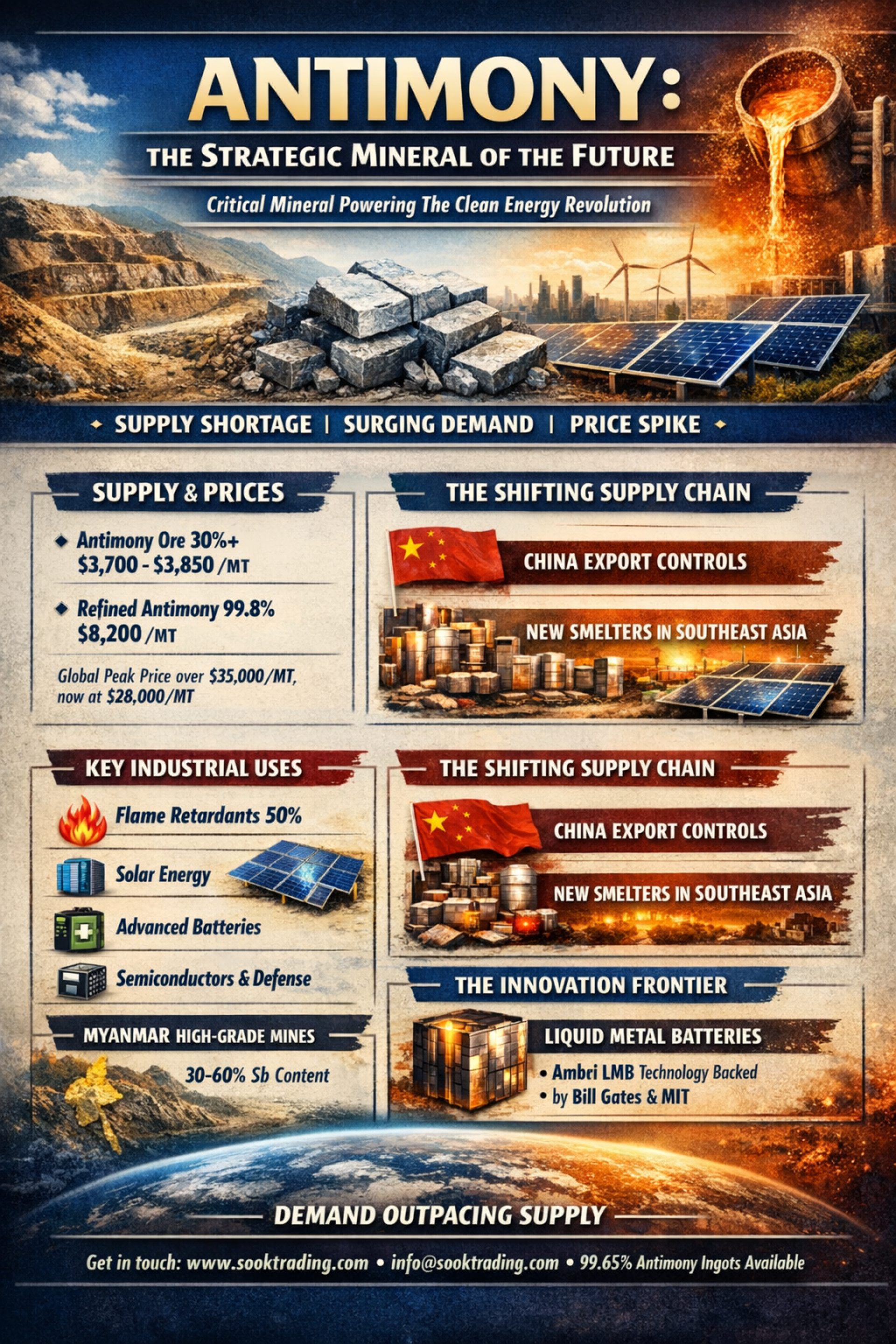
As the world accelerates into the era of clean energy and advanced technology, antimony (Sb) has emerged as a critical mineral under the spotlight. It is not just about volatile prices — antimony is officially classified as a Critical Mineral, a strategic resource essential across multiple industries.

 
From Mines to Global Markets
In April 2026, antimony ore and ingot prices remain elevated:

Antimony Ore (30%+ grade): 130,000 – 135,000 THB/ton
Refined Antimony (99.8%): ~150,000 THB/ton
Globally, prices peaked at over $35,000/ton in 2025, before easing to $28,000/ton (~820,000 THB) today — still well above historical averages.

 
Demand That Never Declines
Antimony is widely used across industries:

Flame Retardants: ~50% of market share
Solar Panels: improves glass quality and light absorption
Batteries: durable lead-acid and next-gen Liquid Metal Batteries (LMB) for clean energy storage
Defense & Semiconductors: vital in infrared devices and advanced chips
 
China’s Supply Shift
Since late 2024, China tightened export controls. Chinese capital moved smelters to Laos and Cambodia to bypass quotas, increasing global ingot supply.

 
Thailand’s Opportunity & Challenge
Opportunity: easier to channel raw ore to border smelters
Challenge: strict licensing and Certificates of Origin required to avoid being labeled “illegal ore”
 
Myanmar: A Powerful New Source
Mines in Shan State and the Thai-Myanmar border (e.g., Tha Byu) produce ore with 30–60% Sb content. Thai imports surged over 300% between 2025–2026.

 
⚡ Antimony Battery Innovation The most exciting development is the Liquid Metal Battery (LMB) by Ambri (MIT spin-off, backed by Bill Gates):

Lifespan over 20 years
Safe, no fire risk
Lower cost than lithium-ion
Rice University also pioneered Antimony-Graphite technology, solving battery degradation issues and expanding antimony’s role in lithium and sodium batteries.

 
Market Outlook
Demand > Supply: imbalance will persist for years
Asia-Pacific: dominates with 64.4% share, driven by solar and electronics production
Recycling: insufficient to meet surging clean energy demand
 
Antimony in Industrial Nations
Antimony is being elevated as the backbone of the green economy and advanced technology:

Clean Energy Storage: LMB for grid-scale solar and wind storage
Lithium Alternative: safer and lower-cost option for renewable systems
Safety Standards: flame retardants in plastics, electronics, and construction
Electric Vehicles (EVs): durable lead-acid and experimental next-gen batteries
Defense & Aerospace: infrared sensors, guidance systems, and specialized semiconductors
 
♻️ Recycling & Circular Economy US and Europe are investing in recycling antimony from old batteries and e-waste to build secure supply chains and reduce reliance on China.

 
Future Projections
Global market expected to grow from $1.22 billion (2026) to $2.01 billion (2037) at CAGR 5.8%
Asia-Pacific will remain the largest hub (China, Japan, South Korea)
Industrial nations accelerating new mines, recycling, and smelters outside China
 
Conclusion
Antimony is no longer just a mineral — it is the new lifeline of the global economy. From clean energy storage and EVs to defense and aerospace, antimony is set to play a decisive role in shaping the future of industries worldwide.

 
For inquiries about 99.65% Antimony Ingots:

Visit: www.sooktrading.com → GIVE INQUIRY
✉️ Email: sooktrading@outlook.com
SO OK TRADING – FAST • SHARP • RELIABLE Follow us on Facebook: SO OK TRADING


Related Content
ALUMINUM PRICE TREND 2026
An analysis of the aluminum market in 2026 indicates a likely continued market deficit and upward price pressure, driven by constrained supply and resilient demand from green energy sectors. However, significant volatility is expected due to policy uncertainties and the potential for new Indonesian supply to eventually balance the market. Key Drivers and Projections for 2026 Supply Side Analysis Capacity Constraints: China's primary aluminum output is approaching its self-imposed 45 million-tonne capacity cap, limiting global supply growth. Power Challenges: Smelters outside of China face intense competition for power from energy-intensive sectors like AI data centers, which are willing to pay higher prices for long-term contracts. This has kept significant capacity offline in Europe and the US. Production Disruptions: Outages and potential shutdowns at existing smelters in Iceland and Mozambique further tighten the market. Scrap Supply Pressure: The EU's planned implementation of the Carbon Border Adjustment Mechanism (CBAM) and potential scrap export tariffs in spring 2026 are expected to impact global scrap flows, creating regional shortages and price volatility. New Capacity: Indonesia is a key source of new supply, with several projects in the pipeline. However, analysts suggest the pace of the ramp-up may be slower than expected due to infrastructure and policy challenges, meaning it is unlikely to fully offset near-term tightness. Demand Side Analysis Green Transition Demand: Demand from "green" sectors such as solar panels, new energy vehicles, and energy transition infrastructure remains strong, providing fundamental support for the market. Substitution Effect: Aluminum's wide price discount relative to copper has encouraged substitution in electrical applications, acting as a tailwind for demand and prices. Construction and Automotive: The construction and automotive industries continue to be major consumers, with growing demand for lightweight, low-carbon aluminum products. Price Forecasts and Volatility The market is expected to remain in a deficit in 2026, with estimates ranging from 200,000 to 600,000 tonnes. This structural tightness is leading most analysts to forecast sustained or rising prices. Bullish Views: Analysts at Bank of America project prices of $3,000/tonne as early as 2026. J.P. Morgan also expects prices to approach $3,000/tonne in Q1 2026. ING forecasts an average price of $2,900/tonne for the year. Bearish/Conservative Views: Goldman Sachs is an outlier, forecasting prices to decline to $2,350/tonne by Q4 2026, anticipating a market surplus later in the year. SMM forecasts a "high first, then lower" pattern, with prices finding equilibrium in the $2,700–$2,800/tonne range by year-end. Premiums: Regional premiums, particularly the US Midwest premium, are expected to remain high and volatile due to tariffs and regional supply dynamics, creating a disconnect from the LME benchmark price. In essence, 2026 is projected to be a year of high volatility where participants need to focus on scenario readiness rather than relying on a single price forecast, as geopolitical and energy policies significantly influence regional supply and costs
31 Dec 2025
“Zinc 2026: From Galvanized Steel to the Heart of EV Batteries — An Ordinary Metal Becoming the Strategic Resource for Clean Energy in a Changing World”   Article by SO OK TRADING | April 3, 2026
In 2026, the zinc market is no longer just about prices and supply-demand balance. Zinc is undergoing a major transformation: from a basic industrial metal used in construction and galvanizing, it is evolving into a strategic resource of the future — powering the global shift toward clean energy and advanced technologies. Beyond its traditional role in protecting steel from corrosion, zinc is now at the center of innovation, from zinc-air batteries for electric vehicles (EVs) to renewable energy infrastructure such as solar panels and wind turbines. While the short-term challenge of oversupply looms large, the long-term opportunity is clear: zinc is becoming the backbone of a sustainable, low-carbon world.
3 Apr 2026
This website uses cookies for best user experience, to find out more you can go to our Privacy Policy and Cookies Policy
Powered By MakeWebEasy Logo MakeWebEasy