Share

“ZINC 2026: Global Zinc Market on Fire – Supply Shortage Driving Prices Higher” BY SO OK TRADING | April 21, 2026
Last updated: 21 Apr 2026
328 Views

Global Zinc Market: When Supply Tightness Becomes the Story
By SO OK TRADING | April 21, 2026

 
Imagine stepping into the London Metal Exchange (LME)
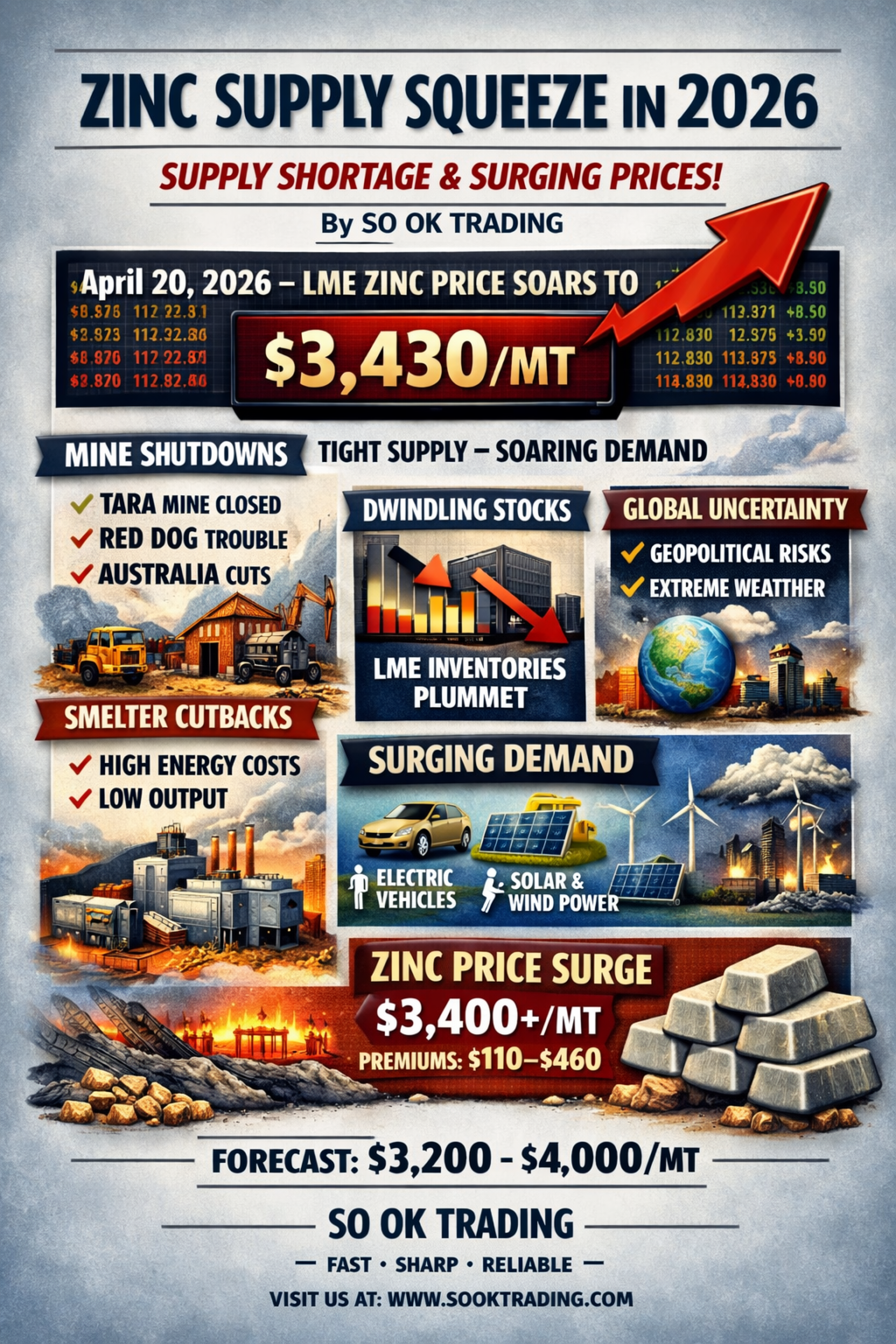
On April 20, 2026, the trading board lit up — Zinc surged to $3,430 per ton, the highest in years. Excitement and concern filled the room as the market reacted to the tightening supply.

 
Silent Mines: The Beginning of the Crisis
Once-busy zinc mines have gone quiet. Tara Mine in Ireland shut down, Australian mines halted due to rising costs, and even Red Dog in the U.S. faced declining ore quality. Supply shrank sharply, leaving the market visibly strained.

 
Struggling Smelters: Lower Output, Higher Costs
Global smelters are burdened by soaring energy costs and strict environmental regulations. European plants reduced output, some went into maintenance shutdowns, while Chinese smelters faced production cuts due to pollution and energy restrictions. Treatment charges (TC) fell below break-even, forcing producers to slow down.

 
Vanishing Stocks: Market Fragility
LME warehouses once full now stand nearly empty. Traders withdrew zinc to store off-market for speculation, causing official inventories to plunge. This fragility makes the market highly sensitive to even minor news or disruptions.

 
A Turbulent World: External Pressures
Trade conflicts and geopolitical tensions disrupted shipments. Droughts and extreme weather hit mines and smelters reliant on water, worsening the global supply squeeze.

 
Relentless Demand: Growth of New Markets
Demand continues to rise, driven by infrastructure projects, electric vehicles, and clean energy. Galvanized steel remains essential for solar and wind projects worldwide, keeping zinc consumption strong.

 
Price Surge: A Signal of Tightness
Zinc prices climbed from $2,900 to above $3,400 per ton. In local currency terms, costs soared further. Regional premiums highlight market differences: Southeast Asia $110–140, Europe $220–260, and the U.S. $400–460 per ton.

 
Grade Differences: Quality Matters
Special High Grade (SHG, 99.99% purity) is vital for precision casting, while High Grade (HG, 99.95% purity) suffices for general galvanizing. Buyers pay more for higher purity, reflecting its value in specialized applications.

 
Price Outlook: Preparing for Uncertainty
Analysts at Goldman Sachs, Citi, and Macquarie remain bullish, forecasting $3,200–3,600 per ton, with potential to hit $4,000 if LME stocks fall to critical levels.

 
Conclusion: A Seller’s Market
The zinc story in 2026 is defined by supply shortages, rising demand, and surging prices. Until inventories recover, sellers will continue to dominate, and prices are likely to climb further.

 
SO OK TRADING – FAST • SHARP • RELIABLE Delivering high-quality ZINC INGOT (SHG / HG) ready for all industries. Contact us: SOOKTRADING@OUTLOOK.COM Visit: www.sooktrading.com Facebook: SO OK TRADING


Related Content
Aluminum Scrap & UBC Scrap: White Gold in Recycling and the Circular Economy Industry Outlook – Thailand’s Aluminum Sector By SO OK TRADING
Thailand’s aluminum scrap market is entering an exciting new era. What was once considered “waste” has now become a strategic resource powering sustainability, circular economy models, and global technology industries. In particular, UBC (Used Beverage Can) scrap is emerging as a cornerstone of the circular economy, enabling closed-loop recycling and reducing carbon footprints. By 2026, Thailand is set to strengthen its role as a regional hub for aluminum recycling, transforming scrap from a low-value byproduct into “White Gold” for both domestic and international markets.
15 Feb 2026
เกร็ดความรู้ การใช้งาน ALUMINUM INGOT (อลูมิเนียม INGOT) P1020 A7
Aluminum Ingot P1020 , A7 อลูมิเนียมเป็นหนึ่งในรูปแบบทั่วไปของโลหะผสมอลูมิเนียมที่ใช้ในอุตสาหกรรมสมัยใหม่ การผสมผสานคุณสมบัติที่เป็นเอกลักษณ์ของอลูมิเนียมทำให้เป็นวัสดุที่มีคุณค่าสำหรับการใช้งานที่หลากหลาย รวมถึงการก่อสร้าง การบินและอวกาศ การขนส่ง และสินค้าอุปโภคบริโภค ในบทความนี้ เราจะพิจารณากระบวนการผลิตแท่งอลูมิเนียมอย่างละเอียดมากยิ่งขึ้น กระบวนการผลิตแท่งอลูมิเนียมเริ่มต้นด้วยการสกัดแร่บอกไซต์ แร่นี้จะถูกบดเป็นผงละเอียดก่อนแล้วจึงผสมกับโซเดียมไฮดรอกไซด์ในกระบวนการที่เรียกว่ากระบวนการไบเออร์ สารละลายที่ได้จะถูกบำบัดด้วยความร้อนและความดันเพื่อสร้างอะลูมิเนียมไฮดรอกไซด์ ซึ่งจะถูกทำให้แห้งเพื่อผลิตผงอะลูมินาจากนั้นนำผงอลูมินามาผสมกับไครโอไลต์ ซึ่งเป็นแร่ธาตุหายากที่ทำหน้าที่เป็นฟลักซ์ ส่วนผสมจะถูกวางในเซลล์อิเล็กโทรไลต์ขนาดใหญ่ที่เต็มไปด้วยเกลือหลอมเหลว และกระแสไฟฟ้าจะถูกส่งผ่านเซลล์ กระบวนการนี้เรียกว่ากระบวนการ Hall-Héroult ทำให้อะลูมิเนียมออกไซด์แยกตัวออกจากออกซิเจน เหลือแต่อโลหะอะลูมิเนียมบริสุทธิ์ จากนั้นโลหะอลูมิเนียมจะถูกเทลงในแม่พิมพ์เพื่อสร้างรูปทรงลิ่ม แม่พิมพ์มักทำจากเหล็กหรือกราไฟต์และมีหลายขนาดและรูปร่าง แท่งอโลหะจะถูกทำให้เย็นและแข็งตัว จากนั้นนำออกจากแม่พิมพ์และตัดตามความยาว (Aluminum Slab) ก่อนที่แท่งอโลหะจะสามารถนำมาใช้ในอุตสาหกรรมได้ จะต้องผ่านกระบวนการต่อไป โดยทั่วไปแล้วจะละลายและหล่อเป็นรูปแบบเฉพาะสำหรับการใช้งานเฉพาะ ซึ่งอาจเกี่ยวข้องกับการผสมอลูมิเนียมกับอโลหะอื่นเพื่อให้ได้คุณสมบัติเฉพาะ เช่น ความแข็งแรง ความทนทานต่อการกัดกร่อน หรือการทนความร้อน แท่งอะลูมิเนียมมีขนาดตั้งแต่ไม่กี่ปอนด์ไปจนถึงหลายตัน ขึ้นอยู่กับการใช้งาน โดยปกติแล้วจะจัดส่งในปริมาณมากไปยังผู้ผลิต ซึ่งจะนำไปแปรรูปเป็นผลิตภัณฑ์ที่หลากหลายต่อไป (Aluminum Ingot, Aluminum Billet, Aluminum Slab) ETC. โดยสรุปแล้ว การผลิตแท่งอะลูมิเนียมเป็นกระบวนการที่ซับซ้อนซึ่งเกี่ยวข้องกับการเปลี่ยนแปลงทางเคมีและกายภาพหลายขั้นตอน จำเป็นต้องมีความเข้าใจอย่างลึกซึ้งเกี่ยวกับวัสดุศาสตร์และหลักการทางวิศวกรรม เช่นเดียวกับแรงงานที่มีทักษะในการใช้งานอุปกรณ์ที่ซับซ้อนที่ใช้ในกระบวนการ แท่งอลูมิเนียมมีบทบาทสำคัญในอุตสาหกรรมสมัยใหม่ และความสามารถรอบด้านและความน่าเชื่อถือทำให้เป็นวัสดุที่ขาดไม่ได้สำหรับการใช้งานที่หลากหลาย ตั้งแต่เครื่องครัว ไปจนถึง เครื่องบิน และ ชิ้นส่วนในยานอวกาศ
28 Nov 2025
This website uses cookies for best user experience, to find out more you can go to our Privacy Policy and Cookies Policy
Powered By MakeWebEasy Logo MakeWebEasy