Global Steel Market 2026: Rising Costs Push Sales Prices Up 10–15% SO OK TRADING – April 20, 2026
Global Steel Market – April 2026: Fragile Recovery, Rising Costs, Prices Up 10–15% SO OK TRADING|April 20, 2026
Global Market Overview
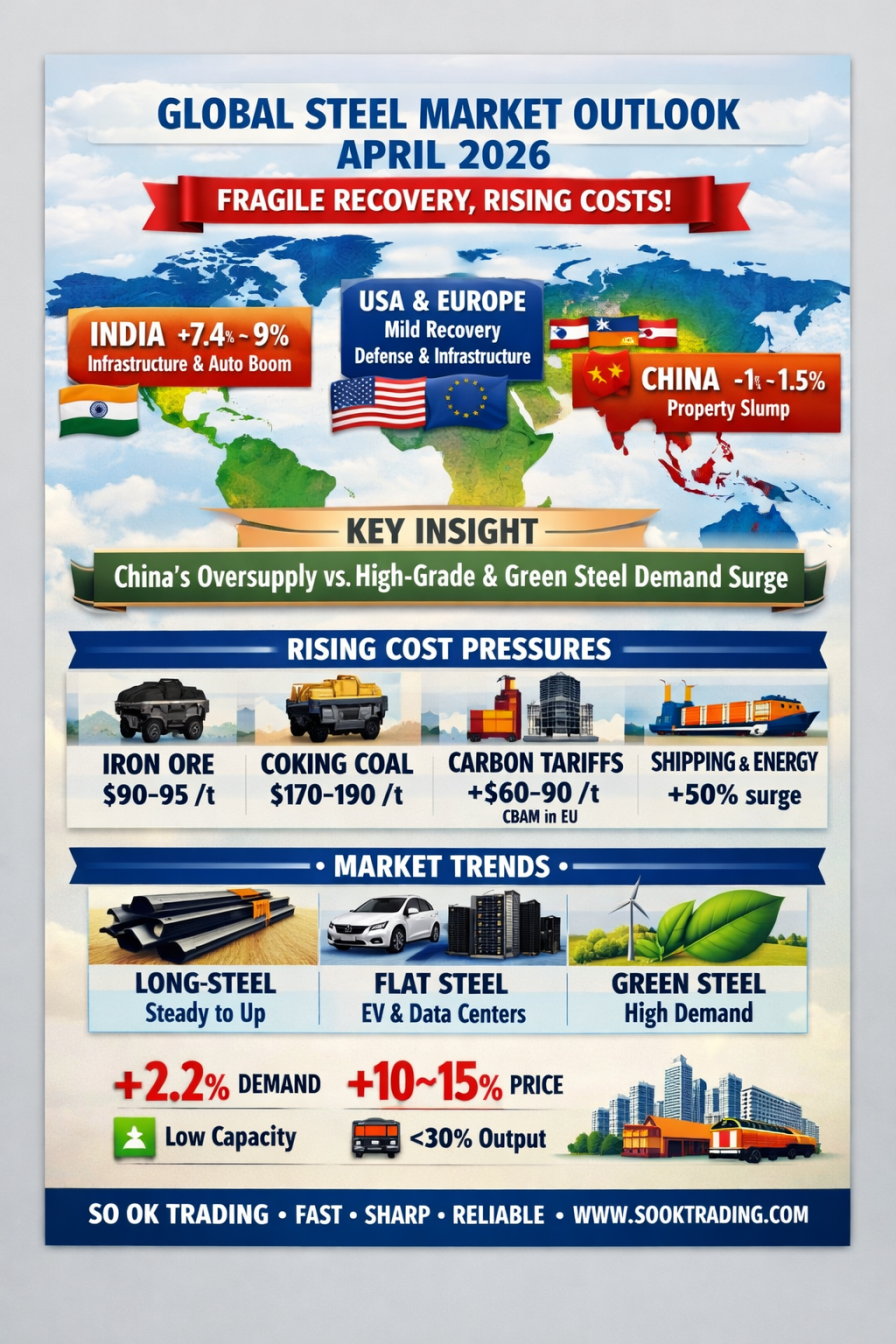
In 2026, the global steel market is undergoing a “fragile recovery.” Overall demand is growing only 0.3–1.3%, with sharp regional differences:
India: Star performer, expanding 7.4–9% driven by infrastructure and automotive investment
ASEAN: Growth of 4%, with Vietnam targeting GDP growth of 10%
United States & Europe: Modest recovery supported by infrastructure spending and defense budgets
China: Continued contraction of -1.0% to -1.5% due to a sluggish real estate sector
Key Insight: The market is splitting between oversupplied commodity steel from China and rising demand for high-quality and Green Steel in developed economies.
Rising Costs Pressure Steel Prices
Raw Materials: Iron ore averages $90–95/ton, coking coal $170–190/ton, Thai scrap surging to 15.2 THB/kg
Energy & Shipping: Middle East instability drives freight and energy costs up more than 50%
Carbon Tax (CBAM): EU enforcement adds $60–90/ton for high-emission steel
Currency: Weaker Thai baht raises import costs for raw materials
As a result, steelmakers worldwide, including Thailand, are raising sales prices by 10–15% to absorb cost pressures.
Product Segment Trends
Construction Steel (Long Products): Stable to slightly positive, supported by government megaprojects, though real estate remains weak
Flat Products: Strong upward trend driven by EV and data center industries
Structural Steel: Continued growth from prefabricated and green building trends
Specialty & Green Steel: Strong demand in Europe and North America, priced 20–30% higher than commodity steel
Thai Market Summary
Demand: Up 2.2% to 18.6 million tons, driven by government projects and EV industry
Supply: Domestic plants running below 30% capacity, struggling against cheaper imports
Price: Rising 10–15% under energy and logistics cost pressures
✨ Key Takeaway: April 2026 marks a clear market split — commodity steel faces oversupply and high costs, while high-quality and Green Steel emerge as premium products in strong demand. Companies pivoting toward Green Steel and EV markets will gain competitive advantage in this new industry landscape.
SO OK TRADING: Your Business Partner SO OK TRADING: FAST • SHARP • RELIABLE
VISIT US AT : WWW.SOOKTRADING.COM FACEBOOK : SO OK TRADING