“Global Oil Market and Thai Oil Price Outlook Q2/2026: The Energy Inflection Point After the US–Iran Ceasefire”
Global Oil Market and Thai Oil Price Outlook Q2/2026 Analysis by SO OK TRADING | April 9, 2026
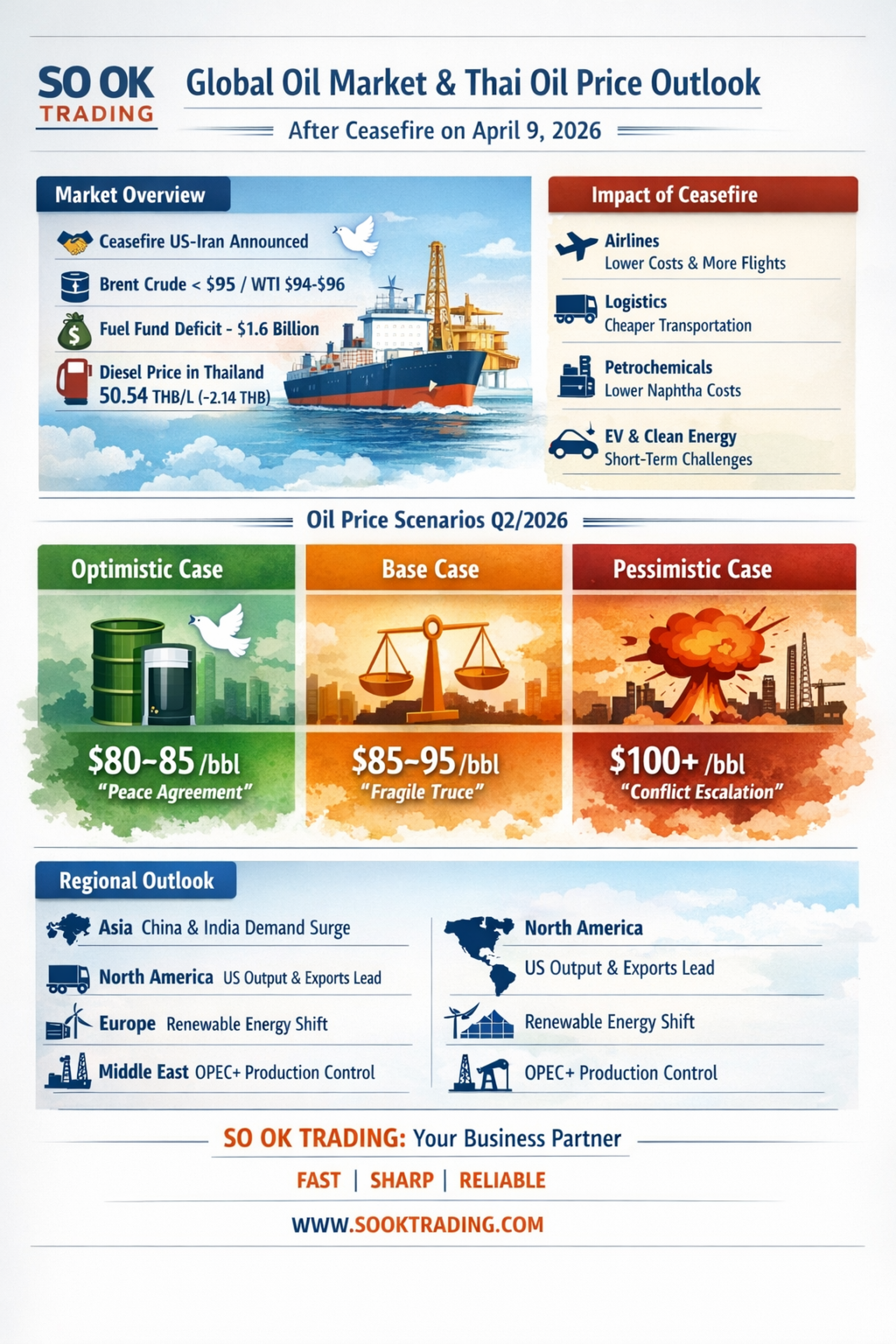
On April 9, 2026, the global energy market reached a critical turning point. Following the temporary ceasefire between the United States and Iran, crude oil prices plunged by 13–16% in a single day. In Thailand, diesel prices were immediately reduced by 2.14 THB per liter, now standing at around 50.54 THB/L, while gasoline and gasohol prices remained unchanged.
Key Market Drivers
Ceasefire in the Persian Gulf: Shipping routes through the Strait of Hormuz reopened, easing supply risks
Global Crude Prices: Brent fell below $95/bbl, WTI at $94–96/bbl
Thai Government Policy: The Fuel Fund Committee (กบน.) expanded diesel subsidies to ease living costs
Fuel Fund Deficit: Still over 56 billion THB in deficit, limiting the scope of price reductions
Forecasts from Financial Institutions
Goldman Sachs: Brent revised down to $90, WTI to $87
DBS: Brent average forecast at $86.5, potentially dropping to $79.5 in Q3 if stability continues
EIA: Despite lower prices, geopolitical risk premiums remain, leaving room for price rebounds
Impact of the Ceasefire on Industries
Airlines: Immediate reduction in jet fuel costs, higher profits, shorter flight routes
Logistics (Thailand): Lower diesel prices reduce transportation costs for consumer goods
Petrochemicals: Naphtha prices drop, lowering production costs for plastics and packaging
EV & Clean Energy: Short-term slowdown in adoption incentives, but strict environmental laws in the US and Europe continue to drive EV production
Oil Price Scenarios – Q2/2026 After Ceasefire
Optimistic Case
Ceasefire extends into permanent peace
Oil stabilizes at $80–85/bbl
Retail fuel prices continue to fall, boosting consumption and easing inflation
Base Case
Ceasefire remains fragile, with occasional violations
Oil fluctuates within $85–95/bbl
Pessimistic Case
Conflict reignites in the Persian Gulf
Oil surges above $100/bbl
Inflation spikes, threatening economic stability
Demand & Outlook by Region
Asia: China and India remain key demand drivers; partial reliance on Hormuz shipping
South Korea & Japan: Heavily dependent on imports via Hormuz, facing higher risk
North America: US acts as a “stabilizer” with strong production and exports
Europe: Accelerating renewable energy transition, reducing oil demand
Middle East: OPEC+ continues production control to maintain price levels
Conclusion
Q2/2026 marks an Inflection Point for the global energy market. If the ceasefire holds, lower oil prices will create golden opportunities for airlines, logistics, and exporters. If conflict resumes, oil prices will surge again, putting pressure on global economies.
SO OK TRADING — Your Business Partner FAST | SHARP | RELIABLE www.sooktrading.com