Share

“Oil Shortage Crisis: Oil Prices Boil! Global Shock, Thailand Hit Hard — Oil as the Catalyst of the World Economy : Article by SO OK TRADING : April 6, 2026”
Last updated: 6 Apr 2026
149 Views

Global Oil Price Crisis and Its Impact on the World and Thailand : Article by SO OK TRADING : April 6, 2026
 
Overview
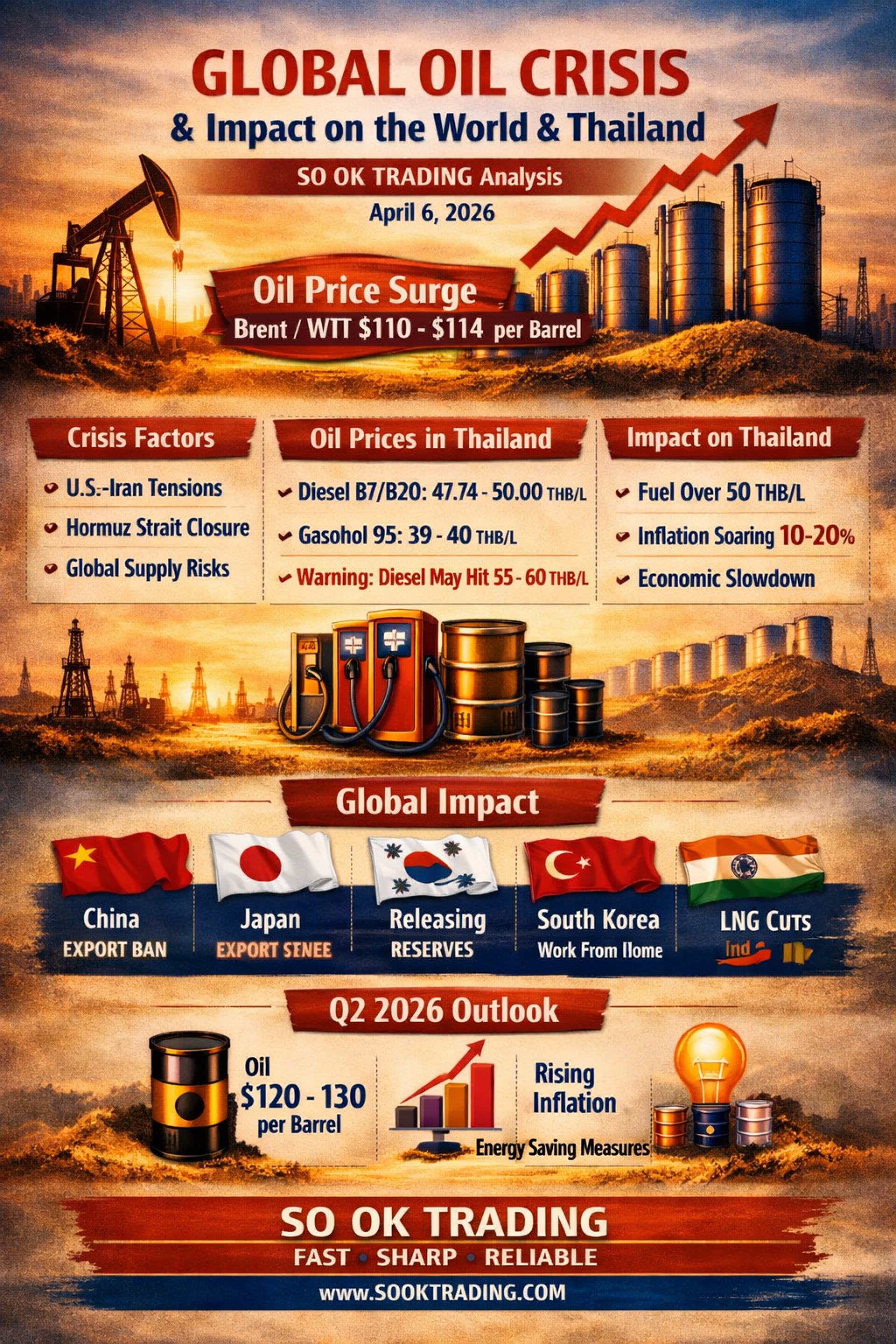
On April 6, 2026, the world is facing the largest oil price crisis in years. Brent and WTI crude prices have surged to $110–114 per barrel, reflecting escalating tensions in the Middle East and the closure of the Hormuz Strait, a vital route that carries more than 20% of global energy shipments.

 
Oil Prices in Thailand
Diesel B7/B20: 47.74–50.00 THB/L (increased by 2.80–3.50 THB/L on April 5)
Gasohol 95: 39–40 THB/L
Gasohol 91: 38–39 THB/L
E20: 37–38 THB/L
Benzene: 48–49 THB/L
Diesel prices may reach 55–60 THB/L in April if the situation persists.

 
Crisis Drivers
U.S.–Israel vs. Iran conflict
Closure of the Hormuz Strait by Iran
Global energy supply risks
 
Impact on Thailand
Retail fuel prices surged immediately, especially diesel exceeding 50 THB/L
Oil Fund deficit surpassing 47 billion THB
Government may introduce national energy-saving measures such as limiting shopping mall hours and promoting work-from-home
Inflation in Thailand may rise 10–20% due to higher transport costs
Economic growth may slow, with SCB EIC forecasting 2026 growth at around 1.4%
 
Regional and Global Impacts
China: Ban on refined oil exports, reserves for 60 days, preparing energy-saving measures
Japan: Oil reserves for 250 days, releasing over 80 million barrels, promoting work-from-home
South Korea: Oil reserves for 200 days, considering work-from-home to reduce energy use
India: Cutting LNG supply to factories to save energy
Australia: Over 283 gas stations without fuel, affecting travel and businesses
 
April and Q2/2026 Outlook
Global crude prices may reach $120–130/barrel if negotiations fail
Diesel in Thailand may rise to 55–60 THB/L
Inflation in Thailand may surge 10–20% due to transport costs
If the Hormuz Strait reopens, oil prices may drop to $90–100/barrel
 
Most Likely Scenario
Middle East tensions will persist at least through Q2/2026, keeping oil prices high at $110–130/barrel
Major importers such as Thailand, China, Japan, and South Korea will strictly manage reserves, enforce energy-saving measures, and accelerate alternative energy adoption
High oil prices will push inflation and production costs higher, slowing economic growth across many countries
Diplomatic negotiations may occur mid-2026, but it remains unclear whether agreements will be reached
 
Impact on Other Countries
China: Despite strong reserves, Hormuz Strait closure delays imports, affecting industry and transport
Japan: Must use reserves strictly, may limit energy use in businesses and households
South Korea: Facing high energy risks, must accelerate conservation and promote work-from-home
India: Cutting LNG supply to factories, slowing some production
Australia: Severe fuel shortages, widespread impact on travel and business
 
Key Watchpoints (April 6–10, 2026)
Iran’s response to U.S. ultimatum
Oil reserve levels of major importers
Thailand’s energy price restructuring, e.g., excise tax reduction
 
Conclusion
This oil price crisis is not just about energy — it is a catalyst forcing nations to restructure their economies and seriously shift toward alternative energy.

 
SO OK TRADING : FAST • SHARP • RELIABLE Your trusted business partner in every global market situation www.SOOKTRADING.com


Related Content
Thai Rubber: Premium Quality, Exported Worldwide – SO OK TRADING Insights into Thai Rubber for the Global Market
Thai Rubber: Global Impact & Future Outlook Thailand is the world’s leading exporter of natural rubber, powering industries from automotive tires to medical gloves. With over 19 million rai under cultivation, Thai rubber is vital for farmers and global supply chains. In 2026, prices are rising—fresh latex averages 57 Baht/kg, RSS3 around 60 Baht/kg—with forecasts reaching 100 Baht/kg as demand grows from EVs and healthcare. The EU’s new EUDR regulation positions Thailand as a low-risk supplier, unlocking premium opportunities in sustainable markets. SO OK TRADING CO., LTD. connects Thai rubber to the world—delivering quality, reliability, and trust.
17 Jan 2026
Rare Earths: Neodymium & Dysprosium Powering the Future of Clean Technology and Global Energy Quick Insight by SOOK TRADING
Rare Earth: Neodymium & Dysprosium Strategic Resources Driving the Future of Clean Energy and Global Industry Insight by SOOK TRADING Key Properties - Neodymium (Nd): A silver-gray metal, the core component of Neodymium-Iron-Boron (NdFeB) permanent magnets — the most powerful magnets in the world. It delivers extremely high magnetic strength in a compact size, enabling powerful yet small devices. - Dysprosium (Dy): A rare metal with very high melting and boiling points. It enhances the heat resistance of NdFeB magnets, ensuring stable performance in high-temperature environments such as electric vehicle motors and offshore wind turbines. Strategic Applications (2026) - Electric Vehicles (EVs): NdFeB magnets make motors smaller, lighter, and more powerful, while Dy improves heat resistance and prevents magnetic energy loss. - Renewable Energy: Offshore wind turbines require hundreds of kilograms of NdFeB magnets per megawatt, boosting efficiency and reducing long-term maintenance costs. - Robotics & Automation: Applied in precision joints and drive systems, supporting the growth of industrial robots and smart agricultural robotics. - Electronics & Medical Devices: Used in smartphone speakers, headphones, haptic feedback systems, MRI scanners, and advanced military radar systems. SOOK TRADING — Your Strategic Partner in Rare Earths and Clean Energy Solutions We provide high-quality materials and integrated solutions to power the future of your industry.
22 Jan 2026
Aluminium Packaging Transforms the Game: From Cans to Circular Economy, Towards the New Standard of Green Packaging Article by SO OK TRADING  March 28, 2026
นี่คือเวอร์ชันภาษาอังกฤษของโพสต์ที่คุณให้มา Mongkol: Aluminium Packaging: The Future of Sustainable Solutions By SO OK TRADING March 28, 2026 In an era driven by the Circular Economy and Net Zero goals, aluminium is no longer just an “option” — it has become the new standard in packaging, meeting both environmental regulations and consumer expectations. ✅ 100% recyclable without loss of quality ✅ Lightweight yet strong, reducing transport and energy costs ✅ Compliant with CBAM and carbon footprint reduction measures This article explores aluminium packaging trends across the globe and in Thailand, analyzing both the opportunities and challenges for producers in a world where “price” is no longer the sole factor — but where “green” is the true driver of competition.
28 Mar 2026
This website uses cookies for best user experience, to find out more you can go to our Privacy Policy and Cookies Policy
Powered By MakeWebEasy Logo MakeWebEasy