Share

Silver Supercycle 2026 – The Golden Era of Silver Power Driving Green Tech & AI Analysis of Silver Market Trends and Industrial Outlook by SOOK TRADING | April 3, 2026
Last updated: 3 Apr 2026
1653 Views

Silver Supercycle 2026 – When Silver Becomes the Strategic Metal of the World
 
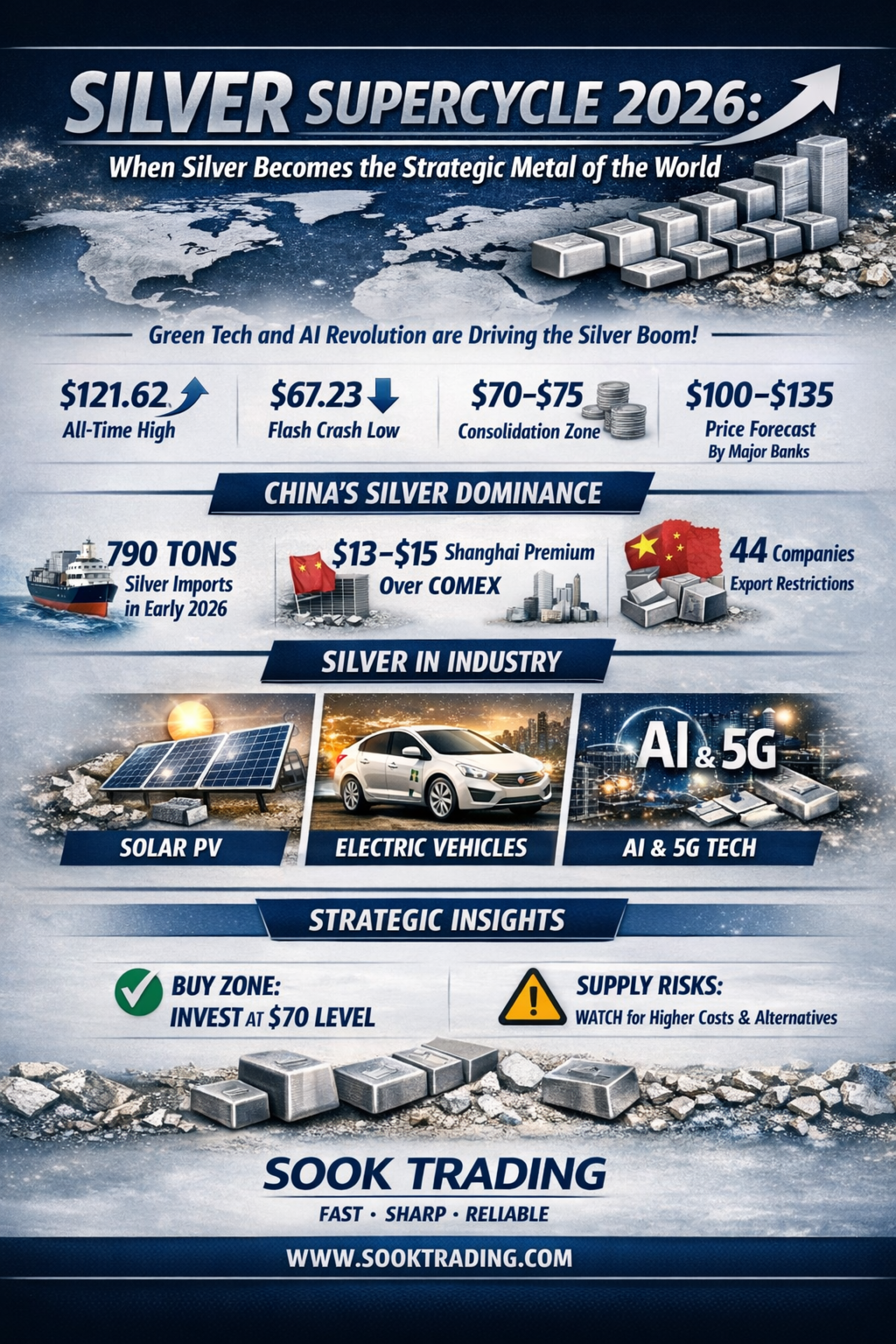
In 2026, silver has moved beyond its role as a mere “safe-haven asset” to become a strategic global metal, driving both the Green Tech transition and the AI revolution.
In January, silver surged to a record all-time high of $121.62. February witnessed a dramatic Flash Crash, dropping to $71. As of April 2026, silver is consolidating at $70–$75, building a new base for the next major rally.

 
Price Highlights and Market Direction
Year High: $121.62 (late January)
Year Low: $67.23 (March)
Current Status: Consolidation at $71–$73
Key Support: $68–$70
Key Resistance: $78–$82
Analysts from Citigroup and Goldman Sachs expect silver to rebound to $100–$110 in Q2, with the potential to break $135 if a short squeeze occurs.

 
Global Financial Institutions’ Outlook
Citigroup: Forecasts $100–$110 in Q2, driven by AI and new solar panel demand.
J.P. Morgan: Predicts April range at $75–$82, citing pressure from high interest rates.
Goldman Sachs: Expects silver to outperform gold, with an annual average of $85–$100. April marks the start of a new bull run.
Bank of America (BofA): Suggests prices could surge past $135 if short covering accelerates.
Market Consensus: Average price projected at $81 for 2026, nearly double that of 2025.
 
China’s Role in the Global Silver Market
China has emerged as the price-setter in 2026:

Massive Imports: Over 790 tons in the first two months, with 470 tons in February alone (an 8-year high).
Shanghai Premium: Prices in Shanghai exceeded COMEX by $13–$15.
Export Controls: Since January 1, 2026, only 44 companies are authorized to export silver. It is now classified as a strategic resource reserved for domestic industries.
 
⚙️ Silver in Chinese Industry
Solar PV: New TOPCon and HJT panels use 30–50% more silver.
Electric Vehicles (EVs): Silver usage nearly doubles compared to gasoline cars.
AI & Data Centers: Silver is essential for chips, high-performance computing, and 5G/6G infrastructure.
 
⚡ Opportunities and Risks
Opportunities: Silver is both a safe-haven asset and an industrial metal, attracting investors and tech manufacturers alike.
Risks: Sustained prices above $120–$150 could push industries toward copper or aluminum substitutes.
Mining Costs: Rising labor and energy costs place the All-In Sustaining Cost (AISC) at $22–$28 per ounce.
 
Strategic Outlook
Investors: The $70 level is an attractive accumulation point for long-term positions.
Industrial Producers: Must prepare for higher costs and supply shortages.
Global Market: 2026 marks silver’s entry into a Supercycle, powered by Green Tech and AI.
 
✨ Key Message: “Silver is no longer just a precious metal – it is the power of the future. Driving Green Tech and AI, 2026 is the Supercycle everyone must watch.”

 
SOOK TRADING – Your Trusted Business Partner FAST • SHARP • RELIABLE www.sooktrading.com


Related Content
“Global Aluminum Market Heats Up! Q3/2026 Price Correction but Premiums Surge to 11-Year High – A New Era of Rising Costs and Targeted Demand” SO OK TRADING | July 2, 2026
Global Aluminum Market Q3/2026 – Price Correction but Premiums Surge to 11-Year High SO OK TRADING | July 2, 2026 Market Overview After hitting the highest level in four years earlier this year, the global aluminum market is now entering a “price correction” phase. However, the spotlight is on the Japanese Premium (MJP Premium), which has surged against the trend, reaching the highest level in 11 years!
2 Jul 2026
“Naphtha: The Lifeblood of Global Industry — From Byproduct to Strategic Material, Driving Plastics, EVs, and a Sustainable Future”   SO OK TRADING | 2 May 2026
Naphtha: From Byproduct to Strategic Material of Global Industry SO OK TRADING | 2 May 2026 Once seen as a mere byproduct of crude oil refining, Naphtha has now become the strategic feedstock driving the world’s transformation — from petrochemicals and packaging to electric vehicles and circular innovation. Light Naphtha fuels the production of ethylene and propylene, forming the backbone of plastics and synthetic rubber. Heavy Naphtha powers aromatics and engineering polymers, shaping textiles, automotive parts, and high-performance materials. As global industries shift toward EV lightweighting, chemical recycling, and bio-based feedstocks, Naphtha stands at the crossroads of energy, sustainability, and technology. Demand continues to rise across Asia, while supply faces pressure from geopolitical risks and China’s capacity surge — redefining market balance and competitiveness. ✨ Naphtha is no longer just fuel — it’s the foundation of the next industrial revolution. SO OK TRADING — FAST • SHARP • RELIABLE
2 May 2026
ทิศทางการใช้ อลูมิเนียมในอนาคต (ปี2026) , ทิศทางราคาอลูมิเนียม และ สถานะการณ์ Carbon Footprint
ทิศทางในอนาคตของอลูมิเนียมไทยมุ่งเน้น ความยั่งยืน (Sustainability) และ เทคโนโลยีขั้นสูง (Advanced Technology) โดยจะเน้น อลูมิเนียมคาร์บอนต่ำ และ อลูมิเนียมรีไซเคิล เพื่อตอบโจทย์อุตสาหกรรมยานยนต์ไฟฟ้า (EV) และการก่อสร้างที่เป็นมิตรต่อสิ่งแวดล้อม พร้อมพัฒนา การเคลือบผิวใหม่ๆ และระบบเศรษฐกิจหมุนเวียน (Circular Economy) เช่น โครงการ Aluminium Loop เพื่อลดต้นทุน เพิ่มมูลค่า และรักษาความสามารถในการแข่งขันในตลาดโลก. แนวโน้มสำคัญ: การเติบโตในอุตสาหกรรมยานยนต์ไฟฟ้า (EV): รถ EV ต้องการใช้อลูมิเนียมเพิ่มขึ้นมากเพื่อลดน้ำหนัก ช่วยประหยัดพลังงานและเพิ่มระยะทางวิ่ง. ความต้องการอลูมิเนียมคาร์บอนต่ำ (Low-Carbon Aluminium): ตอบสนองมาตรการสิ่งแวดล้อมทั่วโลก (เช่น EU CBAM) โดยเฉพาะการใช้อลูมิเนียมรีไซเคิลสูง ซึ่งลดการปล่อยคาร์บอนได้มาก. เศรษฐกิจหมุนเวียน (Circular Economy): โครงการอย่าง "Aluminium Loop" ขับเคลื่อนการรีไซเคิลบรรจุภัณฑ์อลูมิเนียมครบวงจร เพื่อลดขยะและสร้างมูลค่า. นวัตกรรมการเคลือบผิว (Coating Innovations): การเคลือบผิวแบบใหม่ๆ เพื่อเพิ่มฟังก์ชัน เช่น ป้องกันแบคทีเรีย (Anti-microbial) ทำความสะอาดง่าย (Easy-to-clean) สร้างผิวสัมผัสใหม่. การก่อสร้างแบบสำเร็จรูปและโมดูลาร์ (Modular Construction): ใช้อลูมิเนียมมากขึ้นในการผลิตชิ้นส่วนสำเร็จรูปนอกสถานที่ เพื่อความแม่นยำและลดของเสีย. การบูรณาการพลังงานหมุนเวียน (Renewable Energy): ใช้อลูมิเนียมในโครงสร้างรองรับแผงโซลาร์เซลล์ และระบบพลังงานสะอาดอื่นๆ. ความท้าทาย: ต้นทุนพลังงาน & ห่วงโซ่อุปทาน: ความผันผวนของราคาพลังงานและความท้าทายในห่วงโซ่อุปทาน. การแข่งขัน: ประเทศคู่แข่งเร่งพัฒนาเทคโนโลยีรีไซเคิล ทำให้ไทยต้องพัฒนาต่อเนื่องเพื่อรักษาผู้นำ. โอกาส: ไทยมีศักยภาพด้านแรงงานฝีมือ และอุตสาหกรรมต้นน้ำ-กลางน้ำ-ปลายน้ำที่ครบวงจร. การปรับตัวสู่การผลิตคาร์บอนต่ำสร้างโอกาสทางธุรกิจใหม่ๆ โดยเฉพาะการเป็นผู้นำด้านอลูมิเนียมรีไซเคิล. สรุป: อลูมิเนียมไทยจะก้าวสู่ยุคใหม่ที่เน้น "เขียว" (Green) และ "ฉลาด" (Smart) โดยการรีไซเคิลและเทคโนโลยีจะเป็นหัวใจสำคัญในการสร้างการเติบโตและความยั่งยืน.
16 Dec 2025
This website uses cookies for best user experience, to find out more you can go to our Privacy Policy and Cookies Policy
Powered By MakeWebEasy Logo MakeWebEasy