Share

“Oil Shock 2026: Rising Fuel, Rising Costs — When Expensive Oil Becomes the Catalyst of Global Inflation and a Dual Economic Shock shaking the World and Thailand alike” Article by SO OK TRADING | March 27, 2026
Last updated: 27 Mar 2026
266 Views

Oil Price Crisis – Thailand & the World Facing Parallel Shocks
Latest Article from SO OK TRADING | March 27, 2026

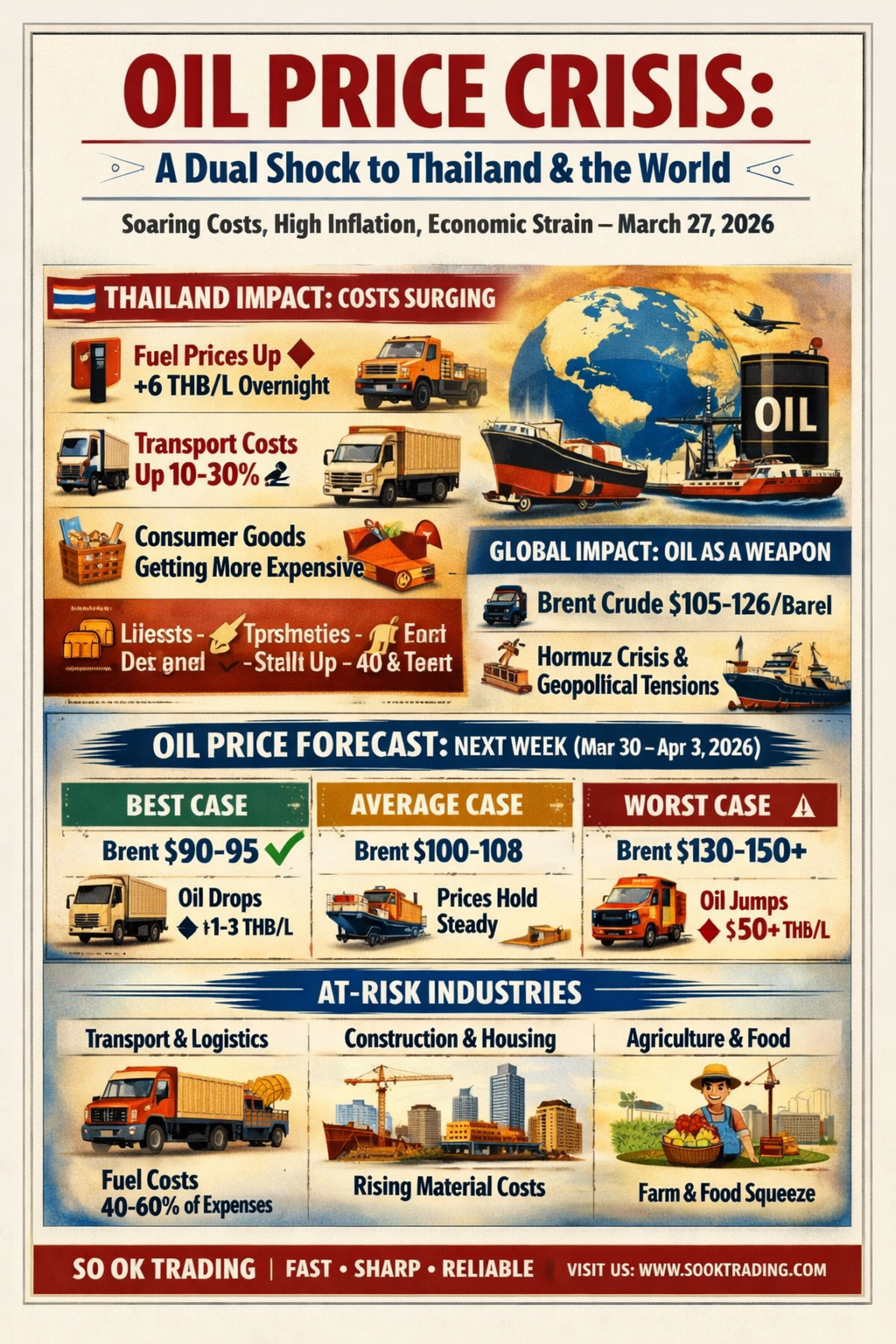
On March 27, 2026, both Thailand and the global economy were hit by a powerful shock as oil prices surged dramatically. This is not merely a fuel issue, but an economic blow reverberating from daily commuters to the world’s financial systems.


Thailand’s Crisis: Rising Costs & Inflation Pressure

Domestic fuel prices jumped +6 THB/L overnight
Transport sector preparing to raise fees 10–30% from April 1
The Oil Fund reduced diesel subsidies → higher production and logistics costs across industries
 

Global Crisis: Oil as an Economic Weapon

Brent crude trading around $105/barrel (after spiking to $120–126 last week)
Strait of Hormuz tensions: Iran released 10 tankers, but 2,000+ remain stalled
US–Iran negotiations resemble a “tug of war”: 15 US proposals vs 5 Iranian counter-demands
OECD warns: soaring energy prices could drag down global GDP and accelerate inflation
 

Next Week’s Oil Price Forecast (Mar 30 – Apr 3, 2026)

Best Case: Brent $90–95 → Thai fuel prices drop 1–3 THB/L
Average Case: Brent $100–108 → Thai fuel prices remain high (Gasohol 95 at 40–42 THB/L)
Worst Case: Brent $130–150+ → Thai fuel prices exceed 50 THB/L, with possible shortages
 

⚡ Impact on Thai Industries

Transport & Logistics: Fuel costs = 40–60% of total expenses → SMEs risk shutdown
Construction & Real Estate: Steel, cement, and transport costs surge → new housing prices up 5–10%, purchasing power down
Agriculture & Food: Fertilizer and machinery costs spike → food processors face “profit squeeze”
 

Thailand & the World: Parallel Shocks

Thailand: Domestic inflation pressure from rising fuel and transport costs
World: Supply risks and geopolitical uncertainty
Cumulative Effect: Worst-case scenario → Thai fuel prices surpass 50 THB/L, global inflation spikes, GDP contracts
 

This crisis shows that oil is not just fuel — it is a catalyst for global economic disruption.
Marketing and business communication strategies should focus on:

Transparency: Explain true cost structures to customers and consumers
Strategic Adaptation: Use technology and logistics management to reduce costs
Trust Building: Demonstrate readiness to face challenges, not simply pass costs to consumers
 

✳️ SO OK TRADING – FAST • SHARP • RELIABLE
Your trusted business partner in every situation

www.sooktrading.com

Related Content
Thai Aluminum Packaging: A Turning Point Toward Global Sustainability
27 Jan 2026
HNY 2026 with a First Analysis on Thai Baht Value
he Thai baht in Q1 2026 is expected to strengthen against the US dollar, driven primarily by a weaker dollar globally, a seasonal tourism boost, and expectations of US Federal Reserve rate cuts. This strength is occurring despite a weak domestic economic outlook and the Bank of Thailand's (BoT) likely continued easing of its policy rate. Exchange Rate Drivers and Forecast External Factors: The primary driver for the strengthening baht is external, mainly the broad weakness of the US dollar as global markets price in expected Fed rate cuts. The baht is also correlated with global gold prices, which have been climbing. Tourism High Season: The period extending into Q1 2026 is the high season for tourism, which typically brings in foreign currency and supports the baht's value. Policy Divergence: The BoT is expected to continue its easing cycle, potentially cutting the policy rate further to 1.00% by Q1 2026 to stimulate the sluggish domestic economy. This divergence from a potentially less aggressive US Fed in Q1 could support the baht in the short term, though some analysts warn the currency could weaken later in 2026. Forecasts: Projections for 2026 generally place the baht in a range of 30.80–33.00 per US dollar. Some models estimate it could trade around 31.06 by the end of Q1. A persistently strong baht below 31 per US$ is seen as a significant risk to the Thai export and tourism sectors. Key Economic Context Weak Growth: Thailand's economy is expected to slow down to a 5-year low growth rate of around 1.6-1.8% in 2026, pressured by US tariffs, global trade tensions, and high household debt. The central bank chief expects an improvement in Q1 2026 after a weak second half of 2025. Political Uncertainty: A general election expected in February 2026 could also introduce volatility, though some historical trends suggest the baht may strengthen following the formation of a new government. Low Inflation: Headline inflation is projected to remain subdued or even negative, providing the central bank with justification for further rate cuts to stimulate demand. In summary, Q1 2026 is characterized by a strong and volatile baht driven by external factors, contrasting sharply with a weak domestic economy and accommodative monetary policy.
1 Jan 2026
This website uses cookies for best user experience, to find out more you can go to our Privacy Policy and Cookies Policy
Compare product
0/4
Remove all
Compare
Powered By MakeWebEasy Logo MakeWebEasy