“Cassava and Corn: From Food to Green Energy and Bio-Packaging Bioplastics and Clean Fuels — From the Kitchen of the World to the Green Innovation Hub” Article by SO OK TRADING | March 24, 2026
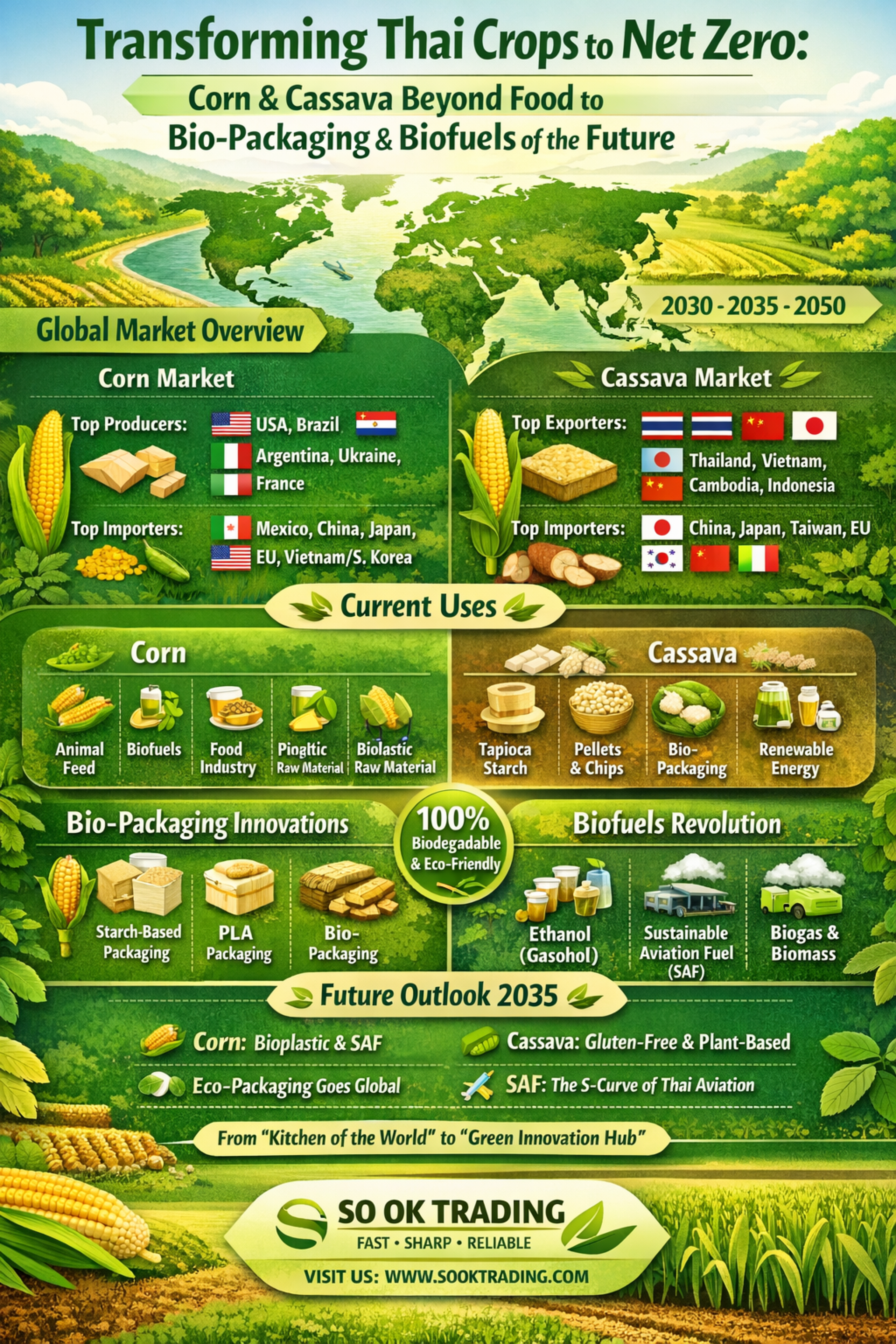
“Transforming Thai Crops to Net Zero: From Cassava and Corn to Bioplastics, Packaging, and Future Fuels”
Cassava and corn are no longer just food crops — they are becoming new innovations for compostable packaging, bioplastics, and clean fuels.
Article by SO OK TRADING | March 24, 2026
Thailand’s Transformation
Thailand is evolving from a “global agricultural exporter” into a world hub for bio-innovation. By using cassava and corn as core raw materials, the country is creating sustainable packaging and clean fuels that support the green economy and Net Zero goals. Short-term targets are set for 2030, with long-term horizons extending to 2035 and 2050.
Global Market Overview
Corn Market
Major Producers: USA, Brazil, Argentina, Ukraine, France
Major Importers: Mexico, China, Japan, EU, Vietnam/South Korea
Summary: Production is concentrated in the Americas, while China and Mexico dominate demand.
Cassava Market
Major Exporters: Thailand, Vietnam, Cambodia, Laos, Indonesia
Major Importers: China, Thailand (imports fresh cassava for processing), Vietnam, Japan, Taiwan/South Korea
Summary: Thailand is the global processing hub, while China accounts for over 50% of global demand.
Current Applications
Corn: Animal feed, biofuels, food industry, bioplastic raw material
Cassava: Tapioca starch, chips/pellets, bioplastics, renewable energy
Bio-Packaging Innovations
Starch-Based Packaging: Cassava starch used for biodegradable bags, food films, disposable containers
PLA Packaging: Corn sugar fermented into lactic acid → converted into PLA resin → cups, cutlery, food packaging
Bio-Composite Packaging: Cassava residues and corn cobs compressed into rigid materials for boxes, furniture, and construction
Highlights: 100% biodegradable, reduces petroleum plastics, compliant with EU and US environmental regulations
✈️ Biofuels Revolution
Ethanol (Gasohol): Blended with gasoline to reduce fossil fuel imports
SAF (Sustainable Aviation Fuel): Ethanol converted into aviation fuel, cutting airline carbon emissions by up to 80%
Cellulosic Ethanol: Agricultural waste such as corn stalks and cassava roots used, reducing competition with food resources
Biogas & Biomass: Cassava factory wastewater converted into biogas, enabling carbon-neutral operations
Future Outlook (2035)
Corn: Transitioning from animal feed to green industry raw material (bioplastics, SAF)
Cassava: Emerging as a “crop of the future” for gluten-free foods, plant-based diets, and renewable energy
Bio-Packaging: Expected to become a global standard, especially in Europe and the US
Biofuels: SAF positioned as Thailand’s critical S-Curve in aviation
Strategic Summary
Bioplastics & Packaging: Focus on high value-added products and waste management → Thailand poised to be a global hub
Biofuels (Ethanol/SAF): Focus on large-scale consumption and energy security → Thailand can become a major player in sustainable aviation
Cassava and corn are not only agricultural commodities for food and farming — they are set to drive high-value industries, creating new S-Curves demanded worldwide, and elevating Thailand’s role from the “Kitchen of the World” to the Green Innovation Hub.
SO OK TRADING: Your Business Partner
SO OK TRADING: FAST • SHARP • RELIABLE
VISIT US AT: WWW.SOOKTRADING.COM
For corn, processed corn, cassava chips, and pellets, contact us via the “Give Inquiry” page or email directly at: sooktrading@outlook.com
Thank you very much.