“Thai Wood Pellets: From Rubber Plantations to Global Clean Energy – Golden Export Opportunities to Japan, Europe, and South Korea” Article by SO OK TRADING | March 23, 2026
“Thai Wood Pellets: Clean Energy from Asia to the Global Stage”
Article by SO OK TRADING | March 23, 2026
Accelerating Toward Net Zero 2050
Thai biomass wood pellets are emerging as one of Asia’s most promising clean energy commodities, steadily building recognition in the global market.
Explosive Growth
In 2023, Thailand exported 207,000 tons of wood pellets, a 55% increase from 2022
Total export value exceeded USD 29 million
Key markets: South Korea (141,300 tons), Japan, and the Netherlands (57,500 tons)
Regional Market Trends
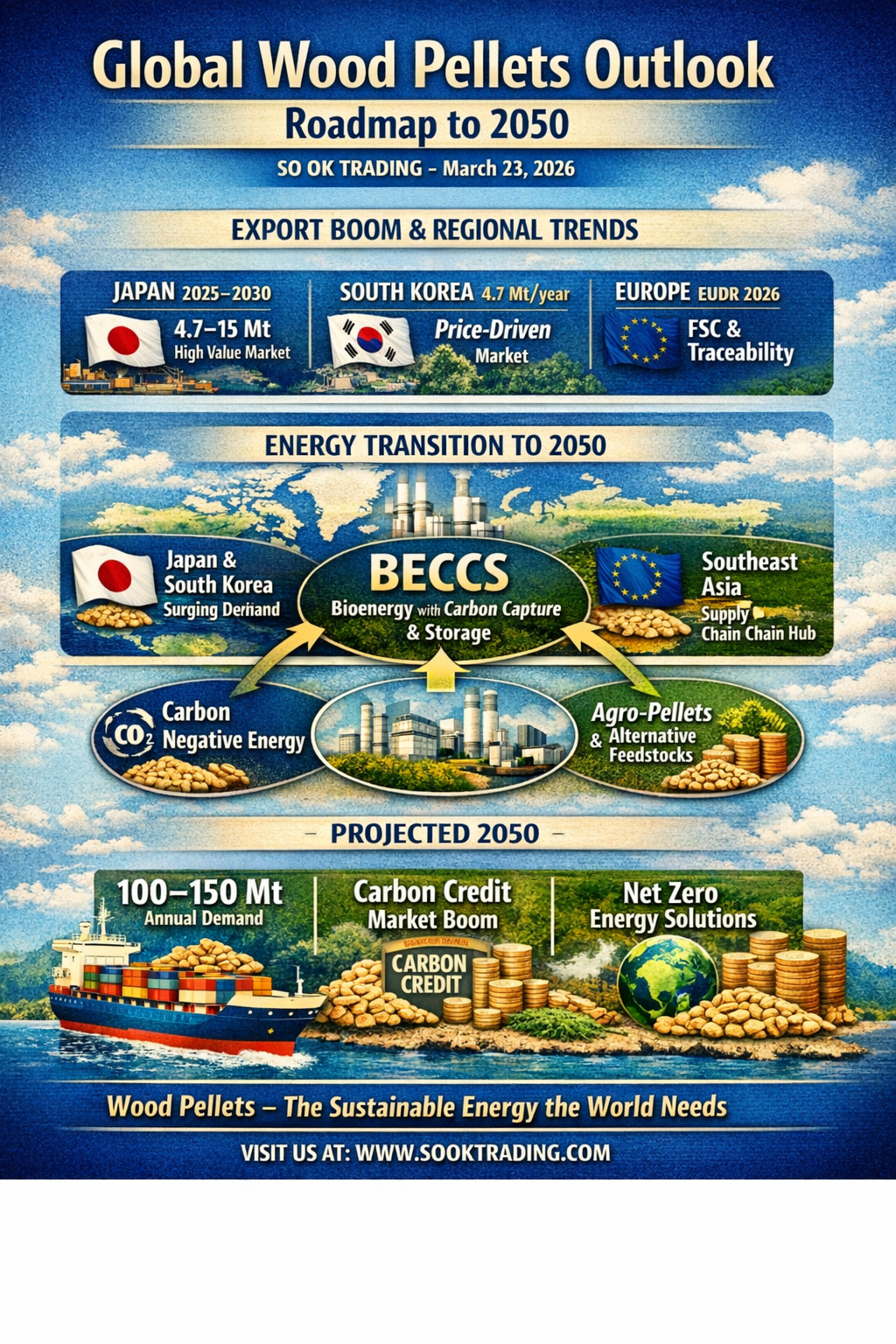
➡ Japan – Asia’s Golden Opportunity
Demand surging as coal-fired plants transition to biomass co-firing
Projected demand: 4.7 million tons by 2025, potentially reaching 15 million tons by 2030
Government continues FiT/FiP support at 24 yen/kWh
Main competitors: Vietnam and Canada, but Thailand is gaining ground
➡ South Korea – A Mature Market
Stable demand at 4.7 million tons/year
Highly price-competitive, with Vietnam holding 63% market share
Thailand must minimize freight costs to maintain competitiveness
➡ Europe – The Market of Sustainability
Recovering from slowdown in 2023–2024
EUDR regulations (effective 2026) require geolocation traceability of raw materials
Netherlands: hub for industrial-grade pellets
Germany & France: premium A1 grade for household heating
➡ Southeast Asia – The World’s Energy Kitchen
Vietnam: world’s No. 2 exporter, controlling 80% of Asia’s market
Indonesia: massive co-firing plans, domestic demand projected at 10.23 million tons/year by 2030
Thailand: current production ~1.2 million tons/year, with raw material potential up to 5.23 million tons/year if fully optimized
➡ North America & Europe
USA & Canada: largest producers globally, supply projected to exceed 31 million tons/year by 2030
Europe: despite strong domestic production, environmental regulations increase reliance on imports from tropical countries
Standards – The Key to Success
ENplus / DINplus: certify combustion quality
FSC / PEFC: ensure wood comes from plantations, not deforestation
EUDR (EU): require precise geolocation of raw materials
Long-Term Outlook
2025–2035: peak demand from Japan & Europe
2035–2050: transition to BECCS (Bioenergy with Carbon Capture & Storage), making wood pellets “carbon-negative energy”
2050: global consumption may reach 100–150 million tons/year
Demand–Supply Summary
Japan = High Value Market → Long-term contracts, premium pricing
South Korea = Market Share Maintenance → Compete via freight costs
Europe = Future Market → FSC + traceability standards essential
Southeast Asia = Supply Hub → Thailand must raise standards to compete with Vietnam
Wood Pellets – Thai biomass is not just fuel, but “the sustainable energy the world needs.”
SO OK TRADING: Your Partner in Global Business
FAST. SHARP. RELIABLE.
Visit us at: www.sooktrading.com
Contact: SOOKTRADING@OUTLOOK.COM
We are ready to serve you.