Share

"Middle East Crisis 2026: Oil Prices Surge, Gold Soars — Shaking Global Economy and Rocking Thailand" — Article by SO OK TRADING, March 15, 2026
Last updated: 15 Mar 2026
1655 Views

Middle East Crisis 2026 and Shockwaves on Global & Thai Economy: Situation Overview as of March 15, 2026 — In-depth Analysis by SO OK TRADING

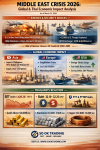
As of March 15, 2026, the Middle East conflict has escalated beyond mere military clashes, becoming a structural shock that severely impacts energy, finance, and industries worldwide.

Security & Energy Dimension

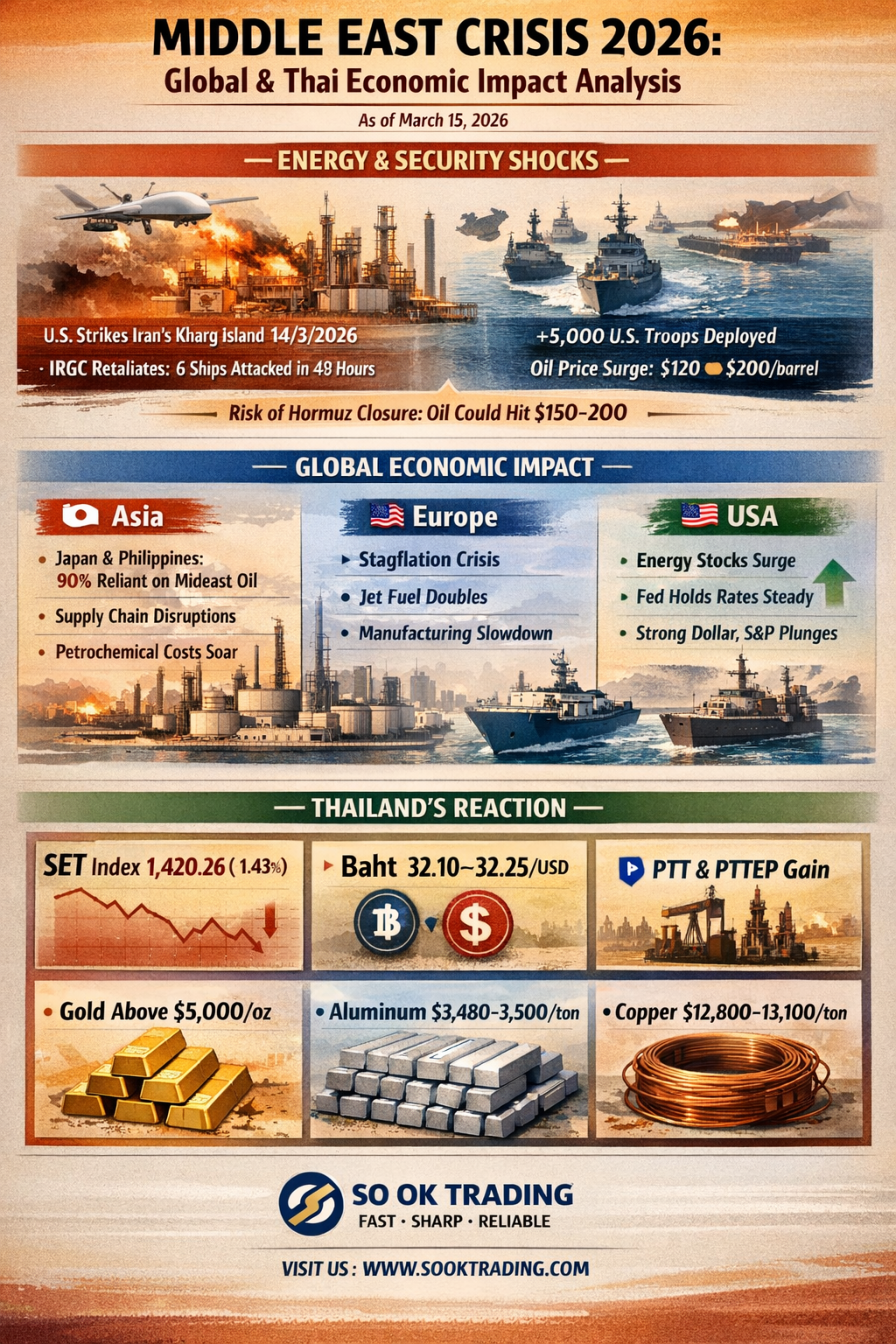
Kharg Island Strike: On March 14, the U.S. bombed Iran’s key oil export hub, causing heavy infrastructure damage.
IRGC Retaliation: Within 48 hours, six ships in the Persian Gulf were attacked, with threats to push oil prices to $200/barrel.
U.S. Reinforcement: Over 5,000 Marines and naval forces deployed to the region.
Immediate Outcome: Brent crude surged past $100/barrel. Analysts warn that a permanent closure of the Strait of Hormuz could drive prices to $150–200.
Global Industry Impact

Asia: Japan and the Philippines rely on Middle Eastern energy for 90% of imports, leading to soaring production costs. Petrochemicals and fertilizers face shortages, hitting agriculture. Shipping costs rise as routes are diverted.
United States: Automotive and aerospace industries suffer from rising raw material costs (e.g., aluminum). Energy stocks like Exxon Mobil surge, while inflation pressures force the Fed to delay rate cuts.
Europe: As a net energy importer, production stalls. Jet fuel prices double, airlines reroute and raise fees. The region faces a “stagflationary shock” — slowing growth with rising inflation.
Global Financial Markets

U.S. Dollar Strengthens: Investors flock to safe-haven assets.
Euro & Won Weaken: High oil import costs pressure currencies.
Gold: Surges above $5,000/oz, though volatility remains tied to dollar movements.
Equities: S&P 500 hits new lows, while energy stocks remain resilient.
Impact on Thailand

SET Index: Closed at 1,420.26 (-1.43%) on March 13, 2026. Energy and petrochemical stocks (PTT, PTTEP) benefit, while power plants and airlines suffer from fuel costs. Key support lies at 1,380–1,400.
Thai Baht: Trading at 32.10–32.25/USD, with potential to weaken to 32.50 if the war drags on. High oil prices and current account pressures weigh heavily.
Industrial Metals: Aluminum spikes to $3,480–3,500/ton. Copper trades at $12,800–13,100/ton; zinc around $3,300/ton. Tin drops 3–4% to $49,500/ton amid electronics sector concerns.
Precious Metals: Gold continues to rally, holding at $5,035–5,052/oz. Silver fluctuates at $80–83/oz, more volatile due to industrial demand slowdown.
Summary

Investors: Focus on high-dividend and upstream energy stocks to hedge inflation.
Industries: Prepare for rising energy and logistics costs.
Consumers: Face higher prices from fuel, electricity, and transportation costs.
This Middle East crisis is not merely geopolitical — it is a structural shock hitting wallets worldwide, from factories in Japan to the Thai stock market, and even the gold in investors’ hands.

 
SO OK TRADING — Your Business Partner
FAST • SHARP • RELIABLE
VISIT US AT: www.sooktrading.com

Related Content
Thai Rubber: Premium Quality, Exported Worldwide – SO OK TRADING Insights into Thai Rubber for the Global Market
Thai Rubber: Global Impact & Future Outlook Thailand is the world’s leading exporter of natural rubber, powering industries from automotive tires to medical gloves. With over 19 million rai under cultivation, Thai rubber is vital for farmers and global supply chains. In 2026, prices are rising—fresh latex averages 57 Baht/kg, RSS3 around 60 Baht/kg—with forecasts reaching 100 Baht/kg as demand grows from EVs and healthcare. The EU’s new EUDR regulation positions Thailand as a low-risk supplier, unlocking premium opportunities in sustainable markets. SO OK TRADING CO., LTD. connects Thai rubber to the world—delivering quality, reliability, and trust.
17 Jan 2026
COPPER PRICE AND TREND  2026
Copper prices are expected to remain elevated and bullish in 2026, driven by strong demand from the green energy transition (EVs, renewables, grid upgrades) and persistent mine supply constraints/disruptions, with forecasts generally placing prices in the $10,000 to over $12,000 per tonne range, although some analysts foresee a slight cooling to $10,000-$11,000 as market balances tighten. Key factors include IRA spending, AI infrastructure needs, constrained new mine supply, and potential Chinese economic recovery, creating tight markets despite some projected minor surpluses. Key Price Predictions (2026): Goldman Sachs: $10,000 - $11,000/tonne range, averaging $10,710/tonne in H1 2026. J.P. Morgan: Averaging around $12,075/tonne, with potential spikes to $12,500/tonne in Q2. Bank of America: Average of $11,313/tonne, with potential for $15,000/tonne spikes. UBS: $11,000/tonne by Sept 2026. World Bank: Average of $9,800/tonne. Bullish Drivers: Energy Transition: Massive demand for grid expansion, EVs, and renewable infrastructure. AI Infrastructure: Increased demand for data centers. Supply Deficit: Mine disruptions (Grasberg, Kamoa-Kakula, etc.) and difficulty bringing new mines online. China: Potential economic rebound acting as a catalyst. Potential Headwinds/Volatility: Policy-induced Surpluses: E.g., from IRA incentives or scrap availability. Stronger USD: Can weigh on commodity prices. Slower Demand: If China's recovery falters. Overall Outlook: Expect a tight market with strong underlying demand, leading to high prices, but with significant volatility due to policy shifts and mine output fluctuations. The market is moving towards a structural deficit, supporting higher prices long-term
30 Dec 2025
“Middle East Crisis Update – April 16, 2026: Oil • Fertilizer • Naphtha — War & Market Moves, When Energy and Raw Materials Become Economic Weapons, A War That Touches Every Breath of the World”
Middle East Crisis Update: War • Energy • Finance (April 16, 2026) The Middle East remains tense and complex, with ongoing battles, fragile diplomacy, and economic ripples spreading worldwide. The closure of the Strait of Hormuz and continued attacks across multiple fronts have driven oil and naphtha prices sharply higher, while global stock markets swing in response to peace talk headlines. This crisis is not confined to the region — it reverberates across every nation. Rising energy costs, soaring fertilizer prices, and escalating shipping fees are directly impacting the daily lives of people everywhere. Stay informed with our latest English Infographic, which captures the dimensions of war, energy, and finance in a concise, easy-to-understand format — ready to be leveraged for business insights and strategy. SO OK TRADING
16 Apr 2026
This website uses cookies for best user experience, to find out more you can go to our Privacy Policy and Cookies Policy
Powered By MakeWebEasy Logo MakeWebEasy