Share

“Battery Recycling: From Old Waste to a Moving Gold Mine – Thailand Rising as ASEAN’s Future Hub” By SO OK TRADING
Last updated: 7 Mar 2026
1767 Views

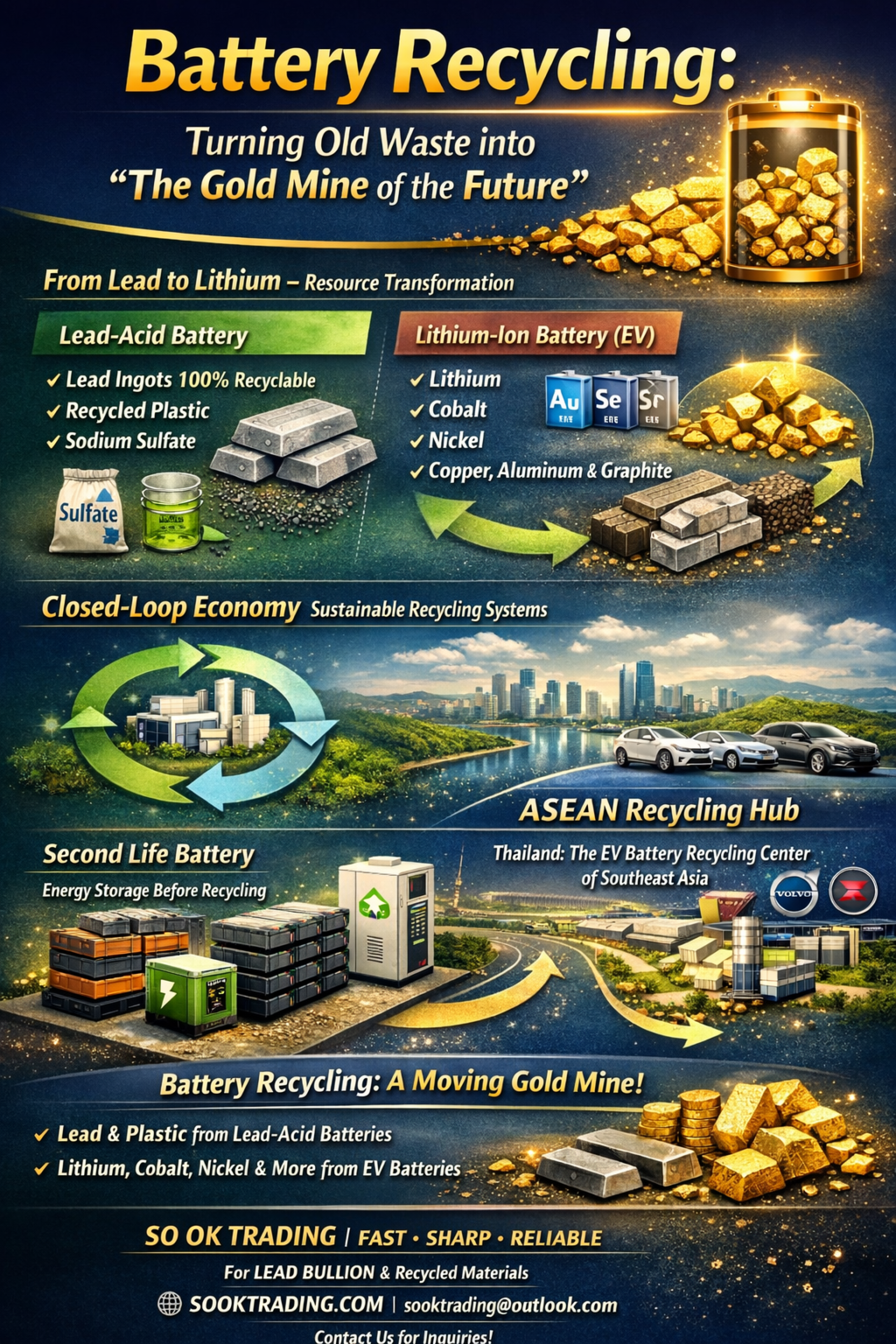
Battery Recycling: Turning Old Waste into the “Gold Mine of the Future”

Battery recycling is not just about disposing of hazardous waste.
It is about transforming “trash” into “precious resources” that can be reused endlessly.
Both lead-acid batteries (used in fuel-powered cars) and lithium-ion batteries (used in EVs) contain valuable metals that can be recovered, making this industry a future driver of both economic value and sustainability.


⚙️ From Lead to Lithium – A Major Transition

Lead-Acid Battery

Lead: Nearly 100% recoverable, remelted into ingots for unlimited reuse.
Polypropylene Plastic: Battery casings can be crushed, cleaned, and remade into plastic pellets.
Sulfuric Acid:
Neutralization → converted into clean water
Sodium Sulfate → used in detergents, glass, and textiles
Highlight: Almost 100% recyclable, the most stable system worldwide, and profitable through battery “trade-in.”

Lithium-Ion Battery (EV)

Lithium
Cobalt
Nickel
Manganese
Copper
Aluminum
Graphite
Highlight: Though complex, more than 90% of valuable metals can be recovered. Plus, “Second Life” use as energy storage systems (ESS) before recycling adds extra value.


♻️ Closed-Loop Economy – Endless Cycle

Thailand’s Department of Primary Industries and Mines (DPIM) has successfully developed EV battery prototypes using recycled domestic materials, reducing mineral imports and minimizing environmental impact.


⚡ Second Life Battery – Use Before Recycling

EV batteries degraded to 70–80% capacity can still serve as Energy Storage Systems for homes and factories before entering the recycling process.


Thailand as ASEAN’s Recycling Hub

Global automakers like Volvo Car Thailand have invested in repair and recycling centers in Thailand, in partnership with Singapore. Thailand is being positioned as the ASEAN hub for EV battery recycling.


EV 3.5 Policy – Attracting Advanced Technology

The Thai government, through BOI incentives, is bringing in advanced extraction technologies such as Black Mass, enabling efficient recovery of lithium, cobalt, and nickel.


✨ Conclusion

Old batteries are not waste — they are mobile mines full of precious resources:

Lead and plastics from lead-acid batteries
Lithium, cobalt, nickel, and rare metals from EV batteries
Battery recycling not only protects the planet but also generates massive economic value, pushing Thailand toward becoming the ASEAN center for battery recycling.


SO OK TRADING FAST • SHARP • RELIABLE
If you are interested in Lead Bullion produced from battery recycling, please contact us:

www.sooktrading.com
sooktrading@outlook.com


Related Content
“Thai Natural Rubber: The Soft Power Driving the World – A Strategic Commodity of the New Century in the EV and BCG Era. Thai Rubber: The Essential Resource Demanded by Global Industries” Article by SO OK TRADING | March 26, 2026
“Thai Natural Rubber: From Plantations to Global Strategic Commodity” Published: March 28, 2026 Thailand is not just a rubber producer—it is the world’s leading exporter, holding over 30% of global natural rubber exports. Thai rubber has become the backbone of industries worldwide, from automotive and medical to construction. This article explores Thailand’s strengths and the future direction of the rubber industry in the EV era and the Bio-Circular-Green (BCG) economy.
28 Mar 2026
Global Steel Market 2026: Rising Costs Push Sales Prices Up 10–15% SO OK TRADING – April 20, 2026
Global Steel Market 2026: Surging Costs Drive Prices Up 10–15% April 2026 marks a turning point for the global steel industry — a fragile recovery amid soaring raw material and energy costs. Iron ore averages $90–95 per ton, coking coal $170–190, and carbon tariffs under the EU’s CBAM add another $60–90 per ton, pushing global steel prices higher by 10–15%.
20 Apr 2026
เกร็ดความรู้ Aluminum โดย SO OK TRADING
เกร็ดความรู้อลูมิเนี่ยม อลูมิเนียมเป็นโลหะน้ำหนักเบา แข็งแรง ทนทานต่อการกัดกร่อน (เกิดชั้นฟิล์มออกไซด์ปกป้องตัวเอง) นำความร้อนและไฟฟ้าได้ดีเยี่ยม เป็นมิตรต่อสิ่งแวดล้อมเพราะรีไซเคิลได้ 100% และปลอดภัยไม่เป็นพิษ ใช้กันแพร่หลายตั้งแต่ภาชนะอาหาร (หม้อ, กระทะ) ไปจนถึงโครงสร้างเครื่องบิน โดยมีการแบ่งเกรดตามธาตุผสมเพื่อให้คุณสมบัติเฉพาะทางมากขึ้น เช่น เกรด 7xxx ผสมสังกะสีเพื่อความแข็งแรงสูงสำหรับอวกาศ หรือ 2xxx ผสมทองแดงสำหรับล้อแม็ก. คุณสมบัติเด่น น้ำหนักเบา: เบากว่าเหล็ก 3 เท่า (ความหนาแน่น 2.7) ทำให้ขนส่งและติดตั้งง่าย. ทนทานการกัดกร่อน: สร้างชั้นฟิล์มอลูมิเนียมออกไซด์บางๆ เคลือบผิวเพื่อป้องกันการเกิดสนิมและกัดกร่อนได้ดี. นำความร้อน/ไฟฟ้าได้ดี: ดีกว่าสแตนเลสหลายเท่า จึงนิยมใช้ในงานไฟฟ้าและอุปกรณ์ระบายความร้อน. ขึ้นรูปง่าย: ดัด พับ หรือแปรรูปเป็นรูปทรงซับซ้อนได้โดยไม่แตกหัก. ปลอดภัย: ไม่เป็นพิษและไม่ทำปฏิกิริยากับอาหาร จึงนิยมใช้ทำภาชนะอาหารและบรรจุภัณฑ์. รีไซเคิลได้ 100%: เป็นมิตรต่อสิ่งแวดล้อมอย่างยิ่ง. เกร็ดน่ารู้เกี่ยวกับอลูมิเนียม มาจากไหน: พบในธรรมชาติในรูปแร่บอกไซต์ (Bauxite). จุดหลอมเหลว: อลูมิเนียมบริสุทธิ์หลอมที่ 660°C แต่เมื่อผสมกับโลหะอื่นจุดหลอมเหลวจะสูงขึ้น. การเกิดออกไซด์: ต่างจากสนิมเหล็กที่เป็นรูพรุน, ออกไซด์ของอลูมิเนียมจะเกาะแน่นเป็นชั้นฟิล์มป้องกันเนื้อโลหะ. เกรดอลูมิเนียม: มี 8 ซีรีส์ (เช่น 1xxx, 2xxx, 3xxx...) แต่ละซีรีส์มีธาตุผสมต่างกัน (เช่น ทองแดง, แมกนีเซียม, สังกะสี) เพื่อให้ได้คุณสมบัติเฉพาะ เช่น ซีรีส์ 7xxx (ผสมสังกะสี) แข็งแรงมาก เหมาะกับยานอวกาศ. การใช้งานหลัก โครงสร้าง: ประตู หน้าต่าง ราวกั้น (น้ำหนักเบา แต่แข็งแรง). ภาชนะ/บรรจุภัณฑ์: หม้อ กระทะ กระป๋องอลูมิเนียม ฟอยล์ (ทนการกัดกร่อน ไม่เป็นพิษ). อุตสาหกรรม: ชิ้นส่วนยานยนต์ เครื่องบิน (น้ำหนักเบา + แข็งแรง). อื่นๆ: อุปกรณ์ไฟฟ้า สายไฟ และอุปกรณ์ระบายความร้อ
6 Dec 2025
This website uses cookies for best user experience, to find out more you can go to our Privacy Policy and Cookies Policy
Powered By MakeWebEasy Logo MakeWebEasy