Share

Nickel: The Strategic Metal of the Clean Energy Future — An Article by SO OK TRADING
Last updated: 26 Feb 2026
862 Views

Nickel: The Strategic Metal of the Clean Energy Future ⚡

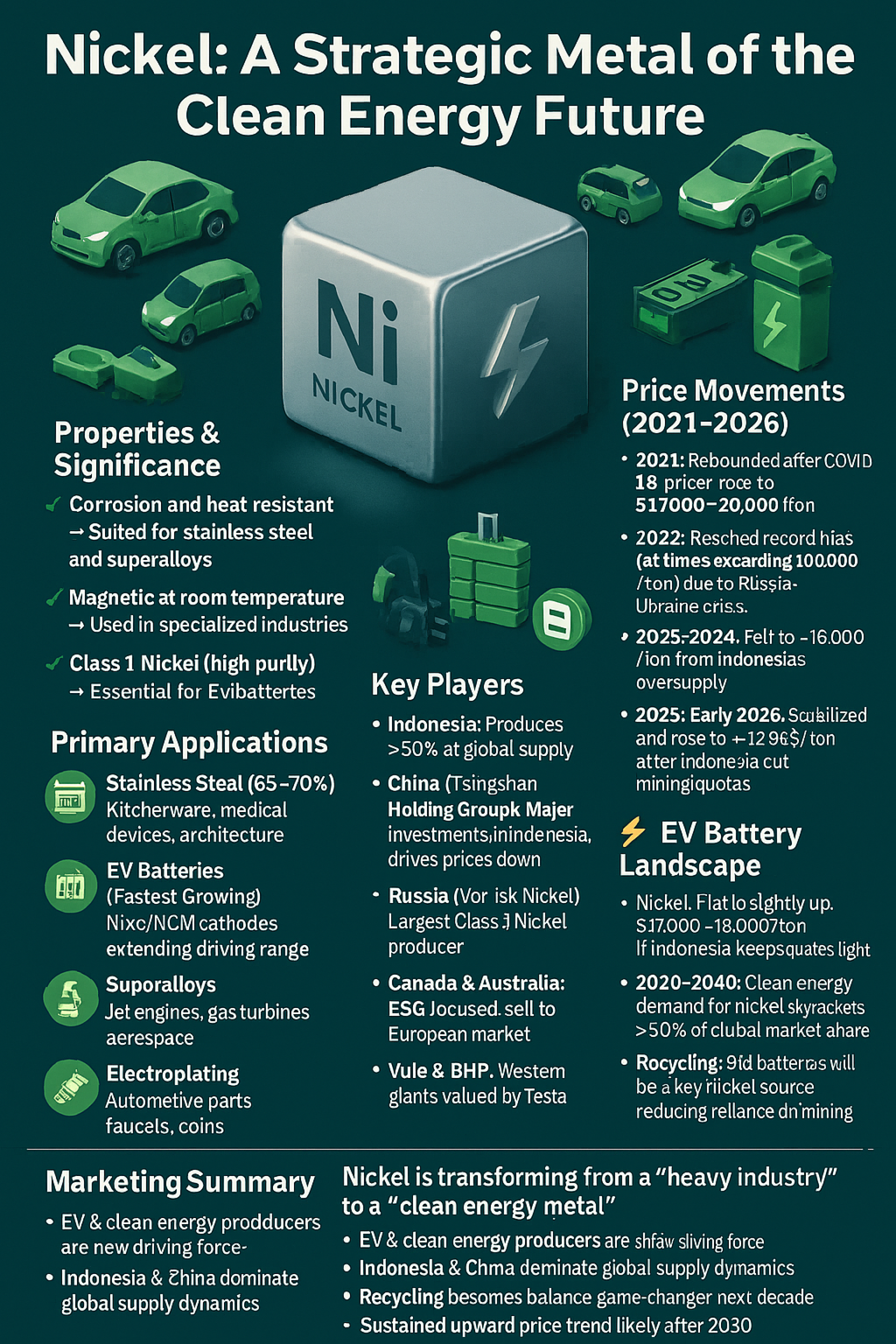
Nickel (Ni) is shifting its role from a traditional heavy industry metal to the core of the clean energy transition. Especially in electric vehicles (EVs) and energy storage systems (ESS), nickel will shape the global economy over the next 10–20 years.


Properties & Significance

Corrosion and heat resistant → Ideal for stainless steel and superalloys
Magnetic at room temperature → Used in specialized industries
Class 1 Nickel (high purity) → Essential raw material for EV batteries
 

Price Movements (2021–2026)

2021: Post-COVID recovery, prices rose to $17,000–20,000/ton
2022: Historic spike (at times exceeding $100,000/ton) due to Russia–Ukraine crisis
2023–2024: Fell to ~$16,000/ton from Indonesia’s oversupply
2025–Early 2026: Stabilized and rebounded to ~$17,963/ton after Indonesia cut mining quotas
 

Primary Applications

Stainless Steel (65–70%): Kitchenware, medical devices, architectural structures
EV Batteries (fastest-growing): NMC/NCM cathodes, extending driving range
Superalloys: Jet engines, gas turbines, aerospace industry
Electroplating: Automotive parts, faucets, coins
Chemical Industry: Catalysts in oil refining and chemical processes
 

Major Players

Indonesia: Produces >50% of global supply
China (Tsingshan Holding Group): Massive investments in Indonesia, driving prices down
Russia (Norilsk Nickel): Largest Class 1 Nickel producer
Canada & Australia: ESG-focused, supplying European markets
Vale & BHP: Western giants valued by Tesla
 

⚡ EV Battery Battlefield

Nickel-based (NCM/NCA): Range >500 km, suited for luxury and high-performance vehicles
LFP (Lithium Iron Phosphate): Cheaper, safer, ideal for city cars and ESS
Recycling: Old batteries will become a key nickel source in the future
 

Price & Market Outlook

2026: Stable to slightly upward ($17,000–19,000/ton) if Indonesia maintains strict quotas
2030–2040: Clean energy demand expected to exceed 50% of global nickel consumption
Battery Recycling: Emerging as a new supply source, reducing reliance on mining
 

Marketing Summary

Nickel is evolving from a “heavy industry metal” to a “clean energy metal”.

EV and clean energy producers are the new driving force
Indonesia and China dominate global supply dynamics
Recycling will rebalance the market in the next decade
Sustained upward price trend expected after 2030
 

About SO OK TRADING

In this strategic metal battleground, SO OK TRADING is committed to bridging premium Thai non-ferrous metal producers with global markets. With expertise in non-ferrous metals and clean energy, we are your trusted business partner.

For Nickel inquiries:
Visit www.sooktrading.com → Click “Give Inquiry”
Or contact us directly via email: sooktrading@outlook.com


Related Content
Aluminium Packaging Transforms the Game: From Cans to Circular Economy, Towards the New Standard of Green Packaging Article by SO OK TRADING  March 28, 2026
นี่คือเวอร์ชันภาษาอังกฤษของโพสต์ที่คุณให้มา Mongkol: Aluminium Packaging: The Future of Sustainable Solutions By SO OK TRADING March 28, 2026 In an era driven by the Circular Economy and Net Zero goals, aluminium is no longer just an “option” — it has become the new standard in packaging, meeting both environmental regulations and consumer expectations. ✅ 100% recyclable without loss of quality ✅ Lightweight yet strong, reducing transport and energy costs ✅ Compliant with CBAM and carbon footprint reduction measures This article explores aluminium packaging trends across the globe and in Thailand, analyzing both the opportunities and challenges for producers in a world where “price” is no longer the sole factor — but where “green” is the true driver of competition.
28 Mar 2026
ALUMINUM PRICE TREND 2026
An analysis of the aluminum market in 2026 indicates a likely continued market deficit and upward price pressure, driven by constrained supply and resilient demand from green energy sectors. However, significant volatility is expected due to policy uncertainties and the potential for new Indonesian supply to eventually balance the market. Key Drivers and Projections for 2026 Supply Side Analysis Capacity Constraints: China's primary aluminum output is approaching its self-imposed 45 million-tonne capacity cap, limiting global supply growth. Power Challenges: Smelters outside of China face intense competition for power from energy-intensive sectors like AI data centers, which are willing to pay higher prices for long-term contracts. This has kept significant capacity offline in Europe and the US. Production Disruptions: Outages and potential shutdowns at existing smelters in Iceland and Mozambique further tighten the market. Scrap Supply Pressure: The EU's planned implementation of the Carbon Border Adjustment Mechanism (CBAM) and potential scrap export tariffs in spring 2026 are expected to impact global scrap flows, creating regional shortages and price volatility. New Capacity: Indonesia is a key source of new supply, with several projects in the pipeline. However, analysts suggest the pace of the ramp-up may be slower than expected due to infrastructure and policy challenges, meaning it is unlikely to fully offset near-term tightness. Demand Side Analysis Green Transition Demand: Demand from "green" sectors such as solar panels, new energy vehicles, and energy transition infrastructure remains strong, providing fundamental support for the market. Substitution Effect: Aluminum's wide price discount relative to copper has encouraged substitution in electrical applications, acting as a tailwind for demand and prices. Construction and Automotive: The construction and automotive industries continue to be major consumers, with growing demand for lightweight, low-carbon aluminum products. Price Forecasts and Volatility The market is expected to remain in a deficit in 2026, with estimates ranging from 200,000 to 600,000 tonnes. This structural tightness is leading most analysts to forecast sustained or rising prices. Bullish Views: Analysts at Bank of America project prices of $3,000/tonne as early as 2026. J.P. Morgan also expects prices to approach $3,000/tonne in Q1 2026. ING forecasts an average price of $2,900/tonne for the year. Bearish/Conservative Views: Goldman Sachs is an outlier, forecasting prices to decline to $2,350/tonne by Q4 2026, anticipating a market surplus later in the year. SMM forecasts a "high first, then lower" pattern, with prices finding equilibrium in the $2,700–$2,800/tonne range by year-end. Premiums: Regional premiums, particularly the US Midwest premium, are expected to remain high and volatile due to tariffs and regional supply dynamics, creating a disconnect from the LME benchmark price. In essence, 2026 is projected to be a year of high volatility where participants need to focus on scenario readiness rather than relying on a single price forecast, as geopolitical and energy policies significantly influence regional supply and costs
31 Dec 2025
This website uses cookies for best user experience, to find out more you can go to our Privacy Policy and Cookies Policy
Powered By MakeWebEasy Logo MakeWebEasy