Share

“ADC12: Forging the Future to 2040 — The Backbone of EVs and the Circular Economy, Where Cost-Efficiency Meets Sustainability"
Last updated: 25 Feb 2026
1666 Views

Here’s the full English translation of your text, polished for a professional marketing tone:


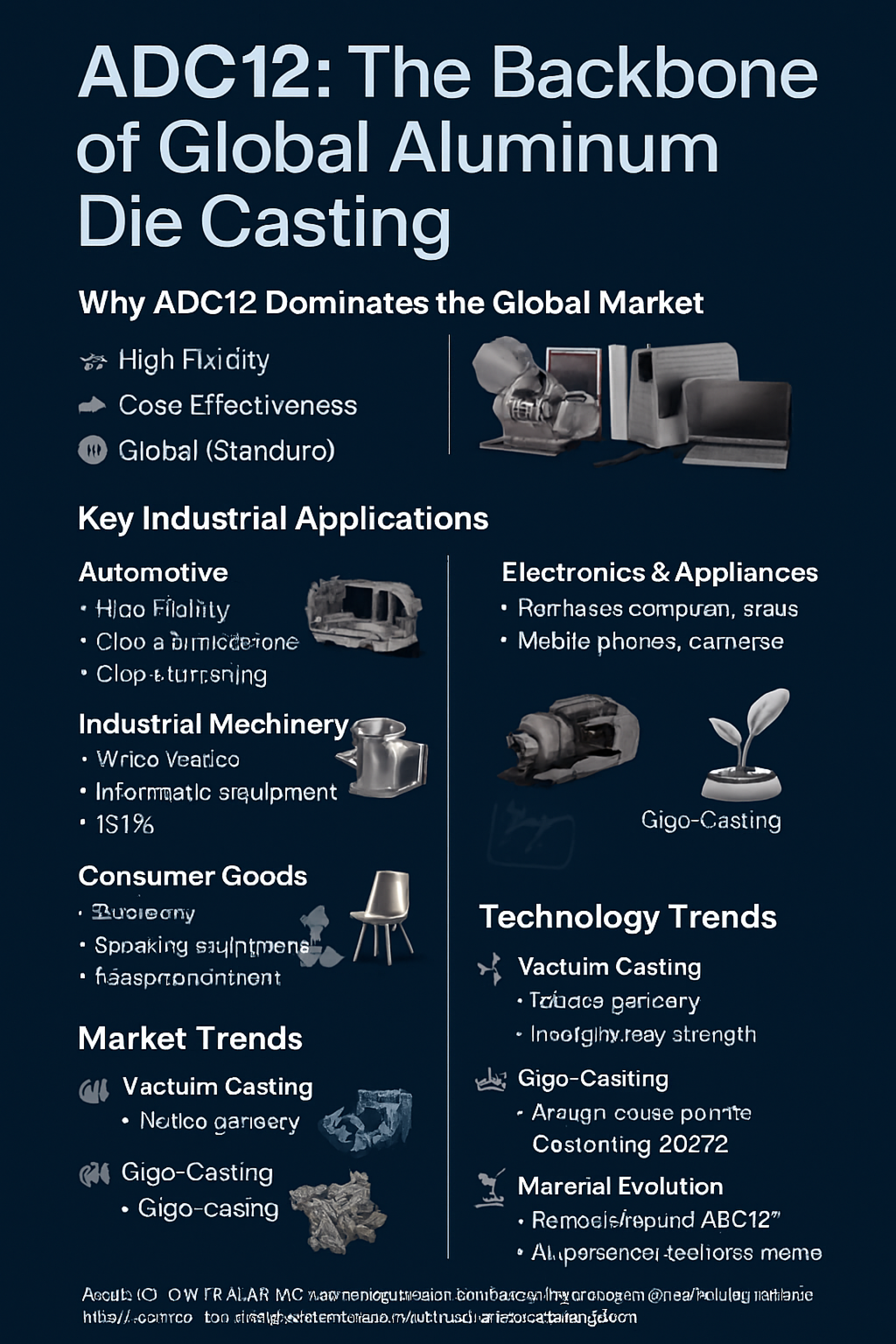
ADC12: The Backbone of the Global Aluminum Die Casting Industry

Why ADC12 Dominates the Global Market

ADC12 (Aluminium Die Casting 12) accounts for more than 90% of all aluminum die casting worldwide. With its balanced properties in fluidity, strength, and cost, it has become the international standard trusted by manufacturers across the globe.

High Fluidity: Enables casting of complex and thin-walled parts, reducing production waste
Cost-Efficiency: Easy to source, reasonably priced, and widely accepted in global supply chains
Machinability: Allows precise turning, drilling, and milling
Global Standard: Equivalent to A383 (ANSI/AA) in the United States
 

Key Industrial Applications

Automotive: Engine blocks, cylinder heads, transmission cases, valve covers, brake components
Electronics & Appliances: Computer cases, mobile phone structures, heat sinks, camera parts
Industrial Machinery: Motor housings, pneumatic equipment, tools
Consumer Goods: Furniture, sporting equipment, household items
 

Market Trends & Pricing

Current price: 3,200 USD/MT (approx. 90–100 THB/kg in Thailand)
Global market remains in a “wait-and-see” state as LME aluminum prices stabilize
Tense scrap, the main cost driver, is priced at 2,300–2,400 USD/ton
 

ADC12 Remelt: From Low-Cost Material to Sustainability Strategy

Up to 95% energy savings compared to primary aluminum production
Net Zero compliance: Global brands now mandate recycled content ratios
EV & Lightweighting: Used in battery housings, E-Axles, and lightweight structural components
Scrap Shortage: Intense competition for high-quality scrap drives price volatility
 

Technology Trends

Vacuum Casting & Semi-Solid Casting: Reduce porosity and enhance strength
Giga-Casting: Large single-piece structures combining ADC12’s fluidity with high-ductility alloys
 

Future Outlook (2025–2040)

Circular Economy: ADC12 will be designed for repeated recycling without loss of properties
EV 2.0: Transition from combustion engines to electric drive systems and thermal management structures
New Markets: Renewable energy infrastructure, energy storage systems (ESS), 6G equipment, smart cities
Material Evolution: Nano-enhanced ADC12 and AI-driven real-time zero-defect manufacturing
 

Conclusion

ADC12 is no longer just a cost-effective casting material. It is becoming the strategic backbone of EVs and the circular economy, driving the world toward a sustainable future by 2040.


Introducing SO OK TRADING

SO OK TRADING is a specialist in metals, non-metals, agricultural products, and green energy, playing a vital role in bringing premium Thai products to the global market.

Strengths: Integrating business strategy with sustainability and circular economy principles
Mission: Building trust and transparency in global markets while promoting Thai premium products such as fruits, rice, metals, and clean energy
Vision: To become a globally trusted brand by blending rational strategies with cultural and spiritual values
If you are looking for a partner who understands both global markets and sustainability, SO OK TRADING is the answer.
For ADC12 inquiries, please visit www.sooktrading.com or email us directly at sooktrading@outlook.com.


Related Content
ZINC INGOT สังกะสีแท่ง และ การใช้งาน
สังกะสีแท่ง (Zinc Ingot) ส่วนใหญ่ใช้ในงานอุตสาหกรรม เช่น ทำแผ่นสังกะสีสำหรับชิ้นส่วนยานยนต์เพื่อลดน้ำหนักและประหยัดน้ำมัน, ทำสังกะสีสำหรับเคลือบกันสนิม (Galvanizing), และใช้ในการผลิตสังกะสีอัลลอยด์ ในการใช้งานกับโลหะ สังกะสีจะทำหน้าที่เป็นขั้วบวกเพื่อป้องกันการกัดกร่อน (Zinc Anode) การใช้งานหลักของ Zinc Ingot อุตสาหกรรมยานยนต์: ใช้ทำชิ้นส่วนต่างๆ เพื่อให้น้ำหนักเบาและประหยัดน้ำมันเชื้อเพลิง การเคลือบกันสนิม: นิยมนำไปใช้ในกระบวนการเคลือบสังกะสี (Galvanizing) เพื่อป้องกันการผุกร่อนของโลหะ เช่น เหล็ก สังกะสีอัลลอยด์: ใช้ในการผลิตสังกะสีอัลลอยด์สำหรับงานต่างๆ
26 Nov 2025
Breaking Barriers: Gold’s $5,000 Milestone & Global Outlook
Gold has officially broken the $5,000 barrier — and the world is watching. From central bank demand to geopolitical tension, the bullish cycle is real. Here’s a quick snapshot of what’s driving the surge, what top institutions are forecasting, and how SO OK TRADING helps Thai brands rise with global momentum.
12 Feb 2026
ALUMINUM PRICE TREND 2026
An analysis of the aluminum market in 2026 indicates a likely continued market deficit and upward price pressure, driven by constrained supply and resilient demand from green energy sectors. However, significant volatility is expected due to policy uncertainties and the potential for new Indonesian supply to eventually balance the market. Key Drivers and Projections for 2026 Supply Side Analysis Capacity Constraints: China's primary aluminum output is approaching its self-imposed 45 million-tonne capacity cap, limiting global supply growth. Power Challenges: Smelters outside of China face intense competition for power from energy-intensive sectors like AI data centers, which are willing to pay higher prices for long-term contracts. This has kept significant capacity offline in Europe and the US. Production Disruptions: Outages and potential shutdowns at existing smelters in Iceland and Mozambique further tighten the market. Scrap Supply Pressure: The EU's planned implementation of the Carbon Border Adjustment Mechanism (CBAM) and potential scrap export tariffs in spring 2026 are expected to impact global scrap flows, creating regional shortages and price volatility. New Capacity: Indonesia is a key source of new supply, with several projects in the pipeline. However, analysts suggest the pace of the ramp-up may be slower than expected due to infrastructure and policy challenges, meaning it is unlikely to fully offset near-term tightness. Demand Side Analysis Green Transition Demand: Demand from "green" sectors such as solar panels, new energy vehicles, and energy transition infrastructure remains strong, providing fundamental support for the market. Substitution Effect: Aluminum's wide price discount relative to copper has encouraged substitution in electrical applications, acting as a tailwind for demand and prices. Construction and Automotive: The construction and automotive industries continue to be major consumers, with growing demand for lightweight, low-carbon aluminum products. Price Forecasts and Volatility The market is expected to remain in a deficit in 2026, with estimates ranging from 200,000 to 600,000 tonnes. This structural tightness is leading most analysts to forecast sustained or rising prices. Bullish Views: Analysts at Bank of America project prices of $3,000/tonne as early as 2026. J.P. Morgan also expects prices to approach $3,000/tonne in Q1 2026. ING forecasts an average price of $2,900/tonne for the year. Bearish/Conservative Views: Goldman Sachs is an outlier, forecasting prices to decline to $2,350/tonne by Q4 2026, anticipating a market surplus later in the year. SMM forecasts a "high first, then lower" pattern, with prices finding equilibrium in the $2,700–$2,800/tonne range by year-end. Premiums: Regional premiums, particularly the US Midwest premium, are expected to remain high and volatile due to tariffs and regional supply dynamics, creating a disconnect from the LME benchmark price. In essence, 2026 is projected to be a year of high volatility where participants need to focus on scenario readiness rather than relying on a single price forecast, as geopolitical and energy policies significantly influence regional supply and costs
31 Dec 2025
This website uses cookies for best user experience, to find out more you can go to our Privacy Policy and Cookies Policy
Powered By MakeWebEasy Logo MakeWebEasy