Share

Thai Rubber: Block & Compound Rubber Driving the Global Automotive Industry
Last updated: 15 Feb 2026
317 Views

Thai Compound & Block Rubber – Dominating Global Markets from Asia to Europe

Article by SO OK TRADING


Thailand: The World’s Leading Rubber Exporter

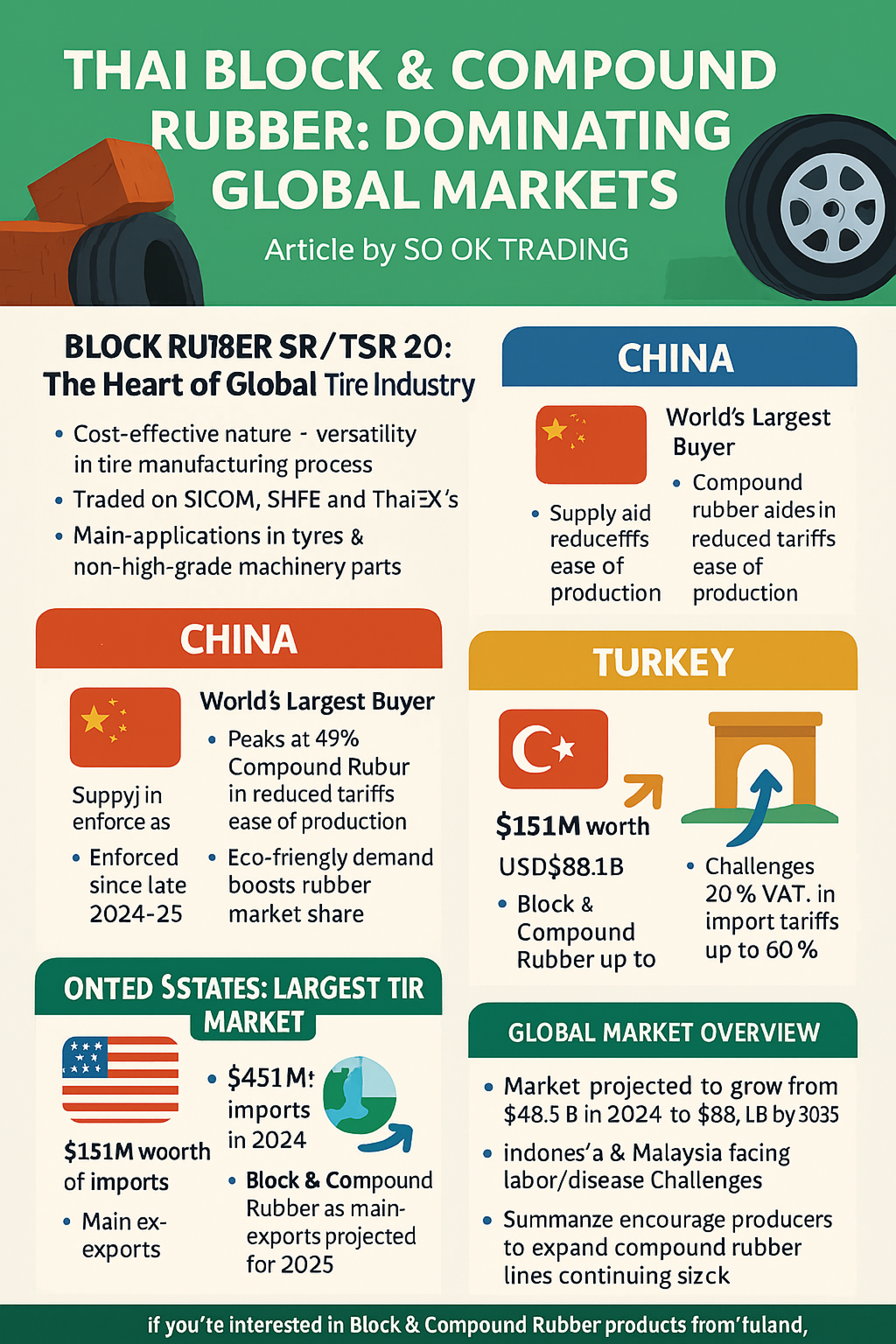
Thailand continues to lead the global natural rubber industry, accounting for 35.6% of worldwide production. The country plays a vital role both in raw materials such as Block Rubber (STR/TSR 20) and in higher-value products like Compound Rubber, which are increasingly in demand across global markets.


STR/TSR 20 Block Rubber: The Backbone of the Global Tire Industry

Key Features: Cost-effective, versatile, and widely used in automotive tires
Trading Markets: SICOM (Singapore), SHFE (Shanghai), and Thai domestic exchanges
Main Applications: Truck and car tires, machinery parts with moderate quality requirements
New Trend: Thai producers are transforming TSR 20 into Compound Rubber, adding value and meeting international demand for semi-finished products
 

Thailand’s Key Export Markets

China – The World’s Largest Buyer

Thailand once held up to 49% market share in China and remains a major supplier
Despite economic slowdown, demand for block and compound rubber remains strong in the automotive sector
Opportunity: Compound Rubber reduces import tariffs and increases production efficiency, keeping Thailand indispensable
European Union – Environmentally Strict Market

EUDR Regulation: Effective from late 2024–2025, requiring deforestation-free products
Thailand’s Advantage: Strong traceability systems compared to competitors
Outlook: EU demand for eco-compliant rubber boosts Thailand’s market share
United States – The Largest Tire Market

Thai tires face 36% import tariffs from mid-2025
Still, exports are projected to grow by 3%
Opportunity: High-quality, eco-compliant STR 20 and Compound Rubber sustain competitiveness
Turkey – Gateway to Europe & the Middle East

Thailand ranked No.1 supplier to Turkey in 2024, with imports worth USD 151M
Main products: Compound Rubber and STR 20
Challenges: Import tariffs up to 60% plus 20% VAT
Opportunity: Turkey serves as a strategic gateway to EU and Middle Eastern markets
 

Global Market Outlook

Natural rubber market projected to grow from USD 48.5B (2024) → USD 88.1B (2035)
CAGR: 5.57%
Competitors like Indonesia and Malaysia face labor shortages and disease issues, strengthening Thailand’s position
 

Conclusion: Thailand’s Future in the Global Rubber Industry

Expand Compound Rubber production – using TSR 20 as the base to meet diverse customer needs
Maintain environmental standards & traceability – building trust in EU and US markets
Forge local partnerships – with tire and automotive parts manufacturers in China, Turkey, and the US
Monitor tariffs & regulations closely – adapting pricing and export strategies in real time
 

✨ STR/TSR 20 remains the backbone of the global tire industry, while Compound Rubber represents Thailand’s next step in adding value and meeting global demand.
From China to the EU, the US, and Turkey, Thailand is positioned to remain a leader in the global rubber trade.

Interested in premium Thai rubber products (Block Rubber & Compound Rubber)? Contact SO OK TRADING at: sooktrading@outlook.com


Related Content
HNY 2026 with a First Analysis on Thai Baht Value
he Thai baht in Q1 2026 is expected to strengthen against the US dollar, driven primarily by a weaker dollar globally, a seasonal tourism boost, and expectations of US Federal Reserve rate cuts. This strength is occurring despite a weak domestic economic outlook and the Bank of Thailand's (BoT) likely continued easing of its policy rate. Exchange Rate Drivers and Forecast External Factors: The primary driver for the strengthening baht is external, mainly the broad weakness of the US dollar as global markets price in expected Fed rate cuts. The baht is also correlated with global gold prices, which have been climbing. Tourism High Season: The period extending into Q1 2026 is the high season for tourism, which typically brings in foreign currency and supports the baht's value. Policy Divergence: The BoT is expected to continue its easing cycle, potentially cutting the policy rate further to 1.00% by Q1 2026 to stimulate the sluggish domestic economy. This divergence from a potentially less aggressive US Fed in Q1 could support the baht in the short term, though some analysts warn the currency could weaken later in 2026. Forecasts: Projections for 2026 generally place the baht in a range of 30.80–33.00 per US dollar. Some models estimate it could trade around 31.06 by the end of Q1. A persistently strong baht below 31 per US$ is seen as a significant risk to the Thai export and tourism sectors. Key Economic Context Weak Growth: Thailand's economy is expected to slow down to a 5-year low growth rate of around 1.6-1.8% in 2026, pressured by US tariffs, global trade tensions, and high household debt. The central bank chief expects an improvement in Q1 2026 after a weak second half of 2025. Political Uncertainty: A general election expected in February 2026 could also introduce volatility, though some historical trends suggest the baht may strengthen following the formation of a new government. Low Inflation: Headline inflation is projected to remain subdued or even negative, providing the central bank with justification for further rate cuts to stimulate demand. In summary, Q1 2026 is characterized by a strong and volatile baht driven by external factors, contrasting sharply with a weak domestic economy and accommodative monetary policy.
1 Jan 2026
Thai Standard Rubber Goes Global – Unlocking the World Market with TSR20 Thai Rubber is Extraordinary – Premium TSR20 the World Demands, for the EV Industry
Thai Standard Rubber TSR20 – The World’s Demand Thailand remains the global leader in natural rubber exports, especially TSR20, which is the core material driving the automotive industry worldwide. Between 2025 and 2027, demand for TSR20 is expected to continue expanding, fueled by the recovery of global car production, the rapid growth of electric vehicles (EVs), and new European environmental regulations (EUDR) that emphasize sustainability and traceability.
9 Feb 2026
This website uses cookies for best user experience, to find out more you can go to our Privacy Policy and Cookies Policy
Compare product
0/4
Remove all
Compare
Powered By MakeWebEasy Logo MakeWebEasy