Share

China 2026: Rebalancing the World, Reshaping the Economic Game — Thailand Must Be Ready (Article by SO OK TRADING)
Last updated: 14 Feb 2026
392 Views

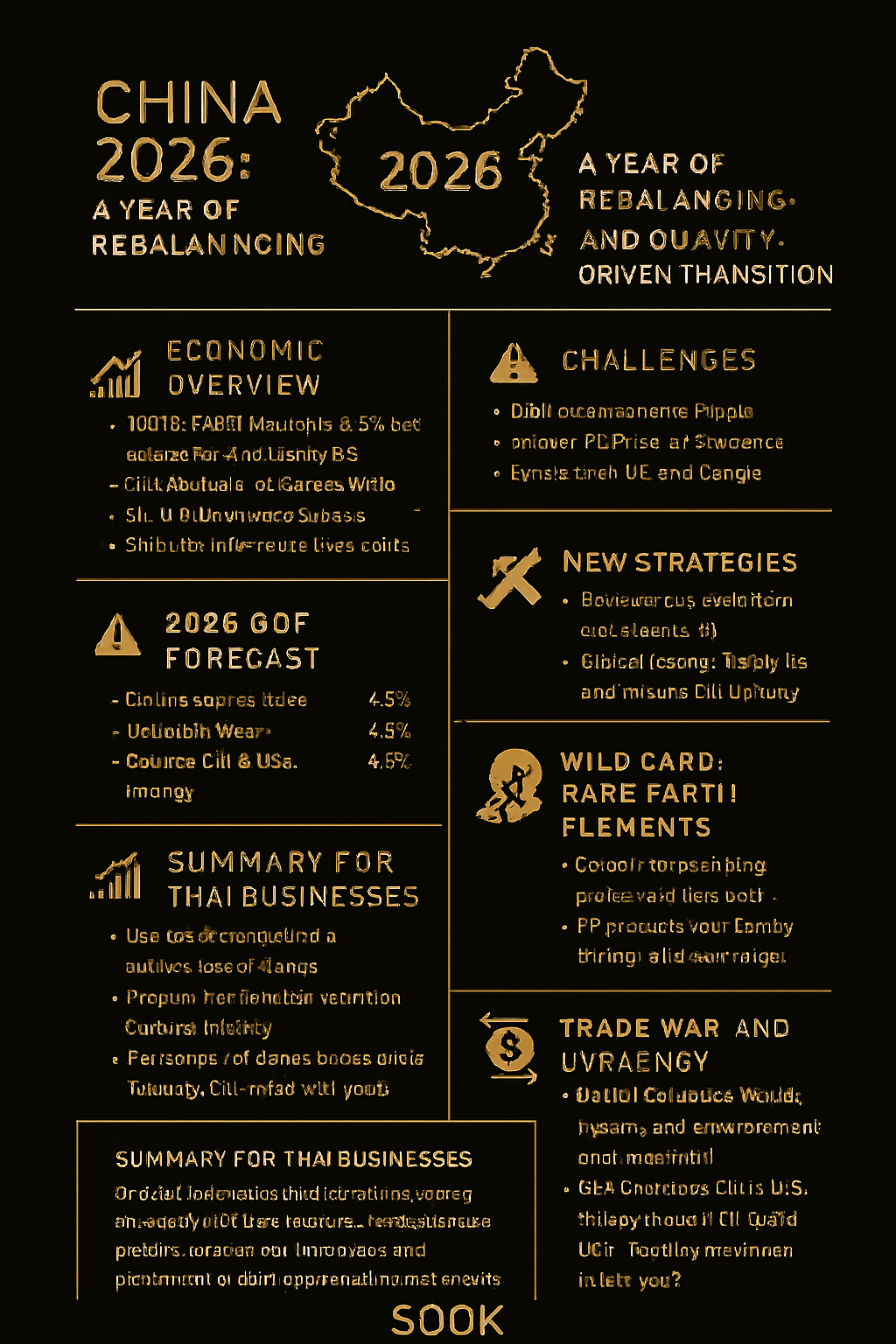
China 2026: A Year of Rebalancing and Quality-driven Transition

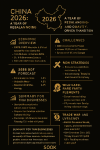
In 2026, China’s economy is moving into a new era of quality-driven growth. After achieving its 5% growth target in 2025, the country continues to face pressure from weak domestic consumption and foreign tariff measures.

Economic Overview

GDP 2025: Grew 5.0% overall, but slowed to 4.5% in Q4
Deflation: Producer Price Index (PPI) has declined for 40 consecutive months, reflecting sluggish domestic demand
Exports: The main growth engine, with a trade surplus reaching USD 1.19 trillion despite trade tensions with the U.S.
Stimulus Measures: The People’s Bank of China (PBoC) cut interest rates and subsidized loans to boost consumption
 

⚠️ Ongoing Challenges

Fragile real estate sector affecting household wealth
Intense EV price wars squeezing corporate profits
Tariff pressures from the U.S. and Europe
 

GDP Forecast for 2026

Chinese Government: May set a target below 5% for the first time in years
IMF: 4.5%
Goldman Sachs: 4.8% (optimistic outlook due to strong exports)
Reuters Poll & UBS: Average forecast of 4.5%
 

️ China’s New Strategies

Investment in semiconductors, clean energy, and AI
Focus on exporting high-margin products
Stimulating consumption in tourism and entertainment services
 

Impact on Thailand (Three Key Areas)

Tourism: Chinese tourists shifting from large group tours to FIT (Free Independent Travelers) → Opportunities for wellness hotels and restaurants leveraging digital marketing on Chinese platforms
Products & Manufacturing: Influx of cheap Chinese goods into Thailand → Pressure on Thai SMEs, but consumers benefit from lower prices
Investment: Export-related Thai stocks may fluctuate; Chinese equity funds should focus on high-tech and green energy sectors


Related Content
HNY 2026 with a First Analysis on Thai Baht Value
he Thai baht in Q1 2026 is expected to strengthen against the US dollar, driven primarily by a weaker dollar globally, a seasonal tourism boost, and expectations of US Federal Reserve rate cuts. This strength is occurring despite a weak domestic economic outlook and the Bank of Thailand's (BoT) likely continued easing of its policy rate. Exchange Rate Drivers and Forecast External Factors: The primary driver for the strengthening baht is external, mainly the broad weakness of the US dollar as global markets price in expected Fed rate cuts. The baht is also correlated with global gold prices, which have been climbing. Tourism High Season: The period extending into Q1 2026 is the high season for tourism, which typically brings in foreign currency and supports the baht's value. Policy Divergence: The BoT is expected to continue its easing cycle, potentially cutting the policy rate further to 1.00% by Q1 2026 to stimulate the sluggish domestic economy. This divergence from a potentially less aggressive US Fed in Q1 could support the baht in the short term, though some analysts warn the currency could weaken later in 2026. Forecasts: Projections for 2026 generally place the baht in a range of 30.80–33.00 per US dollar. Some models estimate it could trade around 31.06 by the end of Q1. A persistently strong baht below 31 per US$ is seen as a significant risk to the Thai export and tourism sectors. Key Economic Context Weak Growth: Thailand's economy is expected to slow down to a 5-year low growth rate of around 1.6-1.8% in 2026, pressured by US tariffs, global trade tensions, and high household debt. The central bank chief expects an improvement in Q1 2026 after a weak second half of 2025. Political Uncertainty: A general election expected in February 2026 could also introduce volatility, though some historical trends suggest the baht may strengthen following the formation of a new government. Low Inflation: Headline inflation is projected to remain subdued or even negative, providing the central bank with justification for further rate cuts to stimulate demand. In summary, Q1 2026 is characterized by a strong and volatile baht driven by external factors, contrasting sharply with a weak domestic economy and accommodative monetary policy.
1 Jan 2026
ALUMINUM PRICE TREND 2026
An analysis of the aluminum market in 2026 indicates a likely continued market deficit and upward price pressure, driven by constrained supply and resilient demand from green energy sectors. However, significant volatility is expected due to policy uncertainties and the potential for new Indonesian supply to eventually balance the market. Key Drivers and Projections for 2026 Supply Side Analysis Capacity Constraints: China's primary aluminum output is approaching its self-imposed 45 million-tonne capacity cap, limiting global supply growth. Power Challenges: Smelters outside of China face intense competition for power from energy-intensive sectors like AI data centers, which are willing to pay higher prices for long-term contracts. This has kept significant capacity offline in Europe and the US. Production Disruptions: Outages and potential shutdowns at existing smelters in Iceland and Mozambique further tighten the market. Scrap Supply Pressure: The EU's planned implementation of the Carbon Border Adjustment Mechanism (CBAM) and potential scrap export tariffs in spring 2026 are expected to impact global scrap flows, creating regional shortages and price volatility. New Capacity: Indonesia is a key source of new supply, with several projects in the pipeline. However, analysts suggest the pace of the ramp-up may be slower than expected due to infrastructure and policy challenges, meaning it is unlikely to fully offset near-term tightness. Demand Side Analysis Green Transition Demand: Demand from "green" sectors such as solar panels, new energy vehicles, and energy transition infrastructure remains strong, providing fundamental support for the market. Substitution Effect: Aluminum's wide price discount relative to copper has encouraged substitution in electrical applications, acting as a tailwind for demand and prices. Construction and Automotive: The construction and automotive industries continue to be major consumers, with growing demand for lightweight, low-carbon aluminum products. Price Forecasts and Volatility The market is expected to remain in a deficit in 2026, with estimates ranging from 200,000 to 600,000 tonnes. This structural tightness is leading most analysts to forecast sustained or rising prices. Bullish Views: Analysts at Bank of America project prices of $3,000/tonne as early as 2026. J.P. Morgan also expects prices to approach $3,000/tonne in Q1 2026. ING forecasts an average price of $2,900/tonne for the year. Bearish/Conservative Views: Goldman Sachs is an outlier, forecasting prices to decline to $2,350/tonne by Q4 2026, anticipating a market surplus later in the year. SMM forecasts a "high first, then lower" pattern, with prices finding equilibrium in the $2,700–$2,800/tonne range by year-end. Premiums: Regional premiums, particularly the US Midwest premium, are expected to remain high and volatile due to tariffs and regional supply dynamics, creating a disconnect from the LME benchmark price. In essence, 2026 is projected to be a year of high volatility where participants need to focus on scenario readiness rather than relying on a single price forecast, as geopolitical and energy policies significantly influence regional supply and costs
31 Dec 2025
SILVER PRICE TREND AND IT CONTINUE UPWARD ON VALUE FOR YEAR 2026
SILVER PRICE 2026 EVALUATION : The Bank of America believe silver will average around $56 in 2026, but could climb to a peak of $65. Robert Kiyosaki believes $75 can be reached, while analysts at CNBC even suggested $100 is achievable following a breakout above $50. Anyhow according to China Policy (start on 1 JAN 2026) on restrict SILVER to export this might create a shortage on Industry which use silver as raw material such as SEMI-CONDUCTER, ARMY HI-TECH WEAPON, SOLAR CELL, EV Car, This will be the pressure on SILVER PRICE To Increae from 72 USD/ONZE to more than 80 USD/ONZ within Early 2026
2 Jan 2026
This website uses cookies for best user experience, to find out more you can go to our Privacy Policy and Cookies Policy
Compare product
0/4
Remove all
Compare
Powered By MakeWebEasy Logo MakeWebEasy