Share

Nickel: A New Power Transforming the EV Industry — From Coins to Clean Energy, Nickel is Changing the World
Last updated: 7 Feb 2026
558 Views

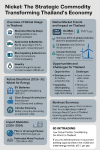
Nickel: The Strategic Commodity Transforming Thailand’s Economy

Nickel is no longer just a metal used for cookware or coins.
Today, it has become the “heartbeat” of Thailand’s transition toward clean energy and advanced industries.


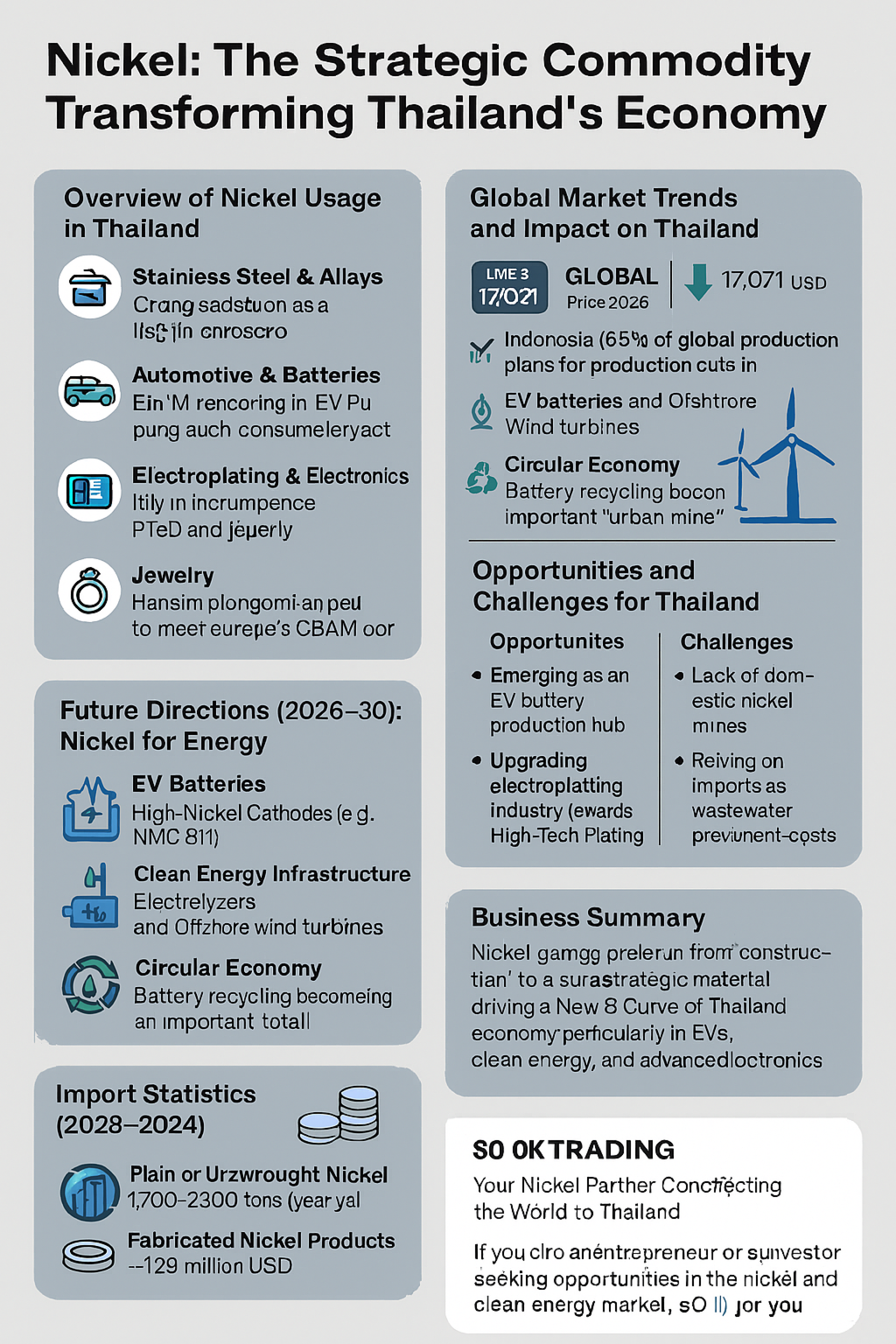
Overview of Nickel Usage in Thailand

Stainless Steel & Alloys: Largest share, used in cookware, construction materials, and architecture
Automotive & Batteries: Demand for nickel sulfate surging with EV investments and battery plants
Electroplating & Electronics: Applied in PCB plating and sensors for IoT and smart vehicles
Jewelry: Mixed in white gold and fashion accessories (standards required to prevent skin allergies)
Coinage: The Treasury Department continues to use nickel in circulating coins
 

Global Market Trends & Impact on Thailand

LME price (Feb 2026): 17,071 USD/ton, down from 19,137 USD/ton in late January
Indonesia (65% of global supply) plans production cuts in 2026 → possible long-term price increase
EV batteries and stainless steel remain the key demand drivers
 

Future Outlook (2026–2030): Nickel for Energy

EV Batteries: High-nickel cathodes (NMC 811) replacing cobalt, enabling longer driving ranges
Clean Energy Infrastructure: Used in electrolyzers for green hydrogen and offshore wind structures
Circular Economy: Battery recycling becoming an “urban mine”
Global Supply Chain: Countries diversifying away from Indonesia and Russia; Thailand positioned as a precursor hub
 

Opportunities & Challenges for Thailand

Opportunities

Becoming ASEAN’s EV battery production hub
Upgrading electroplating industry to high-tech plating
Using recycled nickel to meet Europe’s CBAM requirements
Challenges

No domestic nickel mines, full reliance on imports
Stricter environmental laws requiring wastewater treatment investments
Volatile global nickel prices directly impacting production costs
 

Import Statistics (2023–2024)

Unwrought Nickel: 1,700–2,200 tons/year, valued at ~29 million USD
Processed Nickel Products: ~129 million USD
Main Sources: Japan (36%), followed by Canada, Norway, and China
 

Business Summary

Nickel is shifting from a “construction material” to a “strategic commodity” driving Thailand’s New S-Curve, especially in EVs, clean energy, and advanced electronics.


SO OK TRADING: Your Partner Connecting Global Nickel to Thailand

For entrepreneurs and investors seeking opportunities in nickel and clean energy markets, Thailand is opening its doors wide.
SO OK TRADING is ready to walk with you on this transformative journey.


Related Content
Direction and Price Trends of Antimony Ingots 2021–2030 BY SO OK TRADING
Antimony Ingot Price (99.65% Sb) The latest price is approximately 25,450 USD/metric ton (FOB China, 99.65% purity), while in the European market it is around 34,000–35,500 USD/ton as of the end of December 2025, reflecting supply-side pressure and steady demand in the global market. - European Market (99.65% Sb): 34,000–35,500 USD/metric ton (Dec 31, 2025 – Rotterdam Price) *** Equivalent to about 1.15–1.2 million THB, which represents a decline from mid-2025 when prices peaked at 48,000–52,000 USD/MT, a direct consequence of China’s government-imposed export restrictions.
5 Jan 2026
“Oil Shock 2026: USA–Iran Oil War Shakes the World — Crude Prices Surge, Gold Soars, Stocks Plunge, Inflation Hits the Global Economy. March 7, 2026: Iran’s Oil Depots Attacked, Retaliation Sparks a New Oil War. Article by SO OK TRADING.”
Oil War – March 7, 2026: When the USA & Israel Bombed Iran’s Oil Depots, the World Entered a Massive Oil Shock On March 7, 2026, the world shook overnight. The USA and Israel launched a strike on Iran’s oil depots in Tehran, igniting fires and triggering immediate retaliation. Within 24 hours, Iran officially closed the Strait of Hormuz — the strategic passage for more than 20% of global oil. The result: the largest Oil Shock since the Russia–Ukraine war. Oil Prices: Brent crude jumped from $65–70 to over $92 per barrel, with forecasts pointing to $120–150 if the blockade continues. Gold Prices: From $4,800/oz before the war, gold surged to $5,300–5,400/oz, setting a new floor at $5,000 and potentially climbing beyond $6,000. Currencies: USD strengthened as a safe haven, while JPY, CNY, and THB weakened under soaring energy costs. Stock Markets: Asia-Pacific indices tumbled as investors fled to gold and other safe assets. This is not just a Middle East conflict — it’s a shockwave hitting costs, investments, and wallets worldwide. SO OK TRADING monitors these shifts in real time, standing as your trusted partner in uncertain times.
8 Mar 2026
ALUMINUM PRICE TREND 2026
An analysis of the aluminum market in 2026 indicates a likely continued market deficit and upward price pressure, driven by constrained supply and resilient demand from green energy sectors. However, significant volatility is expected due to policy uncertainties and the potential for new Indonesian supply to eventually balance the market. Key Drivers and Projections for 2026 Supply Side Analysis Capacity Constraints: China's primary aluminum output is approaching its self-imposed 45 million-tonne capacity cap, limiting global supply growth. Power Challenges: Smelters outside of China face intense competition for power from energy-intensive sectors like AI data centers, which are willing to pay higher prices for long-term contracts. This has kept significant capacity offline in Europe and the US. Production Disruptions: Outages and potential shutdowns at existing smelters in Iceland and Mozambique further tighten the market. Scrap Supply Pressure: The EU's planned implementation of the Carbon Border Adjustment Mechanism (CBAM) and potential scrap export tariffs in spring 2026 are expected to impact global scrap flows, creating regional shortages and price volatility. New Capacity: Indonesia is a key source of new supply, with several projects in the pipeline. However, analysts suggest the pace of the ramp-up may be slower than expected due to infrastructure and policy challenges, meaning it is unlikely to fully offset near-term tightness. Demand Side Analysis Green Transition Demand: Demand from "green" sectors such as solar panels, new energy vehicles, and energy transition infrastructure remains strong, providing fundamental support for the market. Substitution Effect: Aluminum's wide price discount relative to copper has encouraged substitution in electrical applications, acting as a tailwind for demand and prices. Construction and Automotive: The construction and automotive industries continue to be major consumers, with growing demand for lightweight, low-carbon aluminum products. Price Forecasts and Volatility The market is expected to remain in a deficit in 2026, with estimates ranging from 200,000 to 600,000 tonnes. This structural tightness is leading most analysts to forecast sustained or rising prices. Bullish Views: Analysts at Bank of America project prices of $3,000/tonne as early as 2026. J.P. Morgan also expects prices to approach $3,000/tonne in Q1 2026. ING forecasts an average price of $2,900/tonne for the year. Bearish/Conservative Views: Goldman Sachs is an outlier, forecasting prices to decline to $2,350/tonne by Q4 2026, anticipating a market surplus later in the year. SMM forecasts a "high first, then lower" pattern, with prices finding equilibrium in the $2,700–$2,800/tonne range by year-end. Premiums: Regional premiums, particularly the US Midwest premium, are expected to remain high and volatile due to tariffs and regional supply dynamics, creating a disconnect from the LME benchmark price. In essence, 2026 is projected to be a year of high volatility where participants need to focus on scenario readiness rather than relying on a single price forecast, as geopolitical and energy policies significantly influence regional supply and costs
31 Dec 2025
This website uses cookies for best user experience, to find out more you can go to our Privacy Policy and Cookies Policy
Compare product
0/4
Remove all
Compare
Powered By MakeWebEasy Logo MakeWebEasy