Share

Carbon Black: Powering Performance, Driving Sustainability : From Soot to Solutions: The Future of Carbon Black
Last updated: 4 Feb 2026
1247 Views

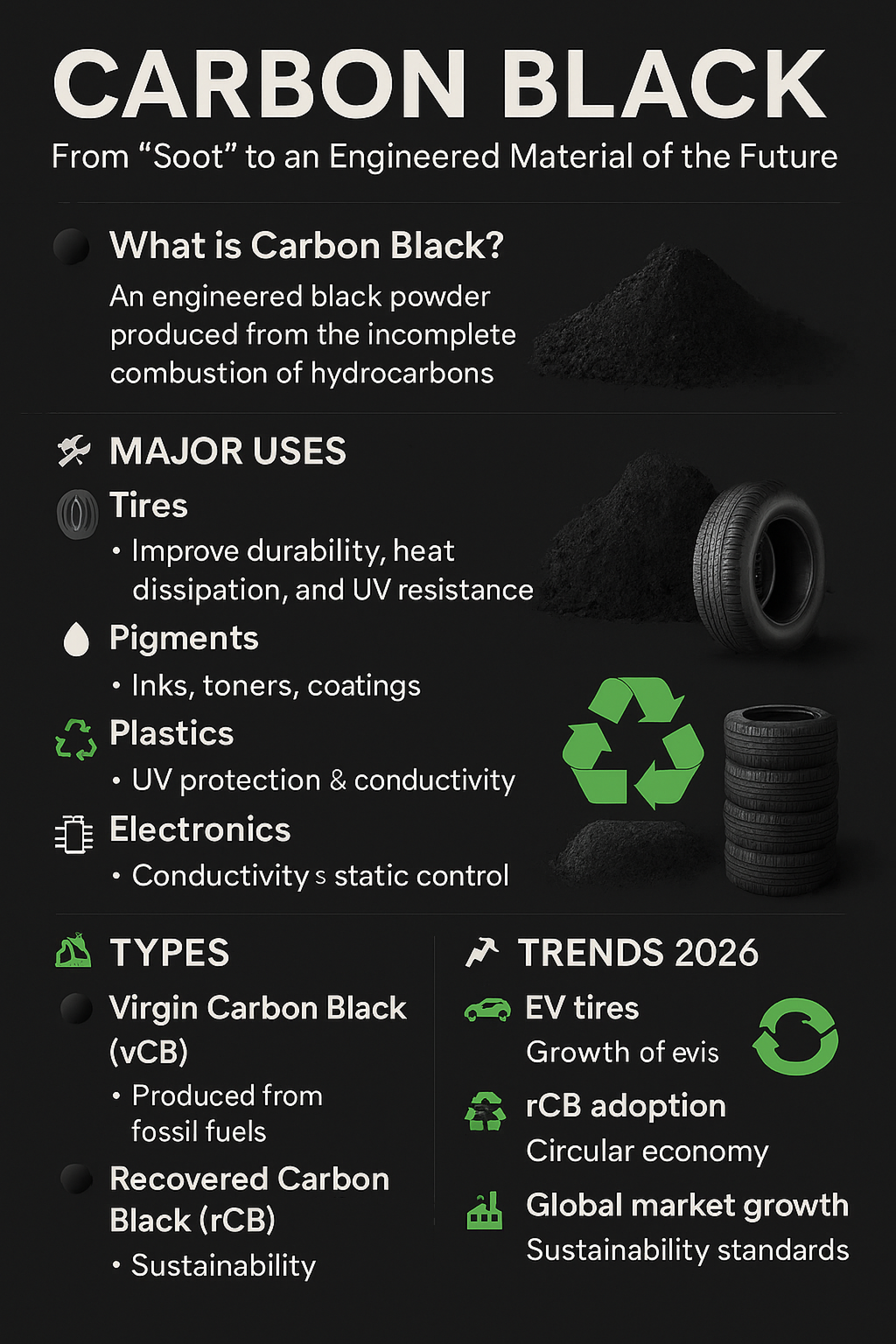
Carbon Black: From “Soot” to an Engineered Material of the Future

Carbon Black is not just a black powder from incomplete combustion—it is an engineered material with a vital role across global industries. Its properties enhance strength, durability, and performance in a wide range of products.

Major Applications

Rubber Industry (70–90%)
Reinforces strength and wear resistance
Helps dissipate heat from tire treads
Protects against UV degradation
Pigments
Used in inks, toners, and coatings for deep, lasting black color
Plastics
Provides UV stabilization in agricultural pipes and films
Adds conductivity and antistatic properties in electronics
 

⚖️ Precautions

Health: Excessive inhalation may irritate the respiratory system
Environment: Uncontrolled emissions become “Black Carbon,” a contributor to global warming
 

Two Types: Virgin vs Recovered

Virgin Carbon Black (vCB)
Produced from fossil fuel combustion
High quality and consistent black, but CO₂-intensive
Recovered Carbon Black (rCB)
Extracted from end-of-life tires via pyrolysis
Reduces waste, fossil fuel use, and cuts GHG emissions by 79–84%
Quality controlled under ASTM D8178
Commonly used in “Hybrid” blends (10–30%) to lower costs and boost sustainability
 

Thailand Market Outlook (2026)

Automotive & Tire Growth
Expected CAGR of 6.25%
Strong demand from EEC factories and EV tire production
Shift to rCB
Supports circular economy (BCG Model)
Reduces costs and creates carbon credit opportunities
Sustainability & Export Standards
Adoption of ISCC PLUS certification
Factories reusing waste heat to cut emissions
 

Global Market Outlook (2026)

Total Market Size: ~$25.95–30.65 billion USD
rCB Market: ~$758 million USD
Asia-Pacific Share: Over 60% of global revenue
Key Insight: Demand will focus not only on “volume” but on “functional quality”—better conductivity, higher purity, and eco-friendly sourcing.


✨ SO OK TRADING: Your Partner in Carbon Black and Thai Exports

If you are seeking raw materials that balance quality and sustainability, SO OK TRADING is your trusted partner. We bring Thailand’s premium products—fruits, rice, metals, and clean energy—to the global stage.

SO OK TRADING ensures your products stand out while building trust and sustainability, delivering solutions aligned with the Net Zero era.


Related Content
“Renewable Revolution – Transforming Global Energy with Biomass and Solar Power: The Green Choice the World Embraces”
Alternative Energy – Biofuels The Game Changer Set to Replace Fossil Fuels and Coal The world is moving forward into the era of clean energy. Energy is no longer just the driving force of the economy—it is also the key to preserving environmental balance and securing the future of humanity. This transition is not merely about technology; it is about laying a new foundation for the global energy system, reshaping how we think about and use energy forever. Alternative energy sources such as Solar Cells and Wood Pellets are becoming central to electricity generation and industry worldwide, with costs steadily decreasing and efficiency rising significantly. While China and Europe are rapidly installing hundreds of gigawatts of renewable energy each year, Asian countries like Japan, South Korea, and Thailand are also accelerating their clean energy transition to achieve Net Zero Emissions within the coming decades. Today, SO OK TRADING is ready to be your trusted business partner in this new energy era. We provide comprehensive solar cell installation services and high-quality wood pellets for export, ensuring your business keeps pace with the global shift toward clean energy with confidence.
17 Apr 2026
ถ่านกะลามะพร้าวคืออะไร ทำไมทางจีนนำเข้าเยอะ ใช้เยอะ By SO OK TRADING
Coconut charcoal is a sustainable, eco-friendly fuel made from carbonized coconut shells, prized for grilling, shisha, and water filtration due to its high heat, long burn time, low ash, and minimal smoke compared to wood charcoal. It's produced by heating shells in an oxygen-deprived environment (pyrolysis) and is compressed into briquettes or used as activated carbon, offering benefits like using agricultural waste and aiding detoxification. Production Source: Discarded coconut shells, a byproduct of the coconut industry. Process (Pyrolysis): Shells are heated to high temperatures (300-500°C) in a limited-oxygen kiln, turning them into charcoal. Forms: Can be crushed and formed into briquettes (cubes/discs) or processed further into activated carbon. Key Benefits & Uses Sustainability: Uses waste, prevents deforestation, renewable. Performance: Burns hotter, longer, cleaner, with less smoke and ash. Versatile Uses: Cooking: BBQ, shisha/hookah. Filtration: Water purification, air deodorization (activated carbon). Health/Beauty: Detoxification (activated charcoal). Agriculture: Ash can be used as fertilizer. Advantages Over Wood Charcoal Longer Burn: A smaller amount goes further. Higher Heat: More efficient for grilling. Eco-Friendly: Doesn't harm trees. Clean Burning: Less smoke and odor.
23 Dec 2025
This website uses cookies for best user experience, to find out more you can go to our Privacy Policy and Cookies Policy
Powered By MakeWebEasy Logo MakeWebEasy