Share

Lead ฺBullion & Circular Economy – Toward a Sustainable Future with Recycled Lead: Primary Energy Supporting the Industry’s Future BY SO OK TRADING
Last updated: 16 Jan 2026
1193 Views

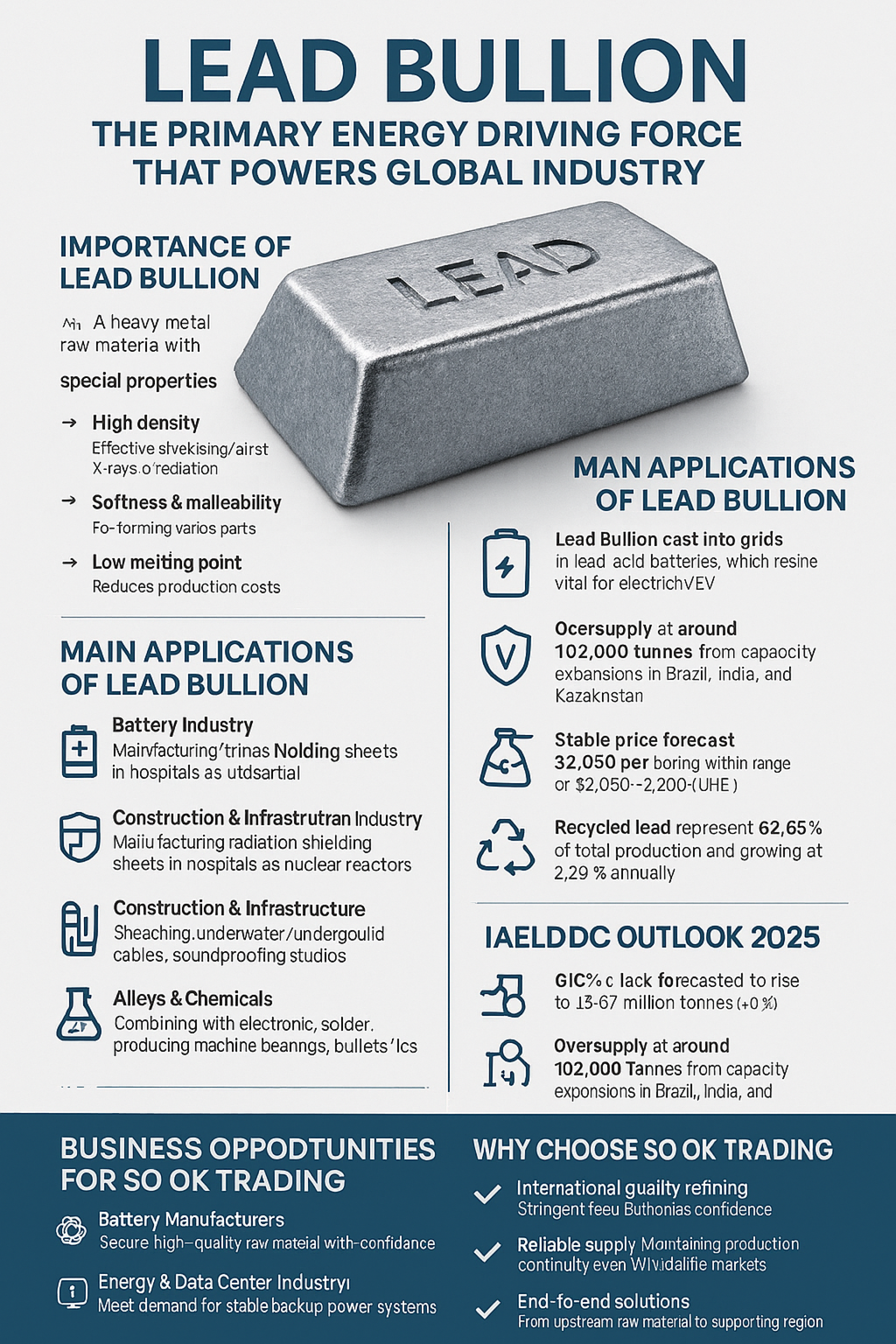
Lead Bullion – The Upstream Energy Driving Global Industry

SO OK TRADING – Supplying High-Quality Lead Bullion for the Future of Energy and Global Industry

Why Lead Bullion Matters

Lead bullion is a heavy metal raw material with unique properties:

High density → Effective shielding against X-rays and radiation
Soft and malleable → Easy to shape into various components
Low melting point → Reduces production costs
100% recyclable → Supports circular economy and ESG standards
 

⚡ Key Applications of Lead Bullion

Battery Industry (>85%)
Lead bullion is cast into grid plates for lead-acid batteries, which remain vital for:
Automobiles and low-speed electric vehicles (EVs, e-rickshaws, golf carts)
Backup power (UPS) for data centers and 5G infrastructure
Renewable energy storage from solar and wind
Radiation Protection & Nuclear Industry
Used in radiation shielding sheets for hospitals and as protective barriers in nuclear reactors
Construction & Infrastructure
Applied in underwater/underground cable sheathing and soundproofing materials for studios
Alloys & Chemicals
Combined with tin for electronic solder, used in machine bearings, ammunition, and stabilizers in plastics
 

Lead Market Outlook 2026

Global demand: Forecast to rise to 13.37 million tonnes (+0.9%)
Oversupply: Surplus of ~102,000 tonnes due to capacity expansions in Brazil, India, and Kazakhstan
Price forecast: Stable at $2,050/ton (LME), within $2,030–2,200 range
Recycling growth: Recycled lead accounts for 62.65% of total production, growing at 2.29% annually
Regulatory push: EU Regulation 2023/1542 requires products to contain up to 85% recycled material by 2031
 

Business Opportunities for SO OK TRADING Customers

Battery manufacturers: Secure high-quality raw material with reliable cost and volume
Energy & Data Centers: Meet demand for stable backup power systems
EV & Infrastructure operators: Support growth of low-speed EVs and digital infrastructure
Recycling & ESG businesses: Align with circular economy principles and environmental responsibility
 

✅ Why Choose SO OK TRADING

International quality standards: Lead bullion refined and sorted with strict processes
Reliable supply: Ensures continuous production even in volatile markets
End-to-end solutions: From upstream raw material to batteries, energy, and infrastructure support
Sustainability partner: Focused on recycling and eco-friendly management
 

✨ SO OK TRADING – Lead Bullion for the Future of Energy and Global Industry
High-quality lead bullion ready to support every production — from automotive batteries and data centers to global infrastructure.

Related Content
Silver Supercycle 2026 – The Golden Era of Silver Power Driving Green Tech & AI Analysis of Silver Market Trends and Industrial Outlook by SOOK TRADING | April 3, 2026
Silver Supercycle 2026 – The Golden Era of Silver Power Driving Green Tech & AI In 2026, silver has transcended its role as a mere “safe-haven asset” to become a strategic metal at the heart of the global transition to clean energy and the AI revolution. In January, silver hit a record all-time high of $121.62 February saw a dramatic Flash Crash down to $71 As of April 2026, silver is consolidating at $70–$75, building a new base for the next rally China has emerged as the price-setter of the global silver market, importing over 790 tons in the first two months of 2026 and enforcing strict export controls. Silver is now classified as a strategic resource, powering: Solar PV: New TOPCon and HJT panels use 30–50% more silver Electric Vehicles (EVs): Silver usage nearly doubles compared to gasoline cars AI & Data Centers: Essential for chips, high-performance computing, and 5G/6G infrastructure ✨ Key Message: “Silver is no longer just a precious metal – it is the power of the future. Driving Green Tech and AI, 2026 marks the Supercycle everyone must watch.” SOOK TRADING – Your Trusted Business Partner FAST • SHARP • RELIABLE
3 Apr 2026
ALUMINUM PRICE TREND 2026
An analysis of the aluminum market in 2026 indicates a likely continued market deficit and upward price pressure, driven by constrained supply and resilient demand from green energy sectors. However, significant volatility is expected due to policy uncertainties and the potential for new Indonesian supply to eventually balance the market. Key Drivers and Projections for 2026 Supply Side Analysis Capacity Constraints: China's primary aluminum output is approaching its self-imposed 45 million-tonne capacity cap, limiting global supply growth. Power Challenges: Smelters outside of China face intense competition for power from energy-intensive sectors like AI data centers, which are willing to pay higher prices for long-term contracts. This has kept significant capacity offline in Europe and the US. Production Disruptions: Outages and potential shutdowns at existing smelters in Iceland and Mozambique further tighten the market. Scrap Supply Pressure: The EU's planned implementation of the Carbon Border Adjustment Mechanism (CBAM) and potential scrap export tariffs in spring 2026 are expected to impact global scrap flows, creating regional shortages and price volatility. New Capacity: Indonesia is a key source of new supply, with several projects in the pipeline. However, analysts suggest the pace of the ramp-up may be slower than expected due to infrastructure and policy challenges, meaning it is unlikely to fully offset near-term tightness. Demand Side Analysis Green Transition Demand: Demand from "green" sectors such as solar panels, new energy vehicles, and energy transition infrastructure remains strong, providing fundamental support for the market. Substitution Effect: Aluminum's wide price discount relative to copper has encouraged substitution in electrical applications, acting as a tailwind for demand and prices. Construction and Automotive: The construction and automotive industries continue to be major consumers, with growing demand for lightweight, low-carbon aluminum products. Price Forecasts and Volatility The market is expected to remain in a deficit in 2026, with estimates ranging from 200,000 to 600,000 tonnes. This structural tightness is leading most analysts to forecast sustained or rising prices. Bullish Views: Analysts at Bank of America project prices of $3,000/tonne as early as 2026. J.P. Morgan also expects prices to approach $3,000/tonne in Q1 2026. ING forecasts an average price of $2,900/tonne for the year. Bearish/Conservative Views: Goldman Sachs is an outlier, forecasting prices to decline to $2,350/tonne by Q4 2026, anticipating a market surplus later in the year. SMM forecasts a "high first, then lower" pattern, with prices finding equilibrium in the $2,700–$2,800/tonne range by year-end. Premiums: Regional premiums, particularly the US Midwest premium, are expected to remain high and volatile due to tariffs and regional supply dynamics, creating a disconnect from the LME benchmark price. In essence, 2026 is projected to be a year of high volatility where participants need to focus on scenario readiness rather than relying on a single price forecast, as geopolitical and energy policies significantly influence regional supply and costs
31 Dec 2025
This website uses cookies for best user experience, to find out more you can go to our Privacy Policy and Cookies Policy
Powered By MakeWebEasy Logo MakeWebEasy