Share

“SO OK TRADING Recommends Teak vs Mixed Hardwoods — In-Depth Analysis of the 2026 Wood Market and Applications in Furniture, Flooring, and Wall Decoration”
Last updated: 13 Jan 2026
80 Views

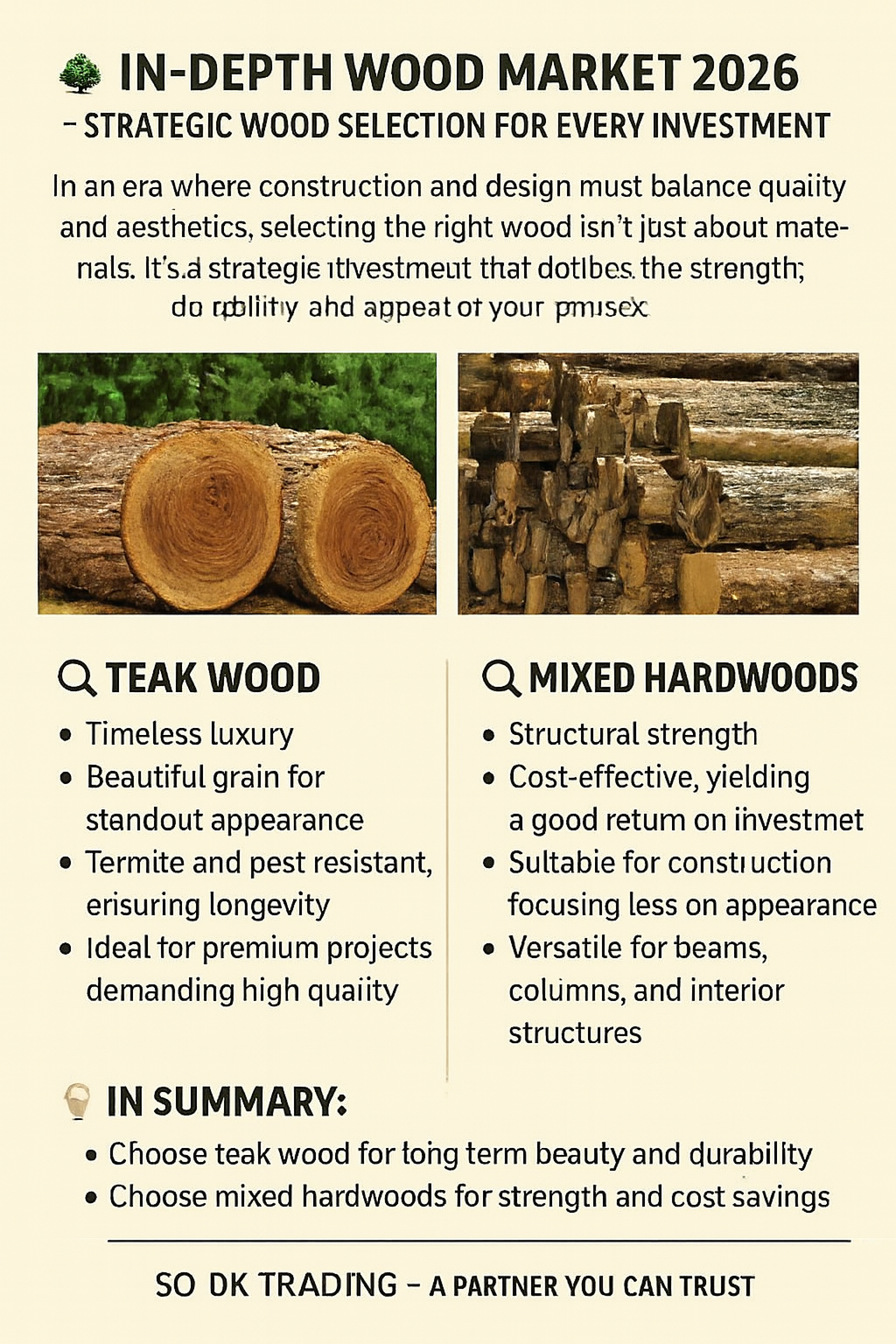
Strategic Wood Selection: In-Depth Market Outlook 2026

In 2026, the construction and interior design markets remain highly competitive. Choosing the right wood is not only a reflection of project quality but also a long-term investment that impacts durability, aesthetics, and overall cost efficiency.


Teak Wood – Timeless Luxury and Value

Teak wood is globally recognized as one of the finest materials for decorative and surface applications, with outstanding qualities:

Natural Beauty: Distinct grain and golden hue create a luxurious and warm appearance. Perfect for premium furniture, flooring, and interior finishes.
Resistance to Termites and Insects: Natural oils protect against pests, ensuring long-lasting use without decay.
Strength and Durability: Suitable for applications requiring stability, such as doors, windows, and structural elements.
Investment Value: Though more expensive, teak adds significant value to projects and builds client confidence.
 

Mixed Hardwoods – Strength and Cost Efficiency

Mixed hardwoods are widely used in general construction, offering both structural reliability and economic advantages:

Structural Strength: Dense and solid, ideal for beams, columns, and load-bearing components.
Cost-Effective: Lower in price compared to teak, making them suitable for budget-conscious projects.
Non-Aesthetic Applications: Best for areas not intended to showcase wood grain, such as internal structures or concealed parts.
Variety: Includes species such as redwood, padauk, and ironwood, allowing flexibility based on project needs and budget.
 

Key Takeaways (2026 Insights)

Choose Teak Wood: When the goal is beauty, visible finishes, long-term termite resistance, and sufficient budget.
Choose Mixed Hardwoods: When the goal is structural strength, cost savings, or use in non-visible applications.
 

SO OK TRADING – A Partner You Can Trust

As demand for construction materials continues to rise in 2026, sourcing high-quality wood from reliable suppliers is a critical strategy.

SO OK TRADING provides premium solutions for every requirement:

✅ Genuine teak wood for luxury finishes
✅ Strong and cost-efficient mixed hardwoods for structural projects
✅ Fast and reliable supply to meet dynamic market needs
✅ End-to-end services, from sourcing and logistics to expert consultation


Contact SO OK TRADING today
Ensure your project excels in beauty, strength, and cost efficiency across every dimension.

SO OK TRADING – Your Trusted Partner in the Global Wood and Construction Materials Market


Related Content
Teak & Thai Mixed Hardwood, Quality Beyond Time
Teak Wood & Thai Mixed Hardwood Teak wood and Thai mixed hardwood are two types of Thai timber with distinct characteristics and uses. Teak is renowned for its durability, resistance to termites, and beautiful natural color, making it ideal for luxury furniture. Thai mixed hardwood, on the other hand, consists of various deciduous species (such as teak, makha, daeng, pradu, and chingchan). It includes both softwood and hardwood, is affordable, easy to source, and strong—commonly used in general construction and formwork, though less favored for furniture that showcases wood grain compared to teak. Teak Wood (Tectona grandis) - Highlights: Attractive color, natural oil content, excellent resistance to termites and insects, long lifespan, strong and durable. - Applications: Luxury furniture, built-in furniture, and premium interior decoration. Thai Mixed Hardwood (Mixed Deciduous Hardwood) - Name Origin: Derived from the word “Benja” (meaning “five”), referring to forests with multiple species, including five key types (teak, makha, daeng, pradu, chingchan). - Characteristics: Deciduous wood, ranging from soft to hard, reasonably strong, widely available, and cost-effective. - Applications: General construction, concrete formwork, scaffolding, roof purlins, ceilings, and pallets. Comparison Summary - Premium Quality: Teak > Mixed Hardwood (especially for furniture). - Price: Mixed Hardwood (cheaper) < Teak. - Main Uses: Teak (furniture, built-in), Mixed Hardwood (construction/structural work).
7 Jan 2026
SILVER PRICE TREND AND IT CONTINUE UPWARD ON VALUE FOR YEAR 2026
SILVER PRICE 2026 EVALUATION : The Bank of America believe silver will average around $56 in 2026, but could climb to a peak of $65. Robert Kiyosaki believes $75 can be reached, while analysts at CNBC even suggested $100 is achievable following a breakout above $50. Anyhow according to China Policy (start on 1 JAN 2026) on restrict SILVER to export this might create a shortage on Industry which use silver as raw material such as SEMI-CONDUCTER, ARMY HI-TECH WEAPON, SOLAR CELL, EV Car, This will be the pressure on SILVER PRICE To Increae from 72 USD/ONZE to more than 80 USD/ONZ within Early 2026
2 Jan 2026
HNY 2026 with a First Analysis on Thai Baht Value
he Thai baht in Q1 2026 is expected to strengthen against the US dollar, driven primarily by a weaker dollar globally, a seasonal tourism boost, and expectations of US Federal Reserve rate cuts. This strength is occurring despite a weak domestic economic outlook and the Bank of Thailand's (BoT) likely continued easing of its policy rate. Exchange Rate Drivers and Forecast External Factors: The primary driver for the strengthening baht is external, mainly the broad weakness of the US dollar as global markets price in expected Fed rate cuts. The baht is also correlated with global gold prices, which have been climbing. Tourism High Season: The period extending into Q1 2026 is the high season for tourism, which typically brings in foreign currency and supports the baht's value. Policy Divergence: The BoT is expected to continue its easing cycle, potentially cutting the policy rate further to 1.00% by Q1 2026 to stimulate the sluggish domestic economy. This divergence from a potentially less aggressive US Fed in Q1 could support the baht in the short term, though some analysts warn the currency could weaken later in 2026. Forecasts: Projections for 2026 generally place the baht in a range of 30.80–33.00 per US dollar. Some models estimate it could trade around 31.06 by the end of Q1. A persistently strong baht below 31 per US$ is seen as a significant risk to the Thai export and tourism sectors. Key Economic Context Weak Growth: Thailand's economy is expected to slow down to a 5-year low growth rate of around 1.6-1.8% in 2026, pressured by US tariffs, global trade tensions, and high household debt. The central bank chief expects an improvement in Q1 2026 after a weak second half of 2025. Political Uncertainty: A general election expected in February 2026 could also introduce volatility, though some historical trends suggest the baht may strengthen following the formation of a new government. Low Inflation: Headline inflation is projected to remain subdued or even negative, providing the central bank with justification for further rate cuts to stimulate demand. In summary, Q1 2026 is characterized by a strong and volatile baht driven by external factors, contrasting sharply with a weak domestic economy and accommodative monetary policy.
1 Jan 2026
This website uses cookies for best user experience, to find out more you can go to our Privacy Policy and Cookies Policy
Compare product
0/4
Remove all
Compare
Powered By MakeWebEasy Logo MakeWebEasy